





Have you heard of the JLPT N3 phrase 〜て仕方がない (~te shikata ga nai)? It a useful phrase for when you want to describe how something was unavoidable or that the speaker couldn’t help but feel a certain emotion. This phrase most closely translates to the following:
- “Can’t help but..”
- “Extremely”
Make Sure to Watch Coto Academy’s YouTube Video About て仕方がない
Before you continue reading, why not take a moment to watch a quick YouTube lesson with our Japanese teacher, Natsumi-sensei.
て仕方がない (Te Shikata ga Nai) Meaning
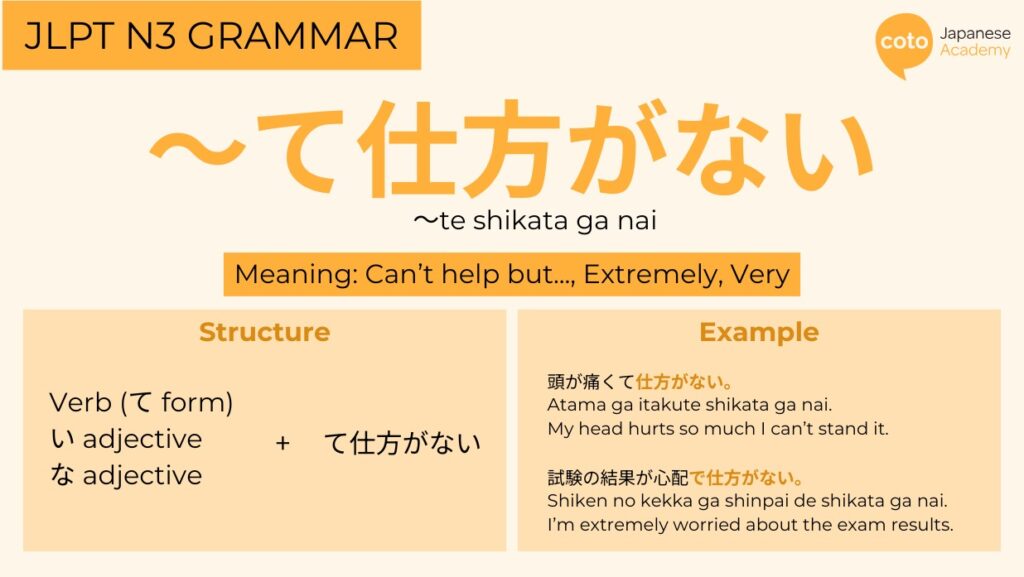
て仕方がない (te Sshikata ga nai) is a phrase that expresses an intense emotion or condition that’s natural or beyond the speaker’s control. You can use this phrase to describe strong, uncontrollable feelings or unavoidable states of being.
The phrase is commonly used to say:
- I can’t help but..
- Extremely..
- Very
てしょうがない (te shouga nai) is a phrase that is very similar to て仕方がない, having mostly the same meaning and uses. The biggest difference is that てしょうがない is considered to be more casual, while て仕方がない is seen as more formal.
Want to study Japanese with us?
JLPT N3 て仕方がない (Te Shikata ga Nai) Sentence Structure
て仕方がない (te shikata ga nai) usually is at the end of the sentence or phrase. The expression, 仕方がない (shikata ga nai), follows a verb or adjective in て (te) form.
| Type | Structure |
|---|---|
| Verb (て form) | Verb (て form) + 仕方がない |
| い-Adjective | い-Adjective + く+ て仕方がない |
| な-Adjective | な-Adjective + で仕方がない |
You can use either positive or negative verbs (in て form) with the phrase て仕方がない (te shikata ga nai).
| Form | Plain て form + 仕方がない | Meaning |
|---|---|---|
| Positive | 食べたくて仕方がない | I couldn’t help but eat |
| Negative | 分からなくて仕方がない | I couldn’t understand at all (it’s frustrating) |
JLPT N3 〜て仕方がない (~Te Shikata ga Nai) Examples
Let’s take a look at some example sentences to understand how to use the phrase: て仕方がない.
Example 1:
頭が痛くて仕方がない。
Atama ga itakute shikata ga nai.
My head hurts so much I can’t stand it.
Example 2:
試験の結果が心配で仕方がない。
Shiken no kekka ga shinpai de shikata ga nai.
I’m extremely worried about the exam results.
Example 3:
彼の態度が失礼で仕方がない。
Kare no taido ga shitsurei de shikata ga nai.
His attitude is unbearably rude.
Example 4:
その映画が見たくて仕方がない。
Sono eiga ga mitakute shikata ga nai.
I really want to see that movie.
Vocabulary List
Check out all the new words in the example sentences above, and try to remember new vocabulary alongside today’s Japanese grammar!
| Kanji / Writing | Furigana | Romaji | English |
|---|---|---|---|
| 頭 | あたま | atama | head |
| 痛い | いたい | itai | painful |
| 試験 | しけん | shiken | exam |
| 結果 | けっか | kekka | result |
| 心配 | しんぱい | shinpai | worry |
| 態度 | たいど | taido | attitude |
| 失礼 | しつれい | shitsurei | rude |
| 映画 | えいが | eiga | movie |
| 見る | みる | miru | to see, watch |
Learn More JLPT Grammar with Coto Academy!
Next time you want to express strong feelings you couldn’t help, use today’s phrase て仕方がない! The more you use it, the more it’ll stick and just become a natural way you express yourself. If you want to practice using this JLPT phrase and many more in real Japanese conversations, nothing beats practicing with a teacher who can offer practical guidance. Sign up with us at Coto Academy.
Coto Academy has been teaching Japanese for over 25 years, with campuses in Shibuya, Yokohama, Iidabashi, Minato, and online. Our courses focus on practical Japanese, so the grammar you learn is designed for real-life use.
We offer part-time, intensive, and fully online lessons to suit your schedule. Start learning Japanese effectively and confidently with Coto Academy today!
Why join Coto Academy?
- Over 60+ different Japanese classes over 18 levels
- Small classroom of only up to 8 students for personalized support
- Professional, native Japanese teachers
- Ready to get started? Fill out the form below to contact us!
FAQ:
What does 〜て仕方がない mean?
It expresses a strong feeling or condition that can’t be controlled, such as intense emotions, desires, or physical pain.
What is the difference between て仕方ない (te shikata ga nai) and しょうがない (te shou ga nai)?
Both phrases have almost the same meaning: “can’t help but…” However, the difference lies mostly in context, where て仕方がない (te shikata ga nai) is considered more formal, and てしょうがない (te shou ga nai) is considered casual.
Is て仕方がない considered formal or casual?
The phrase is somewhat neutral, so it can be used in both situations, where similar phrases like てしょうがない are a bit more casual. In formal situations, it’s best to use 敬語 (keigo), for example, て仕方がないです (te shikata ga nai desu) or to be even more proper, て仕方がありません (te shikata ga arimasen).
Can you use て仕方がない with deliberate actions?
Generally, you use て仕方がない (te shikata ga nai) to describe uncontrollable feelings rather than deliberate actions.