





The grammar pattern 〜らしい is used to express information that is not directly confirmed by the speaker. In English, it can mean “it seems like,” “apparently,” “I heard that,” or “it looks like.”
- To express something you are not completely certain about, or to express something you heard.
- To say something is characteristic or typical of someone, something, or a situation
Although 〜らしい may seem simple at first, it actually has a wide range of meanings and is used in different situations. Depending on the context, it can express information you heard from others or a judgment based on evidence or observation. Learn its meaning, sentence structure, and see plenty of examples, each with Japanese text, romaji reading, and English translation!
Make Sure to Watch Coto Academy’s YouTube Video About らしい (Rashii)
Before you continue reading, why not take a moment to watch a quick YouTube lesson with our Japanese teacher, Natsumi-sensei.
らしい (Rashii) Meaning
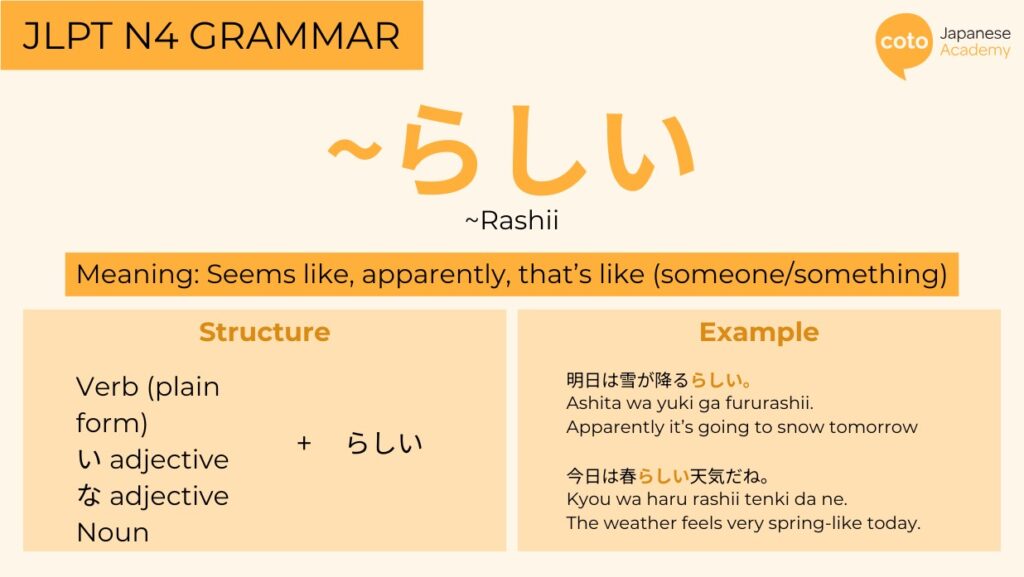
The phrase rashii just means “seems like,” “I heard,” or “typical of (someone or something).” So, you usually use it to express something with some degree of uncertainty or to express that something is characteristic of someone/something, like saying “…that is so like him/her.”
Often this expression is used for:
- I heard that
- Apparently
- it seems
- characteristic of
- what you’d expect from …
JLPT N4 らしい (Rashii) Sentence Structure
You usually use らしい (rashii) at the end of a sentence, and you can attach it to verbs, nouns, or adjectives.
| Type | Structure |
|---|---|
| Verb (plain form) | Verb + らしい |
| い-Adjective | い-Adjective + らしい |
| な-Adjective | な-Adjective + だ + らしい |
| Noun | Noun + だ + らしい |
To use the negative form of らしい, which means “doesn’t seem like” or “not like (someone/something)”, conjugate to らしくない:
- らし
い+ くない → らしくない - rashi + kunai → rashikunai
Now let’s break down how to use らしい with different verb forms, including present, past, negative, past negative, and volitional.
| Form | Plain Form + らしい | Meaning |
|---|---|---|
| Present | 雨が降るらしい | Seems like it will rain |
| Past | 雨が降ったらしい | It looked like it rained |
| Negative | 雨が降らないらしい | Seems like it won’t rain |
| Past Negative | 雨が降らなかったらしい | Seems like it didn’t rain |
| Volitional | 雨が降ろうらしい | Seems like it should rain |
JLPT N4 らしい (Rashii) Examples
Example 1:
明日は雪が降るらしい。
Ashita wa yuki ga fururashii.
Apparently, it’s going to snow tomorrow.
Example 2:
あの店はもう閉店したらしいよ。
Ano mise wa mou heiten shita rashii yo.
I heard that the shop has already closed.
Example 3:
彼女の考え方はとても彼女らしい。
Kanojo no kangaekata wa totemo kanojo rashii.
Her way of thinking is very “like her.”
Example 4:
今日は春らしい天気だね。
Kyou wa haru rashii tenki da ne.
The weather feels very spring-like today.
Vocabulary List
Check out all the new words in the example sentences above, and try to remember new vocabulary alongside today’s Japanese grammar!
| Kanji / Writing | Furigana | Romaji | English |
|---|---|---|---|
| 明日 | あした | ashita | tomorrow |
| 雪 | ゆき | yuki | snow |
| 降る | ふる | furu | to fall (rain/snow) |
| 店 | みせ | mise | shop, store |
| 閉店する | へいてんする | heiten suru | to close a shop |
| 今日 | きょう | kyou | today |
| 春 | はる | haru | spring |
| 天気 | てんき | tenki | weather |
| 考え方 | かんがえかた | kangaekata | way of thinking |
| 本当に | ほんとうに | hontou ni | really; truly |
| 彼女 | かのじょ | kanojo | she; girlfriend |
Learn More JLPT Grammar with Coto Academy!
Try using らしい (Rashii) in different sentences to really understand how to use it and ingrain it into your Japanese arsenal! If you want more practice using this phrase and many others in real Japanese conversations with a teacher who can offer practical guidance, sign up with us at Coto Academy.
Coto Academy has been teaching Japanese for over 25 years, with campuses in Shibuya, Yokohama, Iidabashi, Minato, and online. Our courses focus on practical Japanese, so the grammar you learn is designed for real-life use.
We offer part-time, intensive, and fully online lessons to suit your schedule. Start learning Japanese effectively and confidently with Coto Academy today!
Why join Coto Academy?
- Over 60+ different Japanese classes over 18 levels
- Small classroom of only up to 8 students for personalized support
- Professional, native Japanese teachers
- Ready to get started? Fill out the form below to contact us!
FAQ:
What does 〜らしい mean?
〜らしい has two main meanings:
1. hearsay or reported information: something you heard but did not confirm yourself (i.e., “seems like”, or “apparently”)
2. Typical/characteristic of: something that feels very “like” a person or season (i.e, “~like,” “typical of”)
How is 〜らしい (~rashii) different from 〜そうだ (~souda)?
〜らしい mainly refers to information you heard or something that feels characteristic. While 〜そうだ expresses a direct visual impression or formal hearsay.
Can 〜らしい be used in the first person?
You generally don’t use 〜らしい to report your own feelings. For example, saying something like 私は悲しいらしい (watashi wa kanashii rashii) would be unnatural. It would be like saying, “I seem sad” in English, which also doesn’t make much sense.
Is らしい formal or casual?
It is neutral and commonly used in both spoken and written Japanese, including news, blogs, and everyday conversation.
What are common learner mistakes with 〜らしい?
- Confusing it with 〜みたい or 〜っぽい in formal writing
- Using it for your own confirmed feelings
- Forgetting だ after nouns and な-adjectives
Read More: