




For many Japanese learners, the goal is to become fluent as fast as possible, but that isn’t always realistic. Based on Coto Academy’s curriculum, it takes roughly 180-210 study hours to pass JLPT N5 comfortably, and Japanese immigration also recognizes 150 hours of Japanese language study as equivalent to the JLPT N5 certificate for student visa applications.
In reality, not everyone can study that intensively or has access to quality lessons and resources to speed up the process. Balancing Japanese study with work, daily life, and personal life means not everyone can dedicate their time fully to it. So if it comes down to part-time or intensive Japanese lessons, which one should you pick?
As a Japanese language school that offers both, here’s how to decide.
What Is a Part-Time Japanese Lesson?
Part-time Japanese lessons aren’t held every day; they run on a part-time basis. In practice, that can mean a few different things.
Some part-time lessons happen regularly at set intervals, for example, every Monday evening. At Coto Academy, we call this the Lite Intensive Course: a traditional intensive lesson, toned down a bit and held twice a week instead of five times a week.
Other forms of part-time Japanese lessons offer even more flexibility. Coto Academy’s actual Part-Time Japanese Lesson lets you drop into a lesson whenever you want without committing to it. That means you can take a class one week and skip it the next without any repercussions, as long as you’re familiar with our cancellation policy. Reach out to our staff for details; everything is clear and transparent.
Classes are typically held once a week and are conversation-focused, with flexible scheduling depending on your package plan. You can usually complete course content in a single session, so lessons don’t need to be taken in a fixed order. There are no tests, though some levels include homework.
What Is an Intensive Japanese Lesson?
Intensive Japanese lessons are probably what most people picture when they think of language school. They typically run Monday to Friday, or at least 4-5 days a week, for up to 3 hours a day, and usually require a set commitment.
At long-term language schools, intensive lessons are the default and can run for up to a year, though this is not always the case. Short-term programs like Coto Academy’s don’t require that level of commitment, with each level typically lasting 4 weeks (28 days).
Each course ends with a test, and you must pass to move to the next level. For reference, there is always some sort of test every day. Conversation is the main focus, but students also study all skills — speaking, listening, writing, reading, and kanji — so they can progress efficiently.
Expect homework, progress tests, and feedback sessions from teachers.
Key Differences Between Part-Time and Intensive Lessons
| Part-Time Lessons | Intensive Lessons |
|---|---|
| Part-Time Lessons | Intensive Lessons |
| Once a week, or flexible drop-in options depending on the course | Monday to Friday (or 4-5 days/week), up to 3 hours a day |
| Weekends or evenings available, 1-2 hours a day | Monday to Friday (or 4-5 days/week), up to 3 hours a day |
| Flexible; can join or leave depending on your package plan | Set period required |
| Content can usually be completed in a single session; no fixed order | Structured progression |
| Usually none | Held regularly |
| Conversation-focused, often designed around a specific goal | All-around: speaking, listening, writing, reading, kanji |
| Available at some levels | Available |
Want this dropped into the article as a replacement for the two opening sections, or kept as a standalone comparison table further down the post?
1. Flexibility and schedule
This is the biggest difference. Beyond frequency, part-time lessons give you more flexibility to join or leave a class and are often held on weekends and weeknights, making them a good fit if you work during the day or can’t commit to attending campus (or online lessons) daily.
2. Pace
Intensive Japanese lessons offer maximum progress and a faster pace for all-around improvement. With more class time, teachers can cover every aspect of the language, grammar, vocabulary, kanji, listening, and conversation, in depth.
That doesn’t mean part-time lessons are less challenging. Depending on your focus, you may find them just as engaging! But because they typically run once or twice a week, they leave more breathing room for you to do other things.
This is why a lot of Coto Academy students working in Tokyo often opt for our Part-Time Japanese Lesson or Lite Intensive Lesson instead. Some classes start at 7 PM, perfect timing for after you clock out and commute to one of our 5 physical campuses.
3. Focus
At Coto Academy, part-time lessons are often designed around a specific goal, while intensive lessons cover all aspects of the language.
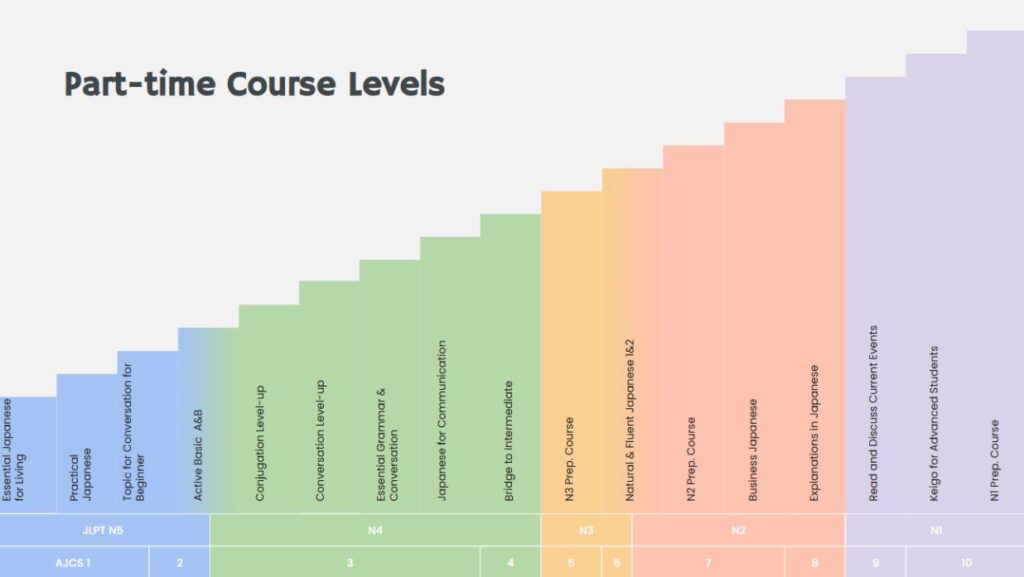
For reference, we offer around 17 part-time courses spanning beginner to advanced levels, including a business Japanese course focused on keigo and workplace etiquette, a conversation-only course, a JLPT preparation course, and a course centered on reading and discussing the news.
What Are Their Similarities?
Now that we know the key differences, let’s discuss the similarities. At Coto Academy, all Japanese lessons, regardless of format, are taught by professional instructors in small classes of up to 8 students. We find this is the ideal size for teachers to give direct feedback while still giving every student room to talk and practice conversation.
That leads to the next point: every Japanese lesson at Coto Academy prioritizes practical Japanese and conversation. Some part-time courses are designed specifically around speaking practice, but across all our courses, we emphasize learning by applying. Teachers pair you up for role-plays and speaking practice and engage with you in Japanese, so whatever you learn, regardless of the class or level, gets put into practice right away.
How to Know Which Japanese Lesson Is Right for You
1. Evaluate Your Goal
Everyone wants to be fluent, but think about why, and what your end goal actually is. A lot of Coto Academy students want to improve their Japanese for work. Their end goal usually isn’t to find a new job (though some do), it’s to communicate better with their Japanese colleagues and teammates.
Other times, we see short-term visitors who just want to dip into the language with no specific goal in Japan itself: they love Japan, love studying, and want to immerse themselves in the culture.
Different people have different goals, and depending on what yours is, one format may fit better than the other. For example, we’d recommend our Business Japanese part-time course to someone who wants to work better with colleagues, but not necessarily to someone learning Japanese on a tourist visa before heading home.
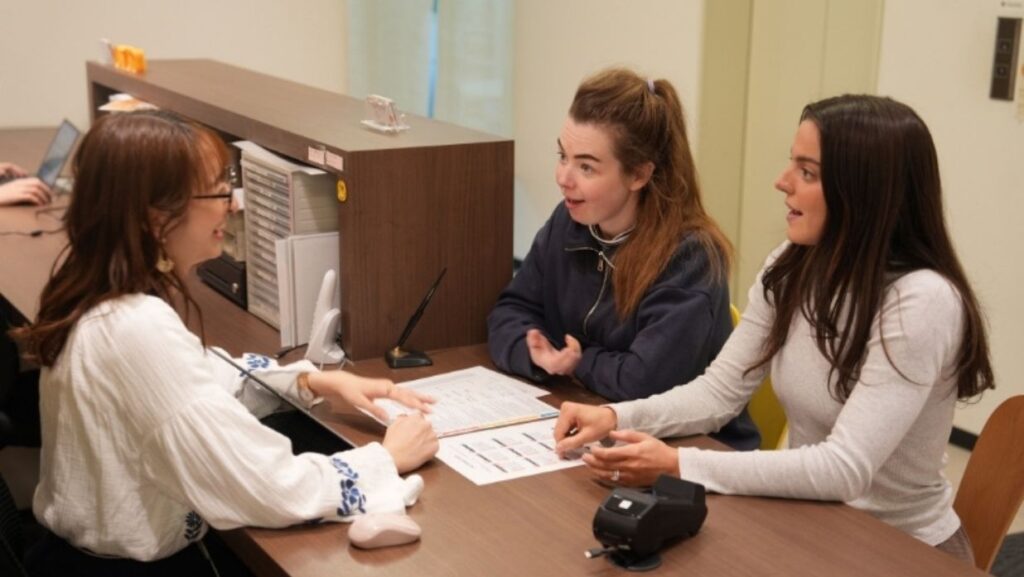
Every learner is unique, so we don’t like giving one-size-fits-all advice. If you already have a goal in mind, contact us to schedule a free course consultation so our team can recommend a plan that fits you.
2. Think About Your Schedule
Be honest about how much time you can realistically commit each week. Some Coto Academy students switch from an intensive course to a Lite Intensive course partway through, and that’s completely fine.
The key is thinking about commute time and overall mental load. A 3-hour lesson might also mean an hour of travel time on top, plus preparing for the test that comes around every Friday.
If you don’t have a clear sense of your schedule yet, that’s fine too. We often recommend starting with a part-time course, and since even our intensive course has some flexibility, you can pause or stop it if it turns out not to be the right fit.
3. Think About What Happens Outside of Class
One common mistake learners make, regardless of which course they take, is skipping self-review. Even in an intensive, Monday-to-Friday course, we recommend spending some time outside class on homework and review. It doesn’t need to be long; 30 minutes a day makes a real difference. Active learning and learning by doing (applying what you learn right away) matter just as much as class time itself.
Conclusion: There’s No “Wrong” Japanese Course
At the end of the day, there’s no wrong course. Whether you thrive on the structure of an intensive schedule or need the flexibility of a part-time lesson, both paths lead to real progress.
That’s exactly why Coto Academy offers more than one way to learn. From the Lite Intensive Course to specialized part-time programs in business Japanese, conversation, JLPT prep, and more, we’ve built our curriculum around the idea that every learner is unique, not around a single one-size-fits-all format.
If you’re ready to find the course that actually fits you, join Coto Academy and get started with a free consultation. Our team will help you figure out the right pace, focus, and schedule from day one.
FAQ
Do part-time Japanese lessons still prepare you for the JLPT?
It depends on the course. We offer a part-time JLPT preparation course specifically for this, but our general conversation-focused part-time lessons aren’t structured around exam prep the way an intensive course or JLPT-specific course is.
Is intensive Japanese harder than part-time Japanese?
Not necessarily harder, but faster paced and more time-intensive overall. Part-time lessons can be just as challenging depending on your focus, since teachers still push you to apply what you learn in each session.
Can I try a course before committing to a full term?
Reach out to our team for a free consultation. We’ll walk you through the course formats and help you figure out what fits your schedule and goals before you commit.
Does Coto Academy provide student visa support?
No, Coto Academy itself doesn’t handle student visa applications directly. If a visa is part of your plan, Coto Institute in Kokubunji is Ministry of Education-accredited and built around full-time study with visa sponsorship in mind, and Coto School Finder offers free, personalized visa guidance and school matching if you’re still deciding which school is the right fit. Reach out to either team and they’ll walk you through the process.