



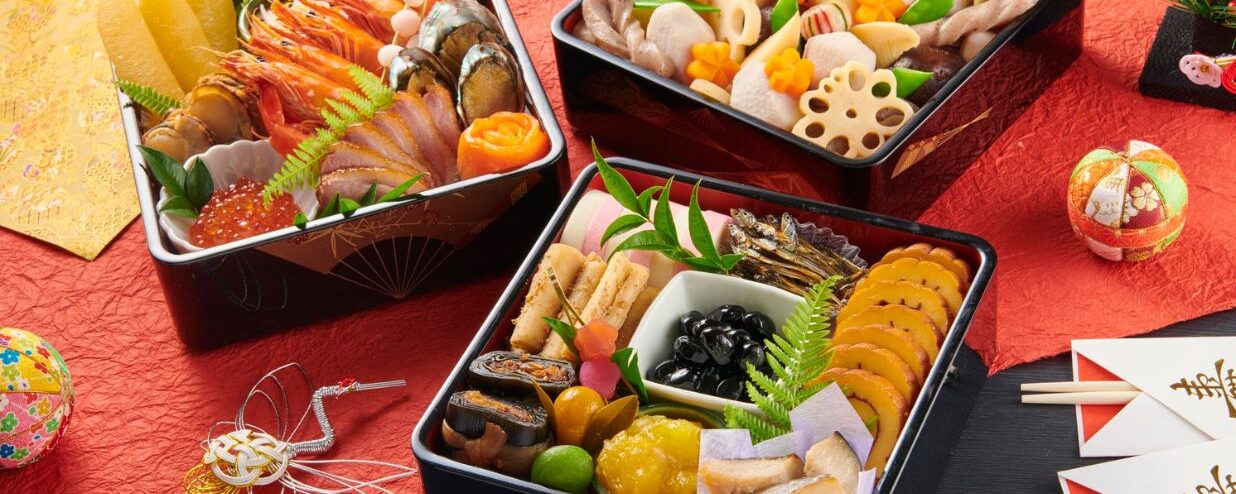


Have you ever tried or heard of osechi ryouri (おせち料理)? It’s a traditional Japanese dish consisting of a variety of small dishes that will definitely catch your curiosity as well as your appetite. But this is no ordinary fancy meal — osechi ryori is meant to be savored slowly and enjoyed during one special time of the year: the New Year.
Osechi ryori dates back to Japanese history and was pivotal to Japanese noble cuisine during New Year’s. Osechi ryori is characterized by its vibrant colors, each dish representing a deeper meaning. The main purpose of osechi ryori is to welcome the New Year.
So what is this elaborate dish, what is usually included, and how can you eat it when you visit Japan during New Year’s?
What is Osechi Ryori?
Breaking down the term, おせち料理 (osechi ryori), おせち (osechi) refers to the special dishes Japanese families eat during the first few days of January. And 料理 (りょうり) is just a general term for food or cooking. So, osechi ryori basically means New Year’s dishes; with each dish being very special as you won’t really find them at any other time of the year.
Recipes vary from region to region. While a particular dish may be a sign of bad luck in one region, it may be appreciated as a sign of good fortune in others. Traditionally, Japanese families prepare these dishes during December, since it was considered taboo to cook on the days following the new year.
They usually prepare all their meals in advance and store the food in a cool area. The おせち dishes are often fermented in sugars, soy sauce, or salt, resulting in sweet or salty flavors as well as drying, which can preserve food without refrigeration. This process has deep cultural ties and was essential for survival prior to technology.
Additionally, the presentation of おせち料理 (osechi ryori) might be considered just as important as the taste itself. They are presented in beautiful lacquer boxes in which food is organized and decorated to look more elaborate and aesthetically pleasing.
Traditionally, osechi ryori is prepared by hand prior the New Year’s Day; however, nowadays, Japanese people often order and buy osechi ryori from department stores, supermarkets, or restaurants, starting from October. Recently, the Japanese are also abandoning traditional dishes for sashimi, sushi, or even Western cuisine.
How do you say New Year’s in Japanese? Read this blog to find out: Happy New Year in Japanese
History of Osechi Ryori
Osechi ryori can be traced all the way back over a 1000 years ago to the Heian era, a period which defined Japanese culture as we know it today. However, at the time, osechi ryori was quite different and only prepared for ceremonies for the imperial courts, and only really included rice. By the Muromachi period (around 1336), honzen ryori, a formal and ritualistic style of dining that was common among the Samurai class, started to shape osechi ryori and give it some of the standard dishes it has today.
Then by the Edo period, osechi ryori had spread beyond the samurai class, establishing its main dishes, and even the name osechi came to only refer to the New Year’s food. The word osechi derives from 御節供 (osechiku), which referred to special foods offered to the gods during important seasonal festivals. These dishes were meant to give thanks for the previous year’s harvest and to pray for good fortune, health, and prosperity in the year ahead. Over time, the New Year celebration became the most important of these seasonal events, and osechi ryori became closely associated with it.
Eventually, certain dishes started to be recognized as staples for osechi ryori as well as their decorative presentation in lacquered boxes called 重箱 (jubako). While over time osechi ryori has gone through changes to become more festive or elaborate, the symbolic nature of the dish remains largely unchanged: welcoming the New Year and looking forward to good fortune.
How Osechi Ryori is Presented: Jubako
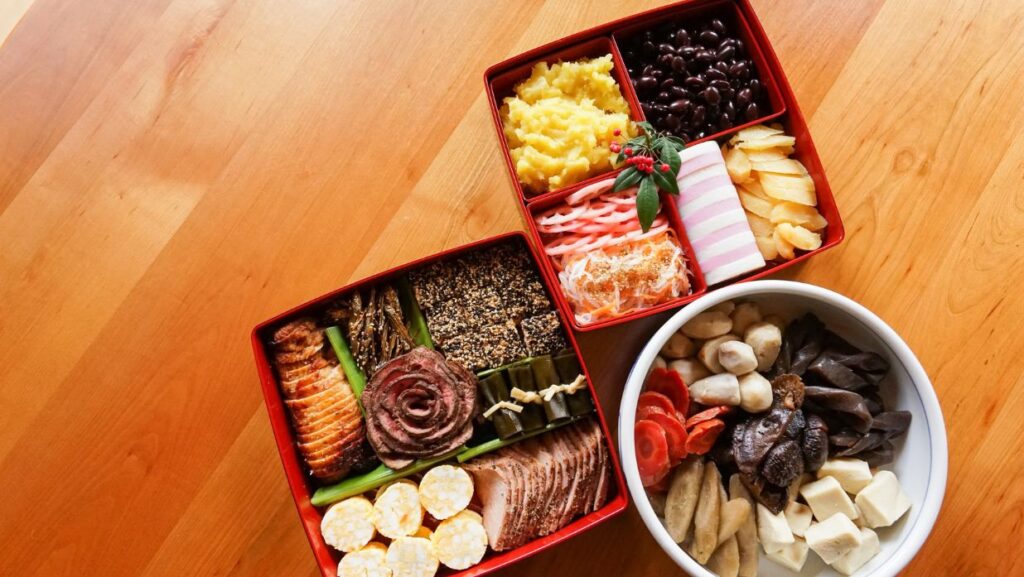
You can immediately recognize osechi ryori by the way they are presented: they are often colorful, intentionally placed dishes put inside special bento-like boxes called jubako, which, like bento, are also stacked against each other.
Traditionally, these jubako consist of five stacks, although three stacks are more common nowadays. Each stack contains specific food items and has its own name. For example, the topmost stack is called ichi no juu, the second is ni no juu, and so forth. Notably, the fourth stack is not called shi no juu because, in Japanese superstition and wordplay, shi means “death.” Interestingly, the fifth box at the very bottom is intentionally left empty. Why? It symbolizes an empty vessel that will store good fortune in the years to come.
| Box Tier | Contents |
| Box 1 | Iwaizakana (celebratory fish dishes) |
| Box 2 | Pickled foods and side dishes |
| Box 3 | Grilled dishes |
| Box 4 | Nimono (simmered dishes) |
| Box 5 | Empty (symbolic space for future fortune) |
Common Osechi Ryori Dishes & Their Meanings
Each dish, from the ingredients to the presentation, is deliberate and holds special meaning. Osechi ryori has played an essential role in Japanese New Year traditions and varies widely across regions in Japan. So, what are the most common dishes in osechi ryori, and what are the deeper meanings within each dish?
Kuromame (Black Beans)
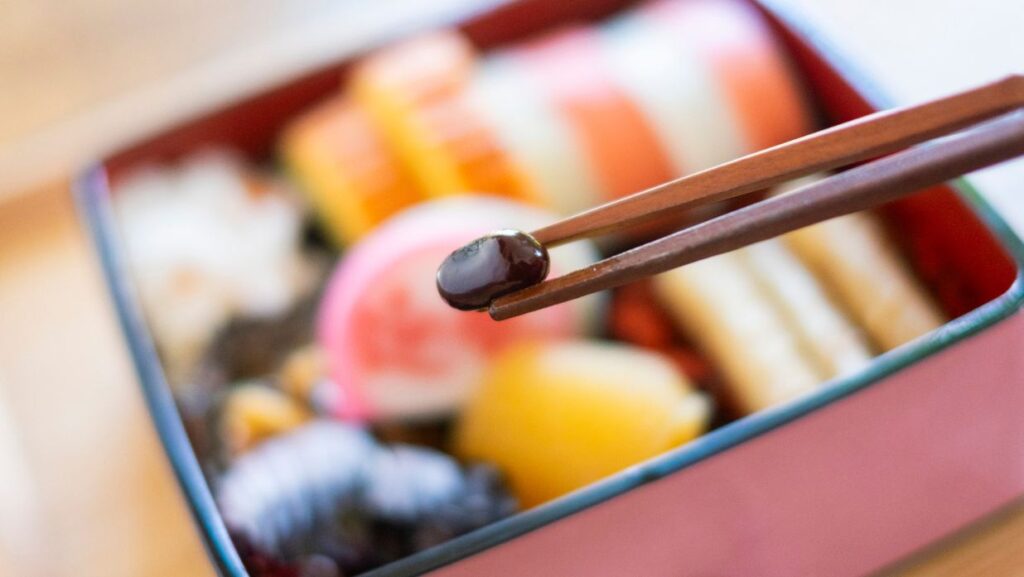
黒豆, or Kuromame, are soft, sweetened black beans that represent good health or resilience. The term kuromame consists of the word 黒 (kuro), meaning black, and 豆 (mame), meaning “beans.” However, the term mame actually sounds similar to the word “mamemameshii”, meaning “diligent;” thus, that is why kuromame symbolizes health and diligence in the new year. Kuromame is also rich in vitamins, which are believed to support health and immunity.
Kazunoko (Herring Roe)
数の子 (kazunoko), known in English as herring roe, is actually fish eggs cooked with soy sauce, mirin, dashi, and topped with dried bonito flakes. So, you may have figured out that this dish symbolizes fertility. The word 数の子 literally translates to “numerous children,” with 数 (kazu) meaning “number” or “numerous” and 子 (ko) meaning “children.”
Datemaki (Fish Paste Roll)
伊達巻 (datemaki) is a sweet omelette made of fish paste and rolled similar to a 卵焼 (tamago yaki). Datemaki symbolizes knowledge and culture because its rolled shape resembles a scroll. It’s often associated with academic success and self-improvement.
Tazukuri (Dry Sardines)
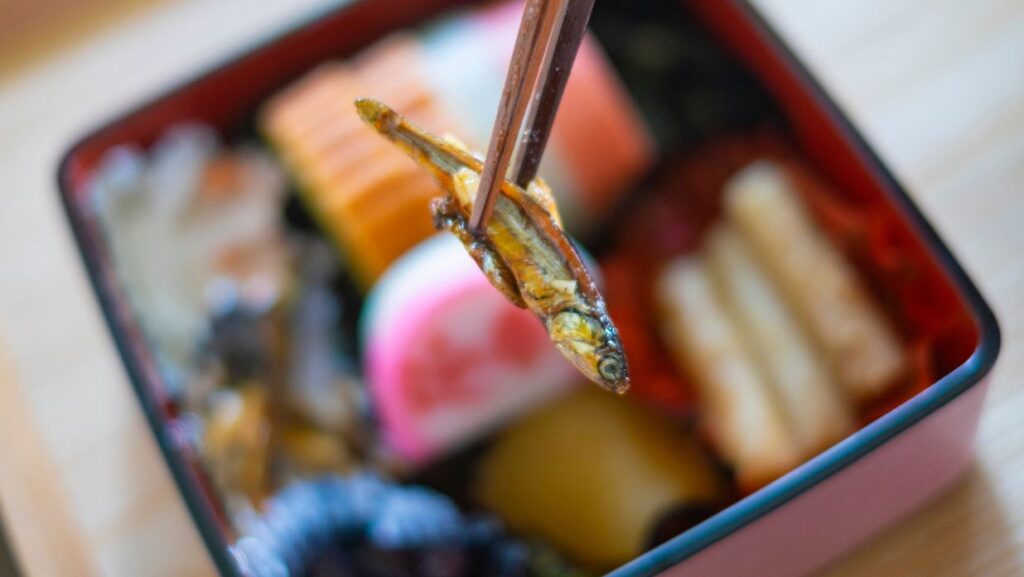
Originally used as fertilizer for rice fields, which is where it gets its name, tazukuri (literally meaning to make rice fields). Thus, it represents a bountiful harvest and financial success. It has a sweet and savory flavor and is often enjoyed as a snack-like dish. They consist of dry sardines covered in a sweet soy sauce glaze.
Kobumaki (Sweet Kelp Roll)
Kobumaki are sweet kelp rolls, usually also consisting of fish, which varies on region. The term for 昆布 (konbu), or kelp, is heavily associated with the phrase yorokobu (喜ぶ), meaning “to be happy.” They are also often eaten with herring, called nisshin in Japanese, which sounds similar to saying “2 parents.” So, eating kobumaki on New Year’s is thought to bring a long life, good fortune, and happiness.
Kurikinton (Sweet Potato and Chestnut)
栗きんとん (kurikinton) are sweet mashed chestnuts and golden sweet potato. Known for their bright gold color, kuri kinton represents wealth and financial prosperity. It’s one of the most visually striking dishes in osechi.
Popular Places to Buy Osechi Ryori in Japan
Traditionally, osechi ryori was prepared at home, but today many people in Japan order osechi in advance from restaurants, department stores, and even convenience stores. Options range from luxurious multi-tiered boxes to affordable, modern-style osechi.
1. Department Stores
Major Japanese department stores such as Mitsukoshi, Isetan, Takashimaya, and Daimaru are among the most popular places to buy osechi. They offer a wide selection, often in collaboration with famous restaurants, ryoutei (traditional Japanese restaurants), and hotels.
Department store osechi are known for their high quality, beautiful presentation, and variety, with options ranging from traditional Japanese to French-, Chinese-, or fusion-style osechi. Orders usually open as early as September.
2. Hotels
Luxury hotels in Japan offer premium osechi that emphasize presentation, refined flavors, and seasonal ingredients. These are especially popular for people celebrating New Year’s at home but wanting a restaurant-level experience.
Hotel osechi often sell out quickly and tend to be more expensive, but they’re ideal for special occasions or gifting.
3. Japanese Restaurants and Ryoutei
Many high-end Japanese restaurants and ryoutei prepare limited quantities of osechi each year. These tend to follow traditional Kyoto or regional styles and focus heavily on craftsmanship. Because quantities are limited, these osechi often require early reservations and are popular among osechi enthusiasts or families who value authenticity.
4. Convenience Stores
Surprisingly, convenience stores are now a very common place to order osechi in Japan. Chains like 7-Eleven, Lawson, and FamilyMart offer reasonably priced osechi that are easy to order online or in-store. These sets are popular with small households, couples, or people trying osechi for the first time. Some also include Western-style dishes or child-friendly options.
5. Online Shopping and Delivery
In the age of the internet, many people now order osechi online through department store websites, restaurant websites, or major online retailers. Osechi is usually delivered directly to your home on December 30 or 31, making it a convenient option, especially for busy families or people living alone.
6. Eat-In Osechi at Restaurants
Some hotels and restaurants offer osechi meals served on-site, especially on January 1st. This is popular with travelers, couples, or those staying at a ryokan during New Year’s.
Conclusion: Try Japanese Osechi Ryori this New Year!
Osechi ryori is a deep-rooted tradition in Japanese culture for celebrating the New Year and welcoming good fortune. It’s a great chance to get a taste for something new as well as for an ancient tradition that has persevered to this day. Why not try Japanese osechi ryori this New Year and experience something truly authentic!
Is Your New Year’s Resolution to Learn Japanese? Study with Coto Academy!
If you really want to make the most out of spending your New Year’s in Japan and perhaps strike up conversations, then we highly recommend taking Japanese classes at Coto Academy! We offer practical, conversation-focused courses that will help you navigate travelling or even living in Japan!
Our teachers pride themselves on providing a fun, casual environment that allows students to practice comfortably and increase their confidence in speaking, reading, and understanding Japanese. We offer online and offline courses in Tokyo and Yokohama! Interested, sign up with the form below.
FAQ
What is osechi ryori?
Osechi ryori (おせち料理) is a traditional Japanese New Year’s meal made up of symbolic dishes meant to bring good luck, health, and prosperity in the coming year. It is typically eaten during the first few days of January.
Why do people eat osechi ryori?
Osechi ryori originated as a way to give cooks a break during New Year’s while celebrating the holiday with food that keeps well. Each dish also carries a meaning related to fortune, longevity, or happiness, making it a symbolic way to welcome the New Year.
When is osechi ryori eaten?
Osechi ryori is usually eaten from January 1st to January 3rd. Some families start eating it on New Year’s Day, while others enjoy it throughout the first few days of the year.
What is a jubako?
A jubako (重箱) is a tiered lacquered box used to store and serve osechi ryori. Each layer contains different types of dishes, neatly arranged and often color-coordinated.
Do people still make osechi at home?
Some families still make osechi at home, but today many people order osechi from department stores, hotels, restaurants, or convenience stores due to time and convenience.
Is osechi ryori always Japanese-style?
Traditionally, osechi is Japanese, but modern versions include Western, Chinese, or fusion-style dishes. Many osechi sets now cater to different tastes and dietary preferences.
Is osechi ryori expensive?
Prices vary widely. Convenience store osechi can be quite affordable, while department store or hotel osechi can be luxury items costing tens of thousands of yen.
Check out our Other Blogs related to the New Year: