




The JLPT N3 Grammar, に決まっている (ni kimatte iru), is a versatile phrase you can use to express that you are certain about something or that something is bound to be or happen. It is similar to the English expressions: surely, certainly, it must be, or bound to. It is often used to:
- Express something you believe is true
- Express how something is bound to be or happen
Learn its meaning, sentence structure, and see plenty of examples, each with Japanese text, romaji reading, and English translation!
Make Sure to Watch Coto Academy’s YouTube Video About に決まっている
Before you continue reading, why not take a moment to watch a quick YouTube lesson with our Japanese teacher, Iwasaki-sensei?
〜に決まっている (~ni Kimatte Iru) Meaning
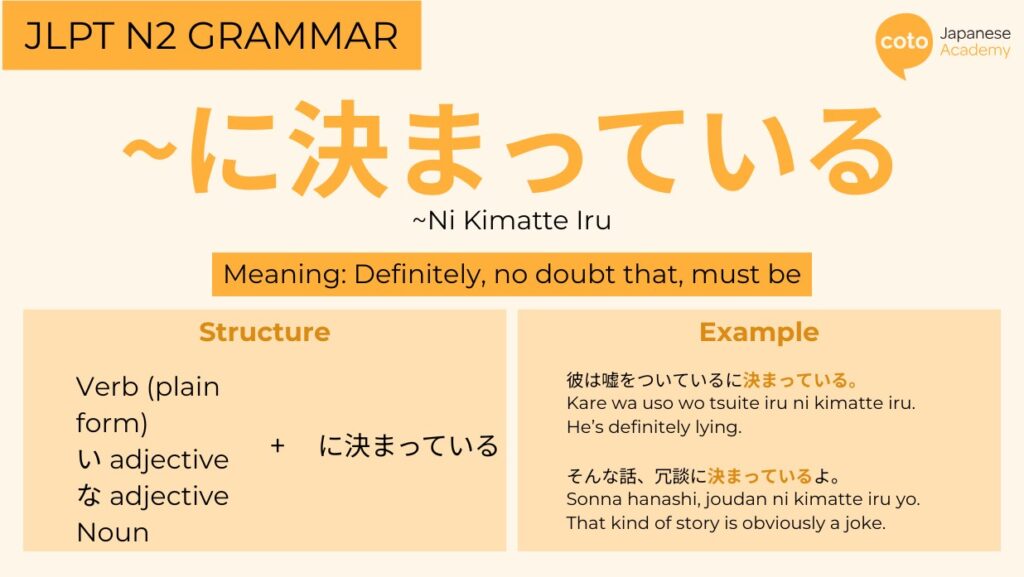
The structure of the phrase comes from the ている (te iru) form of 決まる (kimaru), which means to decide. So, the whole expression with the particle, に (ni) + 決まっている could translate literally to “decisively” or “to be decided.” Thus, this phrase is used to express strong conviction or certainty about something.
Common uses of 〜に決まっている:
- It’s definitely …
- It must be …
- There’s no doubt that …
JLPT N3 〜に決まっている(Ni Kimatte Iru) Sentence Structure
You usually use 〜に決まっている at the end of a sentence. You can attach it to verbs, nouns, or adjectives to express certainty of something, like saying “it’s definitely” or “it must be”.
| Type | Structure |
|---|---|
| Verb (plain form) | Verb + 決まっている |
| い-Adjective | い-Adjective + 決まっている |
| な-Adjective | な-Adjective + 決まっている |
| Noun | Noun + 決まっている |
This section will break down how to use 〜に決まっている with different verb forms, including present, past, negative, past negative, and volitional.
| Form | Plain Form + に決まっている | Meaning |
|---|---|---|
| Present | 勝つに決まっている | I will definitely win |
| Past | 勝ったに決まっている | I definitely won |
| Negative | 勝たないに決まっている | I defitnitely won’t win |
| Past Negative | 勝たなかったに決まっている | I definitely did not win |
| Volitional | 勝とうに決まっている | I definitely should win |
JLPT N3 〜に決まっている (~Ni Kimatte Iru) Examples
Let us take a look at a few example sentences.
Example 1:
あんなに練習しているんだから、試合に勝つに決まっている。
Anna ni renshuu shite irunda kara, shiai ni katsu ni kimatte iru.
He’s practiced that much, so he’s definitely going to win the match.
Example 2:
こんなに安いなんて、何か問題があるに決まっている。
Konna ni yasui nante, nanika mondai ga aru ni kimatte iru.
If it’s this cheap, there must be some kind of problem.
Example 3:
彼は嘘をついているに決まっている。
Kare wa uso wo tsuite iru ni kimatte iru.
He’s definitely lying.
Example 4:
そんな話、冗談に決まっているよ。
Sonna hanashi, joudan ni kimatte iru yo.
That kind of story is obviously a joke.
Vocabulary List
Check out all the new words in the example sentences above, and try to remember new vocabulary alongside today’s Japanese grammar!
| Kanji/Writing | Furigana | Romaji | English |
|---|---|---|---|
| 結果 | けっか | kekka | result, outcome |
| がっかりする | がっかりする | gakkari suru | to be disappointed |
| 言い方 | いいかた | iikata | way of speaking, wording |
| 怒る | おこる | okoru | to get angry |
| 徹夜する | てつやする | tetsuya suru | to stay up all night |
| 明日 | あした | ashita | tomorrow |
| 眠い | ねむい | nemui | sleepy |
| 映画 | えいが | eiga | movie |
| 見る | みる | miru | to see, to watch |
| 泣く | なく | naku | to cry |
Learn More JLPT Grammar with Coto Academy!
Try using 〜に決まっている in several different sentences to really lock the phrase into memory and understand how to use it! If you want to practice using this JLPT phrase and many more in real Japanese conversations with a teacher who can offer practical guidance, sign up with us at Coto Academy.
Coto Academy has been teaching Japanese for over 25 years, with campuses in Shibuya, Yokohama, Iidabashi, Minato, and online. Our courses focus on practical Japanese, so the grammar you learn is designed for real-life use.
We offer part-time, intensive, and fully online lessons to suit your schedule. Start learning Japanese effectively and confidently with Coto Academy today!
Why join Coto Academy?
- Over 60+ different Japanese classes over 18 levels
- Small classroom of only up to 8 students for personalized support
- Professional, native Japanese teachers
- Ready to get started? Fill out the form below to contact us!
FAQ:
What does 〜に決まっている mean?
〜に決まっている is used to express strong certainty or conviction. It means “it’s definitely …” or “there’s no doubt that …”. The speaker feels very confident about the outcome, often based on common sense or experience.
Can 〜に決まっている be used in the first person?
Yes. In first-person contexts, it often expresses an obvious emotional reaction or consequence.
Example:
こんな結果じゃ、がっかりするに決まっている。
Is 〜に決まっている formal?
No. It is mainly used in casual conversation and can sound assertive or emotional, so it’s best avoided in formal writing or business settings.
What is the difference between 〜に決まっている and 〜はずだ?
〜に決まっている is used for expressing strong, emotional, subjective certainty, while 〜はずだ is generally used for logical expectations based on evidence.
Read more: