





The JLPT N3 grammar もし〜たなら (moshi ~ tanara) is a useful phrase for expressing conditional statements. Its meaning is close to “if” or “in the case of,” the phrase is often used for the following situations:
- Expressing hypothetical or unreal situations
- Expressing a conditional situation (i.e., if A, then B)
Continue reading to learn its meaning, structure, and example sentences, each with Japanese, romaji, and English translation!
Make Sure to Watch Coto Academy’s YouTube Video About もし〜たなら
Before you continue reading, why not take a moment to watch a quick YouTube lesson with our Japanese teacher, Natsumi-sensei.
もし〜たなら Meaning
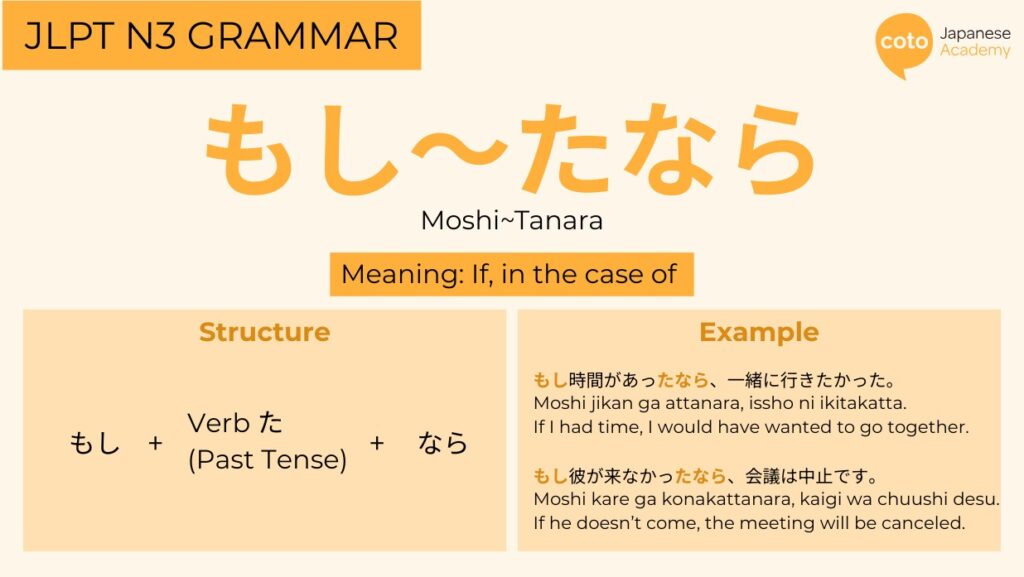
もし〜たなら (Moshi~tanara) most closely translates to “if” or “in the case of” in English. This phrase expresses hypothetical conditions that are useful for discussing imaginary scenarios, possibilities, or even suggestions.
The phrase is often used for:
- Possible future situations
- Hypothetical or imagined scenarios
- Advice, suggestions, or possible consequences
JLPT N3 もし〜たなら (Moshi ~Tanara) Sentence Structure
You often start a sentence with もし + verb た (past tense) + なら to form a conditional, followed by a hypothetical statement. The phrase uses a verb in the past tense; thus, you’re expressing a condition stating that if something had already happened, then B would happen or be true.
| Type | Structure |
|---|---|
| Verb (plain form) | もし + Verb (past tense) + た(な)ら |
Note you don’t always need to use もし (moshi), but it helps to emphasize that the statement is a hypothetical and, in fact, not a reality (yet).
Now, let’s break down how to use もし〜たなら with positive and negative verb forms.
| Form | Plain Form + もし〜たなら | Meaning |
|---|---|---|
| Positive | もし食べたなら | If I had eaten |
| Negative | もし食べなかったなら | If I had not eaten |
Whether the statement is past or present depends on the statement following もし〜たなら. For example:
For past tense:
もし勉強したなら、試験を合格したよ。
Moshi benkyou shita nara, shiken o goukaku shitayo.
If I had studied, I would have passed the exam.
For present/future tense:
もし勉強したなら、試験を撮るよ。
Moshi benkyou shita nara, shiken wo toru yo.
If I had studied, I would have taken the exam.
In both cases, the もし勉強したなら is demonstrating a past regret of not studying, while the following phrase offers a hypothetical either in the past or in an imaginary future where you did study.
JLPT N3 もし〜たなら (Moshi ~Tanara) Examples
Now, let’s take a look at a few example sentences to really understand how this phrase can work in actual Japanese conversation.
Example 1
もし時間があったなら、一緒に行きたかった。
Moshi jikan ga attanara, issho ni ikitakatta.
If I had time, I would have wanted to go together.
Example 2
もし日本に行ったなら、京都に行ってみてください。
Moshi nihon ni ittanara, kyouto ni itte mite kudasai.
If you go to Japan, please try visiting Kyoto.
Example 3
もし分からなかったなら、先生に聞いてください。
Moshi wakaranakatta nara, sensei ni kiite kudasai.
If you don’t understand, please ask the teacher.
Example 4
もし彼が来なかったなら、会議は中止です。
Moshi kare ga konakatta nara, kaigi wa chuushi desu.
If he doesn’t come, the meeting will be canceled.
Vocabulary List
Check out all the new words in the example sentences above, and try to remember new vocabulary alongside today’s Japanese grammar!
| Kanji / Writing | Furigana | Romaji | English |
|---|---|---|---|
| もし | もし | moshi | if; in case |
| 時間 | じかん | jikan | time |
| 一緒に | いっしょに | issho ni | together |
| 行く | いく | iku | to go |
| 日本 | にほん | Nihon | Japan |
| 京都 | きょうと | Kyouto | Kyoto |
| 行ってみる | いってみる | itte miru | to try going |
| 分かる | わかる | wakaru | to understand |
| 先生 | せんせい | sensei | teacher |
| 聞く | きく | kiku | to ask; to listen |
| 彼 | かれ | kare | he |
| 会議 | かいぎ | kaigi | meeting |
| 中止 | ちゅうし | chuushi | cancellation |
Learn More JLPT Grammar with Coto Academy!
Try using もし〜なら to discuss hypothetical situations in Japanese. This expression is very useful for everyday Japanese conversation! So, try using and ingraining this phrase in your memory to expand your Japanese and prepare for the JLPT. But nothing beats real, practical conversation practice with the guidance of a Japanese teacher, so why not sign up with us at Coto Academy?
For more than 25 years, Coto Academy has been helping students master Japanese so that they can actually use it. With schools in Shibuya, Yokohama, Iidabashi, Minato, and online, we make learning accessible wherever you are.
Whether you prefer part-time, intensive, or online lessons, we have a course that fits your schedule. Take the first step toward confident Japanese with Coto Academy.
Why join Coto Academy?
- Over 60+ different Japanese classes for over 18 levels
- Small classroom of only up to 8 students for personalized support
- Professional, native Japanese teachers
- Ready to get started? Fill out the form below to contact us!
FAQ:
What does もし〜たなら mean?
It means “if (something happens/happened), then …” and is used to talk about hypothetical situations or conditions.
Can もし〜たなら be used for commands or requests?
Yes, the phrase is commonly used this way. For example, もし困ったなら、連絡してください (moshi komattanara, renraku shite kudasai), or “if you’re in trouble, please contact me”.
Can もし〜たなら be used for the past?
Yes, whether the statement is past or present, depends on the statement following もし〜たなら (moshi ~tanara). For example: もしもっと勉強したなら、合格できた (moshi motto benkyou shitanara, goukaku dekita), or “if I had studied more, I could have passed.”
What is the difference between 〜たら and 〜たなら?
〜たら expresses a more neutral conditional, while 〜たなら is slightly more deliberate or reflective, often used when giving advice or imagining a scenario
Read More: