




You may be familiar with the JLPT, but have you heard of the BJT and TOPJ? While the JLPT is the most widely recognized proof of Japanese language proficiency, an increasing number of companies and foreigners are now opting for the JLPT test alternatives.
But from JLPT, BJT, and TOPJ, which one should you take? Nowadays, there is even a lot of debate on which test is the best, especially if you want to find a job in Japan. Which certification test should you study for, and which ones will get you hired? This conundrum can be challenging for prospective job seekers in Japan.
In this blog, we’ll cover three main Japanese proficiency tests that you can take to get hired in Japan. We’ll also discuss which certification is best for whom, whether you’re a job seeker in Japan or want to study at a Japanese university.
Why Does Japanese Certification Matter for Jobs in Japan?
If you’ve checked out major job boards aimed towards foreigners, such as LinkedIn, Indeed, or GaijinPot, you probably noticed that most non-English teaching jobs require some form of Japanese proficiency, whether it is conversational level or near-native level.
While some jobs don’t require a high level of Japanese, having business-level or advanced Japanese proficiency opens the door to more opportunities in Japan and helps your resume stand out.
However, you can’t just say that you have conversational Japanese proficiency without the proof to show it. That’s why it can be helpful to have some proof of Japanese proficiency, and possessing a certificate in Japanese can certainly help with the job hunting process in Japan.
Do Japanese employers really ask for a Japanese language certificate?
When applying for jobs, some job portals allow you to upload a scanned copy of your Japanese language certificate as proof. However, not all companies require it.
The question is: if you don’t upload a certificate but list it on your resume, can you claim to have, for example, a JLPT N2?
Even if some employers don’t always request proof, never lie about your qualifications.
If you don’t have a certificate, you can still indicate your estimated Japanese level, but you should not claim to possess a certificate you haven’t earned. Similarly, claiming native-level proficiency when you are not will likely be revealed during the interview process.
Take JLPT Preparation Class at Coto Japanese Academy!
What is the JLPT?
The Japanese Language Proficiency Test is the most widely known proficiency test for Japanese learners. Held throughout Japan and in 85 countries, the JLPT measures Japanese proficiency on a scale of five different levels:
| JLPT Level | Description |
| N5 | The lowest level you can obtain through the JLPT; you can understand some basic Japanese. |
| N4 | You can understand basic Japanese, such as comprehension of daily topics and basic vocabulary. |
| N3 | You can understand Japanese at a daily conversational level. |
| N2 | You can understand Japanese at an advanced level or business-level proficiency. |
| N1 | You can understand Japanese at near-native proficiency. The highest level you can obtain in the JLPT. |
What the JLPT does is test your proficiency in reading, grammar, vocabulary, kanji, and listening. The test is structured into different sections depending on which level of JLPT you’re taking; for N5 to N3, you will take the test in three sections, whereas for N2 and N1, you will take the test in two sections:
- N5–N3:
- Section 1: Vocabulary
- Section 2: Reading and grammar
- Section 3: Listening
- N2–N1:
- Section 1: Vocabulary, grammar, and reading
- Section 2: Listening
You will then receive your test results at least two months after taking the JLPT. To pass the JLPT, you will need to not only meet the minimum required score for each section, but also for the overall test. Passing marks for the overall test can vary according to the level you’re taking; for example, if you’re taking the N3, the minimum score for each section has to be 19 out of 60, but for the overall test, your score has to be 95 out of 180.
Advantages of taking the JLPT
There are many advantages to passing the JLPT, especially if you’re planning on taking the test at the N2 or N1 level. The prestige of possessing a JLPT certificate is advantageous since it’s the most widely known test of Japanese proficiency throughout the world, and is mainly used as a benchmark of Japanese proficiency.
Aside from job hunting advantages, a JLPT certificate can help you with your visa application; for example, possessing an N2 or N1 certificate will meet the benchmark requirements for being admitted to Japanese universities and higher education institutions. In addition, for some visas, such as the Type 1 Specified Skilled Worker visa, you might need an N5 certificate or higher to meet the language requirements for that visa.
Read More: What to Know About Japan’s New Foreign Worker System Starting 2027
Disadvantages of taking the JLPT
Of course, just because the JLPT is the most widely taken proficiency test, it doesn’t mean that it has no flaws.
Since the JLPT only tests vocabulary, kanji, reading, grammar, and listening, there are no speaking or writing tests that you have to take throughout the test. Speaking and writing are important aspects of learning Japanese, so the JLPT might not be a good indicator of your true proficiency in the language, especially since you might need to write reports or participate in meetings when working in Japan.
This can also be detrimental to your overall Japanese proficiency if you revolve your studies around passing the JLPT (which can lead you to focusing too much on grammar and vocabulary and not speaking or writing).
Furthermore, since the test is held once or twice a year, depending on where you live, waiting to take the JLPT can affect your job-hunting journey. If you need the Japanese certification immediately, then taking the JLPT might not be the best option.
What is the BJT?
An alternative to the JLPT is the Business Japanese Test, or the BJT, which tests your ability to communicate in professional and business settings in Japanese.
Unlike the JLPT, the BJT is more focused on practical Japanese, particularly in work-related situations. This test is held in 16 different countries, including Japan. The test is mainly computer-based (though you will need to take it at a test center), and you can take the BJT once every three months.
The test lasts for a total of 1 hour and 45 minutes and will test your listening and reading comprehension in a variety of business situations, such as situational understanding, information listening, and written materials such as memos, emails, and business documents.
Instead of grading on a pass/fail basis, the BJT is scored from 0 to 800 on a scale of six levels, from J1+ to J5. The highest level you can obtain is J1+, with a score of 600 to 800, which demonstrates that you have an advanced knowledge of business Japanese and can use the language in a variety of business situations. You will receive your BJT results immediately after the test.
Learn more about the Business Japanese Test here.
Advantages of taking the BJT
The advantages of taking the BJT are that since it tests you on your Japanese in the workplace, studying for the test allows you to adapt to Japanese workplaces easily, since you will be tested on your ability to understand a variety of Japanese business situations, as well as comprehend business documents and emails. In addition, since results are always instantaneous, you can use these results in lieu of JLPT scores for job hunting, university applications, and even visa applications.
Disadvantages of taking the BJT
Like the JLPT, the BJT doesn’t really give you an idea about your ‘true’ Japanese proficiency, since it only tests you on business Japanese. This means that while your Japanese could be considered sufficient for the workplace, your practical Japanese proficiency might not be the best. Studying for the test can only prepare you for surviving a Japanese business setting, not daily life in Japan.
What is the TOPJ?
The Test of Practical Japanese, otherwise known as either the TOPJ or J.TEST, is another alternative test to the JLPT. Held in Japan and in 12 different countries, it tests your Japanese ability in daily, practical situations. The format of the test is similar to the JLPT in terms of sections; the TOPJ includes a writing comprehension section (though it depends on which level of the test you’re taking).
Like the JLPT, the test is administered according to level, which uses letters from A to G to determine proficiency:
- F/G level: The equivalent of the JLPT N5. The beginner level test is taken by those with basic proficiency in Japanese.
- D/E level: The equivalent of the JLPT N4 and N3. This test is taken by those with intermediate proficiency in Japanese.
- A to C level: The equivalent of the JLPT N2 and N1. This test is taken by those with advanced proficiency in Japanese.
Whichever level you are taking, the TOPJ is graded based on how many points you get. Unlike the JLPT, there is no minimum points requirement according to the section; instead, the letter grade that you will get is determined by how many points you score in the test overall. To get the lowest grade in the level you’re taking, you will have to meet the minimum score required for the overall test.
Advantages of taking the TOPJ
The format of the TOPJ really tests you on your use of Japanese in practical situations, which can give a better idea of your overall Japanese proficiency. As writing skills are an important indicator of Japanese proficiency, the addition of writing sections in the test can help you to find out what your Japanese proficiency is. Recently, the TOPJ has become an accepted credential for job hunting, university admissions, and even visa applications.
Disadvantages of taking the TOPJ
While the TOPJ does prepare you to use Japanese in a variety of practical situations, the TOPJ isn’t widely known worldwide, as it’s mainly offered in Asian countries, except for Brazil. Furthermore, studying for the test can be difficult as resources for the test can be limited.
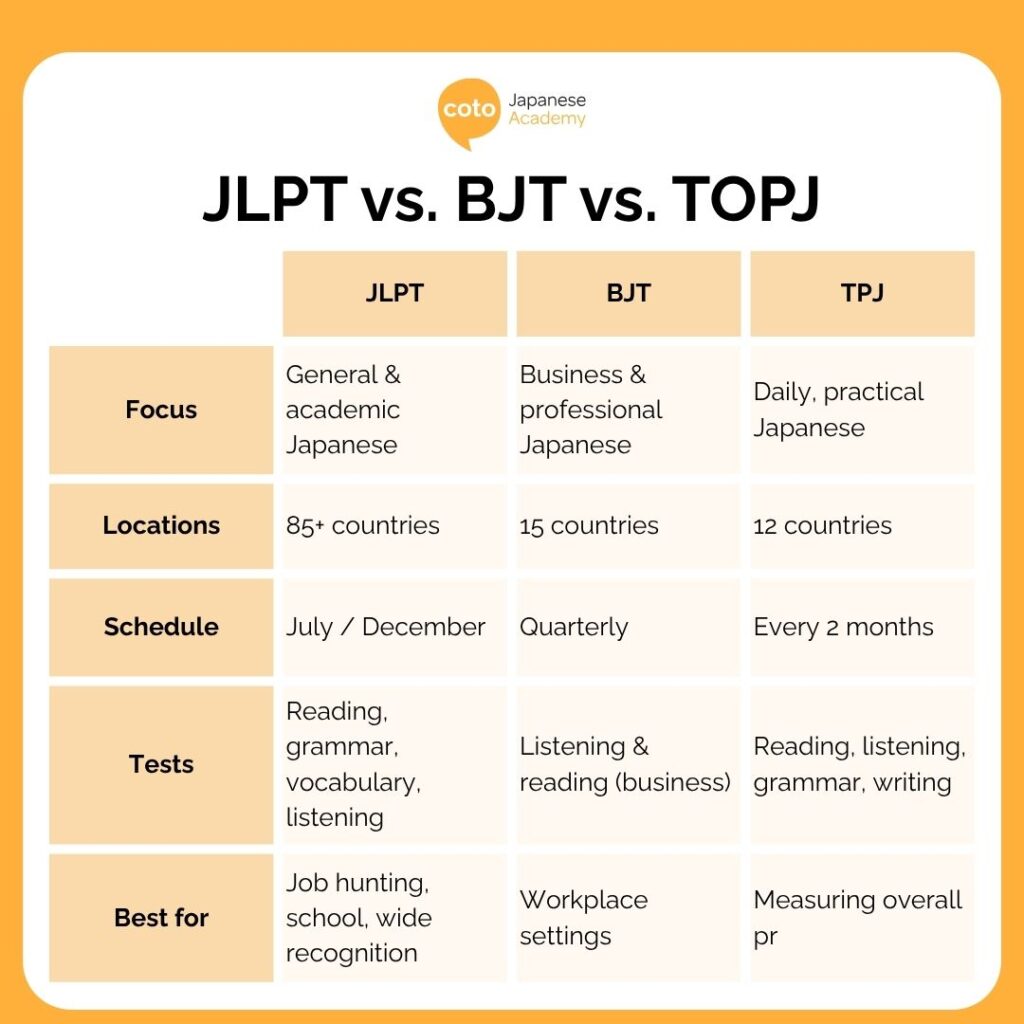
JLPT vs. BJT vs. TOPJ: Key comparisons
| Japanese Language Proficiency Test | Business Japanese Test | Test of Practical Japanese | |
| Overview | Tests general and academic Japanese proficiency | Tests Japanese proficiency in business and professional settings | Tests Japanese proficiency in daily, practical situations |
| Location | Japan, and 85 different countries | Japan, and 15 different countries | Japan, and 12 different countries |
| Held when? | July and/or December (depending where you live) | Year-round; you take the test once every three months | January, March, May, July, September, November |
| What is being tested? | Reading, grammar, vocabulary, and listening | Listening and reading comprehension in business situations | Reading, listening, grammar, and writing |
| Pros | July and/or December (depending on where you live) | Scores are available immediately after the exam. It is more focused on practical Japanese usage Can be used in lieu of JLPT scores for study or work | Is becoming a widely accepted form of certification Can give you a better idea of your overall proficiency |
| Cons | Doesn’t really give you an idea of your overall proficiency Only offered twice a year | Doesn’t give you an idea of your overall proficiency Studying for the test only prepares you for workplace situations, not daily conversations | Isn’t as well-known as compared to the JLPT Aside from practice questions on the official website, resources to study for this test are limited |
| Application fee (as of 2026) | ¥7,500 (in Japan) | ¥8,000 (in Japan) | ¥5,800 (in Japan) |
Which Certificate Do Employers Actually Care About?
It can be difficult to decide which test you want to take for employment purposes. It’s true that most jobs in Japan do require business-level Japanese, and even though there are English-speaking jobs in Japan, most jobs do require fluency in both English and Japanese. This is why bilingual candidates are commonly sought after in the job market, especially at international companies. For the most part, however, the JLPT is widely accepted as proof of Japanese proficiency; the BJT can also be beneficial in job hunting as well.
JLPT N2 Benchmark for Key Professional Working Visa
For prospective job seekers looking to start a career in Japan, it might be useful to have a JLPT N2 certificate, as this will be a gateway to most bilingual jobs in Japan. Even if your resume is considered to be ‘perfect’, companies prefer to find someone with Japanese proficiency. If possible, possessing an N1 certificate can increase your chances of finding a job.
The reality is, the level of proficiency you’re going to need in Japanese depends on your role and industry. For most office jobs, you’re going to need a high level of proficiency (preferably N2 or N1), while jobs at international companies and in tech tend to not care about Japanese proficiency that much, though it’s a bonus to have Japanese certification.
Japan May Require Proof of N2-Level Proficiency Soon
In April 2026, official sources reported that the Japanese government is considering updating its visa requirements to mandate N2-level proficiency for the Engineer/Specialist in Humanities visa.
There are discussions that the Japanese government might accept N2-equivalent proof of proficiency, which could include the TOPJ and BJT. However, the JLPT N2 is generally the most widely recognized, so it should be a key consideration when weighing your options.
We also recommend checking out our blog about the potential Japanese language requirement for the Engineer/Specialist in Humanities visa here.
Best Certification Based on Your Goal

For Students
If you’re planning to study at a Japanese university, we recommend taking the JLPT N2, as it will help you increase your chances of being admitted. In addition, most Japanese universities will also require you to pass the EJU, or Examination for Japanese University Admission for International Students. This is just to test your language proficiency, as well as core academic proficiencies.
If you’re planning on studying at a Japanese language school, we recommend taking the JLPT N5 to prove that you have completed 150 hours of Japanese study. Some language schools offer BJT preparation courses for those who plan to work in Japan post-graduation. You can consider taking our JLPT preparation courses here.
For Job Seekers
While it is true that there are English-only roles in the Japanese job market, those types of jobs are rare. You should consider having a JLPT N2 or N1 certificate to increase your chances of getting hired, though having a BJT level of J1 can also increase your chances of securing an interview. Achieving a BJT level of J1+ can be more beneficial than J1 as it will demonstrate your proficiency in business Japanese to your future employers.
Final Verdict: Which Test Should You Take?
With all that being said, which certification will get you hired in Japan? The answer is, it depends on the company. While it is true that any proof of Japanese proficiency can increase your chances of securing a job in Japan, most companies will automatically assume that you would have a JLPT certificate due to its recognition and prestige. Likewise, a BJT certificate can show the company your ability to adapt to a Japanese work setting, and a TOPJ certificate can be used in a wide range of applications.
In the end, choose which certificate suits your job or even academic needs. To get started on your job hunting in Japan, we recommend checking out our recommendations for job boards here.
Good luck, future job seeker, in finding a job in Japan!
Want to prepare for any Japanese proficiency test?
If you want to prepare to take any Japanese proficiency test, why not study Japanese at Coto Japanese Academy? With over 25 years of experience in offering practical Japanese lessons in Shibuya, Shinjuku, Iidabashi, Minato, Yokohama, and online, we offer JLPT preparation as well as business Japanese courses for those who want to improve their language skills for work or school.
Ready to take lessons with us? Contact us below by filling out the form, and get a free level check!
FAQ
Is having JLPT N3 enough to live in Japan?
Technically, yes. You can survive living in Japan with just N3, and some jobs only require conversational-level fluency in Japanese.
If I’m taking the JLPT, can I skip the N5 to take the N4?
Absolutely! There’s no prerequisite for you to take the JLPT at higher levels, so you can take the N4 without having to take the N5.
Is N2 the equivalent of business Japanese?
Yes, having an N2 level of Japanese means that you have a near-advanced proficiency in the language, which means you can understand Japanese in professional settings.