






When learning Japanese, you may hear someone mention something unfamiliar using the grammar pattern という (to iu). This expression is commonly used to connect two nouns and introduce or explain a name, term, or concept. In English, it often translates to phrases like “called,” “known as,” or “something called…”
In this lesson, we’ll explore how という works, how it connects nouns, and look at several example sentences to help you understand how it’s used in everyday Japanese.
Make Sure to Watch Coto Academy’s YouTube Video About という!
Before you continue reading, why not take a moment to watch a quick YouTube lesson with our Japanese teacher, Nami-sensei?
Meaning of という
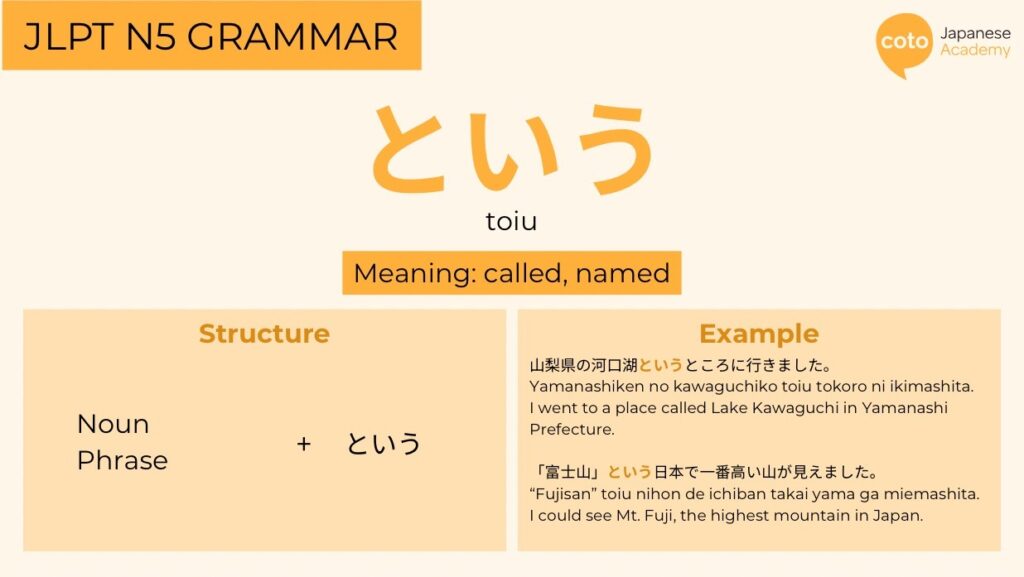
という is a way to define something, someone, or some place that isn’t known to the listener. It connects two nouns in order to introduce, explain, or identify something by name. It often translates into English as “called,” “known as,” or “something/someone called…”.
This is unlike its most basic usage, which is to indicate what someone says or said. For example:
ご飯を食べる前に、「いただきます」と言います。
Gohan wo taberu mae ni, “itadakimasu” to iimasu.
Before we eat, we say “itadakimasu.”
Although 言う (iu) means to ‘say something’, it actually implies that the listener doesn’t know about the information the speaker is talking about, and requires knowledge that isn’t known to them yet.
It is commonly used when:
- Introducing a name
- Explaining a term or concept
- Referring to something someone said
- Describing a category or type
You shouldn’t use this grammar point to define things that are common knowledge; for example, a place like Tokyo or food like sushi; everyone knows what Tokyo or sushi is. Only use this grammar point for things that aren’t common knowledge.
Grammar Structure of という
Below are the common structures in which という is used.
| Structure | Pattern | Meaning |
| Noun + という + Noun | N + という + N | A noun called/known as something |
| Clause + という + Noun | Sentence + という + N | A noun described by a clause |
| Noun + という | N + という | Something called/known as |
| Sentence + という | Sentence + という | It is said that / the statement that |
In simple terms, という works like a label or explanation marker. It links information (a name, phrase, or sentence) to a noun so that it can be described or identified.
For beginners, the most common and easiest pattern is:
Noun + という + Noun
Note that という is usually not used as a complete sentence by itself. It typically connects a word, phrase, or clause to a noun, so it needs to be followed by another word to complete the idea!
日本という国が好きです。
Nihon to iu kuni ga suki desu.
I like the country called Japan.
Here, 日本という describes 国 (country), so the sentence continues and becomes complete.
Because of this, という is usually part of a larger phrase, rather than ending a sentence on its own.
Want to study Japanese with us?
JLPT N5 という Example Sentences
Now that you know how to form sentences using this structure, let’s explore a few example sentences that use という (to iu). As mentioned before, you can use this grammar pattern to define or explain something, someone, or some place that might be unknown to the listener. For example:
私は先週、山梨県の河口湖というところに行きました。
Watashi wa senshuu, yamanashi ken no kawaguchiko to iu tokoro ni ikimashita.
Last week, I went to a place called Lake Kawaguchi in Yamanashi Prefecture.
「富士山」という日本で一番高い山が見えます。
“Fuji san” toiu ichiban takai yama ga miemasu.
I can see Mt. Fuji, the highest mountain in Japan.
You can also use といいます (to iimasu) to introduce something that the listener doesn’t know about.
この場所は日本語で何といいますか。
Kono basho wa nihongo de nanto iimasu ka.
What do you call this place in Japanese?
温泉の名前は「ゆらり」といいます。
Onsen no namae wa “yurari” to iimasu.
The name of the hot spring is called “Yurari.”
More ways to use という
1. ということ (toiu koto)
ということ (toiu koto) is a grammar pattern that is used to convert a phrase into a noun. It can be translated to “A is said to be.”
| Type | Structure |
| Verb (casual form)Noun + だな adjective + だい adjective | Phrase + ということ |
来月帰国するということは本当ですか。
Raigetsu kikokusuru toiu koto wa hontou desu ka.
Is it true you’re going back to your country next month?
2. ということだ (toiu koto da)
This can be translated in English as “I heard that,” “Rumor has it that,” or “It means that.” Use this grammar pattern to talk about something that you heard from another person.
| Type | Structure |
| Verb (plain form)Noun (だ)な adjective (だ)い adjective | Phrase + ということだ |
佐藤さんと木下さんは、結婚したということだ。
Satou san to Kinoshita san wa, kekkonshita toiu koto da.
Rumor has it that Satou-san and Kinoshita-san got married.
このイベントは中止されるということだ。
Kono ibento wa chuushi sareru toiu koto desu.
I heard that the event got cancelled.
3. というのは (toiu no wa)
Use this grammar pattern to define or explain something that isn’t known to the listener. It can be translated as “the meaning of A is B,” or “A, that is to say B.”
| Type | Structure |
| Phrase/noun | Phrase/noun + というのは + definition/explanation/reason |
「自販機」というのは自動販売機の略です。
“Jihanki” toiu no wa jidouhanbaiki no ryaku desu.
“Jihanki” is short for vending machine.
「あざす」というのは「ありがとうございます」の短くした言い方です。
“Azasu” toiu no wa “arigatou gozaimasu” no mijikakushita iikata desu.
“Thanks” is a shortened way to say “thank you very much.”
4. というと (toiu to)
This grammar point can be translated to “speaking of…” in English. Use it in response to remind the speaker of something related to the topic being discussed earlier, or to provide more information on the subject.
| Type | Structure |
| Noun | Noun + というと |
仕事というと、山田さんが仕事を辞めるのを聞いたことがありますか。
Shigoto to iu to, Yamada san ga shigoto wo yameru no wo kiita koto ga arimasu ka.
Speaking of work, did you hear that Yamada-san is leaving their job?
日本料理というと、かけうどんが一番です。
Nihon ryouri toiu to, kakeudon ga ichiban desu.
Speaking of Japanese cuisine, Kake Udon is the best.
Conclusion
という can be useful for explaining information that others might not know about, whether it be talking about a niche place you want to introduce others to, a person of interest, or something that listeners might not be aware of. Try using it the next time you want to talk about your favorite things!
Learn More JLPT Grammar with Coto Academy!
Coto academy has been offering Japanese classes for over 25 years, with campuses in Shibuya, Yokohama, Iidabashi, Minato, Shinjuku, and online. Our courses focus on practical Japanese, so the grammar you learn is designed for real-life use.
We offer part-time, intensive, and fully online lessons to suit your schedule. Start learning Japanese effectively and confidently with Coto Academy today! Fill out the form below for a free level check.
FAQ
What does という (toiu) mean?
という (toiu) means to “say something,” but in this context, this means to describe, define, or explain something that isn’t known to the listener.
How do you use という (toiu) in a sentence?
You can use という to define or explain something to the listener, for example, when you’re describing a place that isn’t common knowledge, or a food not everyone knows about.
When should you not use という (toiu)?
Don’t use という when the place, thing, or someone you’re defining or explaining is common knowledge.
You may be interested in:
- らしい (Rashii): Meaning, Explanation, Example
- もし〜たなら (Moshi ~ Tanara) Meaning, Explanation, Example
- 〜に決まっている (~Ni Kimatte Iru): “Obviously” or “It Must Be” in Japanese
- て仕方がない (Te Shikata ga Nai): “Can’t Help But..” in Japanese
- 気味 (Gimi): Saying “Seems” or “Tends to Be” in Japanese
- ので (Node): Because in Japanese