





Numbers in Japanese can be confusing because they use 2 different counting systems, and numbers themselves must be conjugated into one of them. The good news is that counting from 1 to 10 is actually the hardest part since everything after that gets much easier, even when counting up to a million or even a hundred million. However, where things get tricky is when you need to count different types of things, like people or different objects, but once you understand the patterns, it becomes surprisingly intuitive!
In this comprehensive guide, we’ll walk you through everything you need to know about the Japanese number system, including both the Sino-Japanese readings (onyomi) and native Japanese readings (kunyomi), and how to count from basic digits all the way to massive numbers like 1,000,000,000.
Want to improve your pronunciation as you learn to count? Check out our guide to Japanese pronunciation. Don’t forget to watch our YouTube video about it, too!
Basics of Japanese Numbers and How They Work
Japanese numbers come in two main readings: native Japanese numbers, called wago, and Chinese-based numbers, called kango. While they use the same kanji characters, their pronunciation and usage change based on what you are counting.
Kango, the system featuring ichi, ni, san, is the mathematical and technical standard used for things like phone numbers, years, and formal measurements. It is almost always paired with a specific “counter” suffix that denotes the object’s category, such as -mai for flat things or -nin for people. This makes the Kango system highly precise but also linguistically complex because you must know the correct counter for every noun you encounter. For example:
- にん (nin) is used for people
- まい (mai) is used for flat things like paper
- ほん (hon) is used for long, thin things like pencils or bottles
- ふん (hun) is used for counting minutes
- じ (ji) is used for counting hours
| Numbers | 人 (nin): People | 枚 (mai): Flat Objects | 本 (hon): Long, Thin Things | 分 (hun): Minutes | 時 (ji): Hours |
|---|---|---|---|---|---|
| 1 (ichi) | 1人 (hitori) | 1枚 (ichimai) | 1本 (ippon) | 1分 (ippun) | 1時 (ichiji) |
| 2 (ni) | 2人 (futari) | 2枚 (nimai) | 2本 (nihon) | 2分 (nifun) | 2時 (niji) |
| 3 (san) | 3人 (sannin) | 3枚 (sanmai) | 3本 (sanbon) | 3分 (sanpun) | 3時 (sanji) |
| 4 (yon) | 4人 (yonin) | 4枚 (yonmai) | 4本 (yonhon) | 4分 (yonpun) | 4時 (yoji) |
| 5 (go) | 5人 (gonin) | 5枚 (gomai) | 5本 (gohon) | 5分 (gofun) | 5時 (goji) |
| 6 (roku) | 6人 (rokunin) | 6枚 (rokumai) | 6本 (roppon) | 6分 (roppun) | 6時 (rokuji) |
| 7 (nana/shichi) | 7人 (shichinin) | 7枚 (nanamai) | 7本 (nanahon) | 7分 (nanafun) | 7時 (shichiji) |
| 8 (hachi) | 8人 (hachinin) | 8枚 (hachimai) | 8本 (happon) | 8分 (happun) | 8時 (hachiji) |
| 9 (kyuu/ku) | 9人 (kyuunin) | 9枚 (kyuumai) | 9本 (kyuuhon) | 9分 (kyuufun) | 9時 (kuji) |
| 10 (juu) | 10人 (juunin) | 10枚 (juumai) | 10本 (juppon) | 10分 (juppun) | 10時 (juuji) |
So if you want to say “three people,” you say さんにん (sannin), and for “three pencils,” it’s さんぼん (sanbon). Notice how the pronunciation changes a little to sound smoother, particularly for the numbers 1, 3, 6, and 8 when using the 本 (hon) and 分 (hun) counters. Learning counters is important because you can’t just say numbers alone when counting things in Japanese. But don’t worry. Once you get used to it, it becomes easy! Dive into our complete guide on Japanese counters to learn more about that.
In contrast, Wago acts as a “universal counter” that is incredibly helpful for language learners. The system consists of the familiar hitotsu, futatsu, mittsu sequence, and is generally used only for the numbers one through ten. Because Wago numbers already have a counting suffix built into them (the “tsu” at the end), they can stand alone without a specialized counter word.
Don’t forget that it is always better to learn Japanese with a native Japanese tutor! Want to learn all the essential Japanese numbers and start speaking with confidence? Join our part-time or intensive Japanese lessons at Coto Academy — Tokyo’s leading language school. Get in touch for a free level check and course consultation today!
Even though Arabic numerals still use commas every three digits when written, the way Japanese people mentally group numbers is by four digits. This difference can be confusing and takes some getting used to for language learners!
Japanese numbers also come with two main reading systems:
Counting 1 – 10 in Japanese
Here’s a table that shows Japanese numbers 1 to 10 in both 和語 (wago) — native Japanese numbers — and 漢語 (kango) — Sino-Japanese (Chinese-derived) numbers:
| Number | Wago (Native Japanese) | Kango (Sino-Japanese) |
|---|---|---|
| 1 | ひとつ (hitotsu) | いち (ichi) |
| 2 | ふたつ (futatsu) | に (ni) |
| 3 | みっつ (mittsu) | さん (san) |
| 4 | よっつ (yottsu) | し (shi) / よん (yon) |
| 5 | いつつ (itsutsu) | ご (go) |
| 6 | むっつ (muttsu) | ろく (roku) |
| 7 | ななつ (nanatsu) | しち (shichi) / なな (nana) |
| 8 | やっつ (yattsu) | はち (hachi) |
| 9 | ここのつ (kokonotsu) | きゅう (kyuu) / く (ku) |
| 10 | とお (too) | じゅう (juu) |
Kunyomi: Native Japanese Numbers (1–10)
Wago numbers are mainly used for counting general items (especially up to 10), the ages of small children, and traditional Japanese contexts. If you are at a restaurant or shop and want to order a specific number of items (especially those that don’t have a distinct counter like “bottles” or “sheets”), you use wago up to 10.
When telling someone’s age, you can use the counter -sai (kango), but it is very common to use wago for young children or in casual conversation.
The final function of wago is its use in the Japanese calendar. The first 10 days of the month (and the 20th) use the native wago pronunciation rather than the kango and nichi pattern. For example, instead of saying ninichi to denote the first day of the month, you pronounce it as futsuka (二日), from the word futatsu.
Example:
お菓子をひとつください。
Okashi o hitotsu kudasai.
Please give me one snack.
Kunyomi numbers are rarely used beyond 10. For everything else, we use the more common Sino-Japanese system.
Onyomi: Sino-Japanese Numbers (1–10)
Kango numbers are used in most modern and formal contexts, like times, phone numbers, prices, and mathematics.
Example:
紙を一枚ください。
Kami o ichimai kudasai.
Please give me one sheet of paper.
Read More: Basic Japanese Words to Know
Irregular Japanese Number Readings
In Japanese, while most numbers follow regular patterns, the numbers 4, 7, and 9 are famous for having multiple readings that change depending on the counter and context. This happens because these numbers have both a native Japanese reading (wago) and a Chinese-derived reading (kango), and sometimes one is avoided due to cultural superstitions.
For example, the number 4 can be read as し (shi) or よん (yon), but よん is preferred because し sounds like the word for death (死), which is considered unlucky. Similarly, 7 is read as しち (shichi) or なな (nana), with なな commonly used in daily speech to avoid confusion with the number 1 (いち).
| Number | Irregular / Preferred Reading |
|---|---|
| 4 | よん (yon) |
| 7 | なな (nana) |
| 9 | きゅう (kyuu) |
| 1 & 2 (people) | ひとり (hitori), ふたり (futari) |
The “correct” reading depends entirely on the following counter. For example, when telling the time in Japanese, 4:00 is always yo-ji (a shortened version of yon), while 7:00 is usually shichi-ji, and 9:00 is ku-ji. Because these rules are so specific, most learners memorize these particular numbers as part of a set with their counters rather than trying to apply a single rule.
There are also pronunciation changes when numbers combine with counters to make speech smoother, like the ones below!
| Number | Japanese (Kanji) | Reading (Hiragana) | Reading (Romaji) |
|---|---|---|---|
| 300 | 三百 | さんびゃく | sanbyaku |
| 600 | 六百 | ろっぴゃく | roppyaku |
| 800 | 八百 | はっぴゃく | happyaku |
| 3000 | 三千 | さんぜん | sanzen |
| 8000 | 八千 | はっせん | hassen |
Examples:
- 12: (じゅうに) juu-ni
- 157: (ひゃく ごじゅう なな) hyaku go-juu nana
- 1861: (せん はっぴゃく ろくじゅう いち) sen happyaku roku-juu ichi
Counting Double-Digit Numbers in Japanese: 10 – 100
Counting double-digit numbers in Japanese is simple once you understand the pattern. To form these numbers, you start with the number for the tens place, followed by じゅう (juu), which means “ten.”
For example, 20 is にじゅう (ni-juu), meaning “two tens,” and 30 is さんじゅう (san-juu), meaning “three tens.” If the number has a digit in the ones place, you simply add it after the tens. So, 21 becomes にじゅういち (ni-juu-ichi), and 47 becomes よんじゅうなな (yon-juu-nana). If there’s no number in the ones place — like in 10, 20, or 30 — you just say the tens part: じゅう (juu), にじゅう (ni-juu), さんじゅう (san-juu), and so on. This system continues consistently, making it easy to build up to higher numbers once you know the basic 1–10.
| Number | Japanese Reading | Breakdown |
|---|---|---|
| 11 | じゅういち (juu ichi) | 10 + 1 |
| 27 | にじゅうなな (ni juu nana) | 20 + 7 |
| 38 | さんじゅうはち (san juu hachi) | 30 + 8 |
| 49 | よんじゅうきゅう (yon juu kyuu) | 40 + 9 |
| 50 | ごじゅう (go juu) | 5 × 10 |
You’ll notice that after the number 10, Japanese typically uses the preferred pronunciations for 4, 7, and 9 — that is, yon, nana, and kyuu — instead of shi, shichi, or ku. This is especially true for double-digit numbers. For example, 40 is read as yon juu, not shi juu, to avoid the negative connotations associated with shi (death) and ku (suffering). Once you have a solid grasp of numbers 1 to 10 and understand which readings are preferred, it becomes much easier to count larger numbers and form double-digit combinations naturally.
Check out the table below for the numbers 10 – 90.
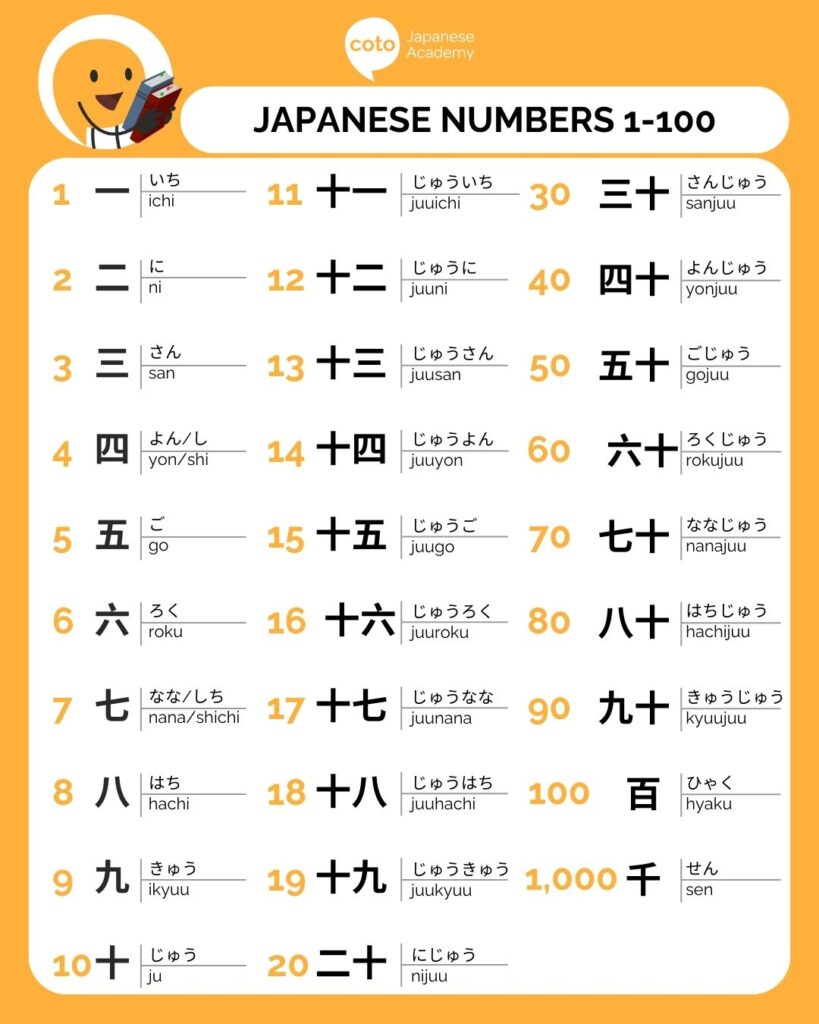
| Number | Kanji | Hiragana | Romaji |
|---|---|---|---|
| 10 | 十 | じゅう | juu |
| 20 | 二十 | にじゅう | nijuu |
| 30 | 三十 | さんじゅう | sanjuu |
| 40 | 四十 | よんじゅう | yonjuu |
| 50 | 五十 | ごじゅう | gojuu |
| 60 | 六十 | ろくじゅう | rokujuu |
| 70 | 七十 | ななじゅう | nanajuu |
| 80 | 八十 | はちじゅう | hachijuu |
| 90 | 九十 | きゅうじゅう | kyuujuu |
Counting Numbers in Japanese from 100 to 900
Counting in Japanese from 100 to 900 is straightforward. To count by hundreds, you take the number (1–9) and add ひゃく (hyaku), which means “hundred.”
Note that in Japanese, the numbers 300, 600, and 800 do not follow the regular pattern of simply adding hyaku (ひゃく). Instead, they undergo sound shifts to make pronunciation smoother. For 300, san-hyaku changes to sanbyaku (さんびゃく), where the “h” sound becomes a “b” sound. For 600, roku-hyaku becomes roppyaku (ろっぴゃく), with a doubled consonant sound (small っ) and the “h” shifting to a “p” sound. Similarly, 800 changes from hachi-hyaku to happyaku (はっぴゃく), also using a doubled consonant and a “p” sound.
| Number | Japanese Reading | Notes |
|---|---|---|
| 100 | ひゃく (hyaku) | Base form |
| 200 | にひゃく (ni-hyaku) | Regular pronunciation |
| 300 | さんびゃく (san-byaku) | Sound change for easier pronunciation |
| 400 | よんひゃく (yon-hyaku) | Uses “yon” instead of “shi” |
| 500 | ごひゃく (go-hyaku) | Regular pronunciation |
| 600 | ろっぴゃく (roppyaku) | Small つ (っ) added, sound shift |
| 700 | ななひゃく (nana-hyaku) | Uses “nana” instead of “shichi” |
| 800 | はっぴゃく (happyaku) | Small つ (っ) added, sound shift |
| 900 | きゅうひゃく (kyuu-hyaku) | Regular pronunciation |
Read More: Guide on Double Consonants and Long Vowels in Japanese
Reading Larger Numbers in Japanese: 10,000 to 1,000,000,000
The Japanese counting system is still based on a base-10 structure, just like English, but the units are grouped differently, especially beyond 10,000.
Unlike English, which groups numbers by thousands (thousand, million, billion), Japanese groups by myriad units. In English, we count large numbers by thousands: 1,000 is one thousand, 1,000,000 is one million, and 1,000,000,000 is one billion. But in Japanese, the system is different. The key unit is 10,000, not 1,000. This unit is called 万 (まん or man). Ten thousand “man” makes the next unit: 億 (おく or oku), which is 100 million.
There are no in-between units like in English, so it jumps from man (10,000) to oku (100 million). This means numbers like 100,000 or 1,000,000 don’t have their own unique names; they are just “multiples of ten thousand.”
For example, to say 100,000, a Japanese speaker thinks of it as “ten blocks of ten thousand,” which becomes 十万 (juuman). When you move up to 1,000,000, the logic follows the same stacking principle: it is “one hundred blocks of ten thousand,” or 百万 (hyakuman).
The main units are:
| Japanese Unit | Kanji | Value |
|---|---|---|
| まん (man) | 万 | 10,000 |
| おく (oku) | 億 | 100 million |
| ちょう (chou) | 兆 | 1 trillion |
| けい (kei) | 京 | 10 quadrillion |
This stacking continues all the way up to 10,000,000, which is “one thousand blocks of ten thousand,” known as 千万 (sen-man). It is only when you reach 100,000,000, or “ten thousand blocks of ten thousand,” that the man unit is finally “full,” and the language introduces a brand-new word: 億 (oku).
| Number | Japanese (Kanji) | Reading (Romaji) |
|---|---|---|
| 10,000 | 一万 | ichi-man |
| 100,000 | 十万 | juu-man |
| 1,000,000 | 百万 | hyaku-man |
| 10,000,000 | 千万 | issen-man |
| 100,000,000 | 一億 | ichi-oku |
| 1,000,000,000 | 十億 | juu-oku |
| 1,000,000,000,000 | 一兆 | icchou |
Example:
- 320,000 = san-juu ni man (さんじゅう に まん)
- 18,257 = ichi-man hassen ni-hyaku go-juu nana (いちまん はっせん にひゃく ごじゅう なな)
How to Say Zero in Japanese
In Japanese, zero is commonly said as ゼロ (zero), borrowed from English, or れい (rei), which is the native Japanese word often used in counting and formal contexts. Both are correct, but ゼロ is more common in everyday speech and measurements. Maru should only be used when you are referring to zero as a number for phone numbers or codes, although the same word is also used to denote that something is correct.
- ゼロ (zero): Common, borrowed from English
- まる (maru): Used in phone numbers or codes
- 零 (rei): Formal but rarely used in speech
Example:
- 郵便番号は102-0072です。
- Yuubin bango wa ichi maru ni no maru maru nana ni desu.
- My postcode is 102-0072.
Do Japanese Use Arabic Numerals?
Nowadays, you might notice that Japanese people use Arabic numerals (1, 2, 3) in almost every aspect of daily life, including prices, phone numbers, and writing the time.
This is because Arabic numerals are the standard for horizontal writing, such as on digital screens, in newspapers, and on price tags at most retail stores.
But in traditional establishments, like high-end restaurants and izakaya, kanji numbers are often used to maintain an aesthetic of elegance and heritage. You might also notice that they write the text vertically, instead of horizontally, and read from right to left, instead of left to right.
However, you will still see Japanese kanji used for numbers in specific traditional or formal contexts. You will also see kanji numbers used on legal documents, certificates, and paper currency to prevent fraud, as it is much harder to alter a complex kanji character than it is to change a “1” into a “7” with a single stroke of a pen. Additionally, certain fixed expressions and compound words are always written in kanji, even in modern text.
Understanding numbers is just one part of mastering Japanese. To count things properly, you’ll also need to learn counters — like 本 (for long objects), 個 (for small items), and 枚 (for flat objects).
Conclusion: Japanese Numbers are Easier to Remember than You Think!
Remembering how to say numbers in Japanese might seem a bit overwhelming to remember, especially since you have to conjugate numbers depending on what you’re counting. However, the first 10 numbers are where the most differences lie, so all you have to remember is the correct counter! Don’t worry; as you get used to speaking Japanese, you will start to quickly build an intuition for using the right counter and conjugating numbers as needed!
Want to go beyond numbers? Learn Japanese at Coto Academy!
Ready to go beyond the basics? At Coto Academy, we offer a variety of courses designed to help you do just that, whether you’re a complete beginner or looking to level up your skills.
Have questions? Send us an inquiry. We’re happy to help!
FAQ
How do you count from 1 to 10 in Japanese?
You can use either Sino-Japanese (ichi, ni, san…) or native Japanese (hitotsu, futatsu…). The Sino-Japanese system is more common and used with counters.
What does 'man' mean in Japanese numbers?
Man (万) means 10,000. Unlike English, Japanese numbers are grouped by ten-thousands instead of thousands. For example, 20,000 is ni-man (二万).
Why are there two readings for Japanese numbers?
Japanese has Sino-Japanese (onyomi) readings from Chinese and native Japanese (kunyomi) readings. The context (counting objects, reading dates, math) determines which to use.
How do you say 100,000 in Japanese?
100,000 is said as juu-man (十万), which means “ten ten-thousands” — because Japanese groups numbers by 10,000 units.
Do Japanese people use kanji for numbers?
In daily life, Arabic numerals (1, 2, 3) are common. Kanji (一, 二, 三) are used in formal documents, banking, and legal writing.