


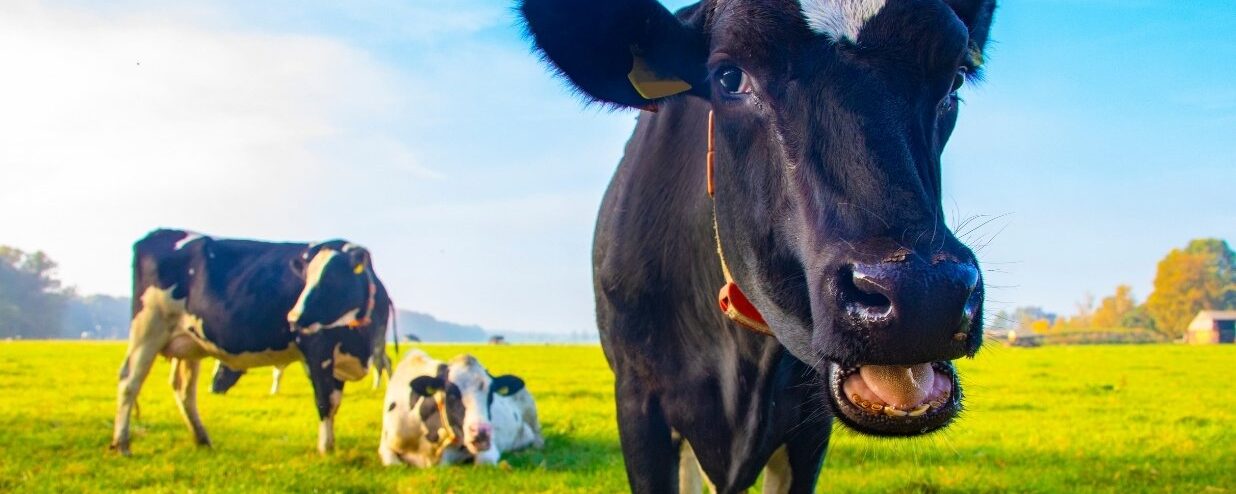


Ever want to learn some fun Japanese onomatopoeia? Onomatopoeia is a word created from the vocal imitation of the sound associated with it. Think the bees buzz, the cat meows, and the cow moos. They’re all taken from the things we hear, right? Now, Japanese onomatopoeia takes it to the next level. In fact, there are 4,500 existing onomatopoeia that not only describe sounds but also feelings, atmospheres, and even situations.
Although the English language doesn’t incorporate many onomatopoeic words, you’d be surprised to know you’ve probably been using them this whole time when speaking Japanese. The truth is, 4,500 is a big number, but we’re not expecting (or demanding) you to know all of them — we’ll even bet not all Japanese people know every last bit.
Still, think of onomatopoeia as an earworm. A lot of them are catchy and repetitive, like piyo piyo and zara zawa, which makes learning them fun. So, let’s dive into what onomatopoeia are, how they are used in Japanese, and the most common Japanese onomatopoeia!
What is Japanese Onomatopoeia & How is it Used?
Japanese onomatopoeia are known in Japanese as オノマトペー (onomatopee). Just like in English with words like tick-tock, boom, or bang, onomatopoeia mimics sounds you can hear. But in Japanese, they can also attribute sounds to emotions, sensations, movements, or even different situations. They generally consist of a pair of two-syllable words that repeat, such as ピカピカ (pika pika), made famous by Pikachu, meaning “shiny” or “brand new.”
Onomatopoeia are used all the time in everyday Japanese conversation, perhaps even more than in English. They are ingrained in everyday Japanese expressions because there are more types of onomatopoeia than in languages like English.
What Are the Types of Japanese Onomatopoeia?
Onomatopoeia is stereotypically cartoon-ish, but the Japanese language takes them seriously. Japanese onomatopoeias are unique as they use not only words to mimic the sound, but feelings and situations as well. Onomatopoeia plays a huge part in Japanese people’s casual speech. For instance, words such as “ゆっくり, yukkuri” (slowly) or “色々, iro iro” (variety) are common onomatopoeia used.
They’re broken down into five groups
- Animal and human sounds: Giseigo (擬声語)
- Sounds made by inanimate objects and nature: Giongo (擬音語)
- Sounds to describe conditions and states: Gitaigo (擬態語)
- Sounds to describe movements and motions: Giyougo (擬容語)
- Sounds to describe feelings: Gijougo (擬情語)
Of the five types of onomatopoeia, giseigo and giongo are the only two that the English language has. They represent sounds you can hear, like a hissing snake or a buzzing bee.
Check out our more complete common animal onomatopoeia used by the Japanese.
Want to study Japanese with us?
Japanese Onomatopoeia and How They Are Used
To spice up your Japanese conversation, include onomatopoeias here and there — it’ll be like adding colors to your drawing, making it more lively.
Sometimes, instead of rummaging your mind for an appropriate vocabulary, it would be simpler to just use an onomatopoeia. It is also easier for the listener to visualize your speech. For example, peko peko sounds more catchy and therefore more memorable than お腹がすいた (onaka ga suita).
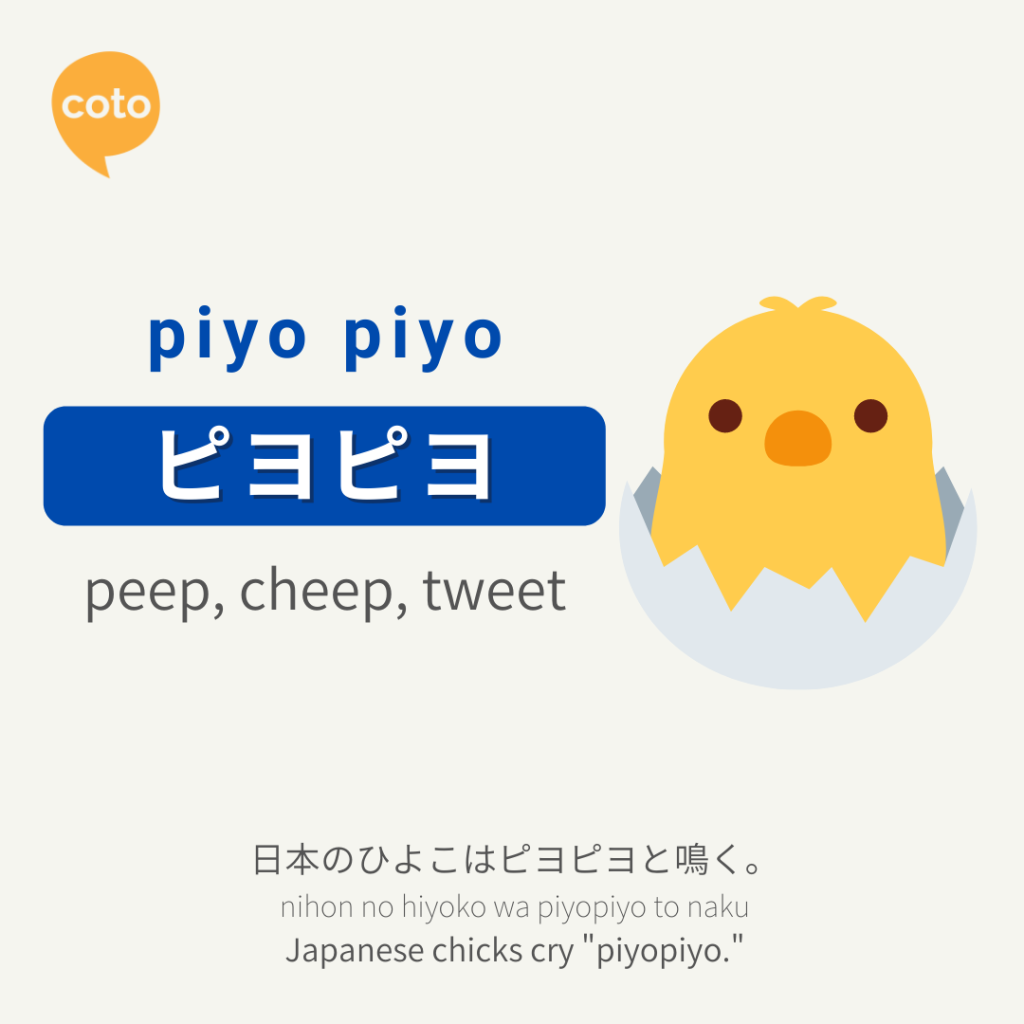
1. Piyo Piyo (ピヨピヨ)
Piyo Piyo, meaning peep or chirp, sounds like a chick chirping.
Example Sentences:
見て!ひよこはピヨピヨ鳴いてる!可愛い!
mite! hiyoko wa piyo piyo natte iru! kawaii!
Look! The chick chirping “piyo piyo” is so cute!
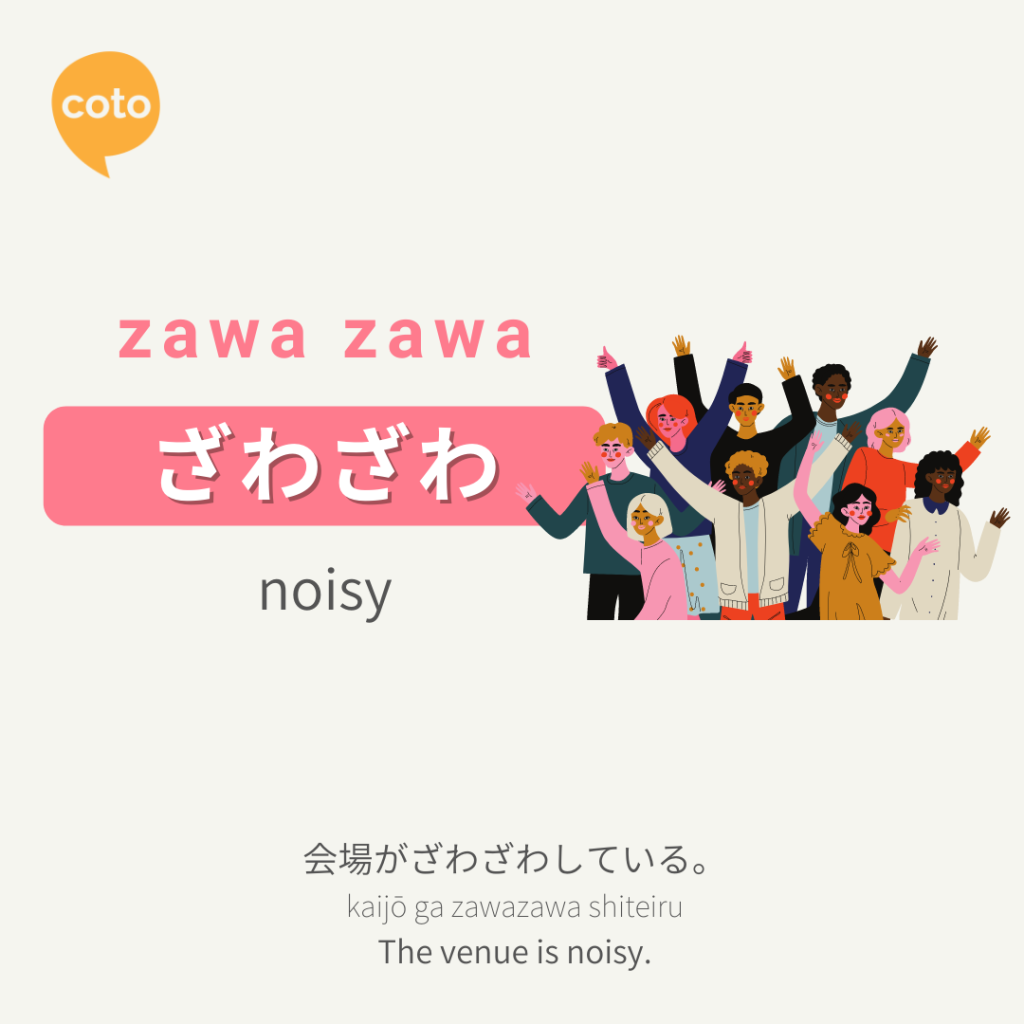
2. Zawa Zawa (ざわざわ)
Zawa zawa, meaning noisy, is meant to sound like a lot of people talking at once.
Example Sentence:
先生が来る前にクラスはざわざわしていた。
sensei ga a mae ni kurasu wa zawa zawa shiteita.
The class was noisy before the teacher came.
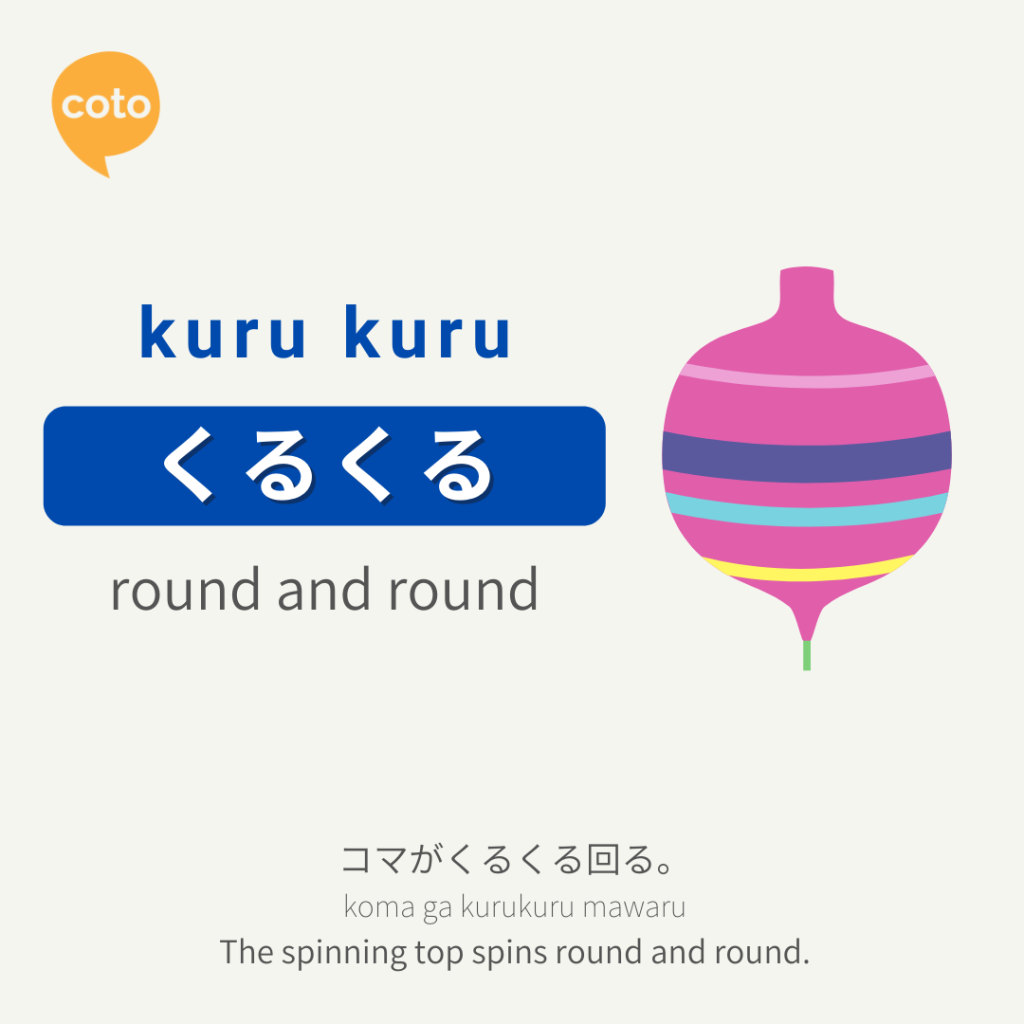
3. Kuru Kuru (くるくる)
Kuru Kuru, meaning round and round, sounds like something rotating or spinning round and round.
Example Sentence:
目がくるくると回る。
me ga kuru kuru to mawaru.
My eyes are spinning round and round.
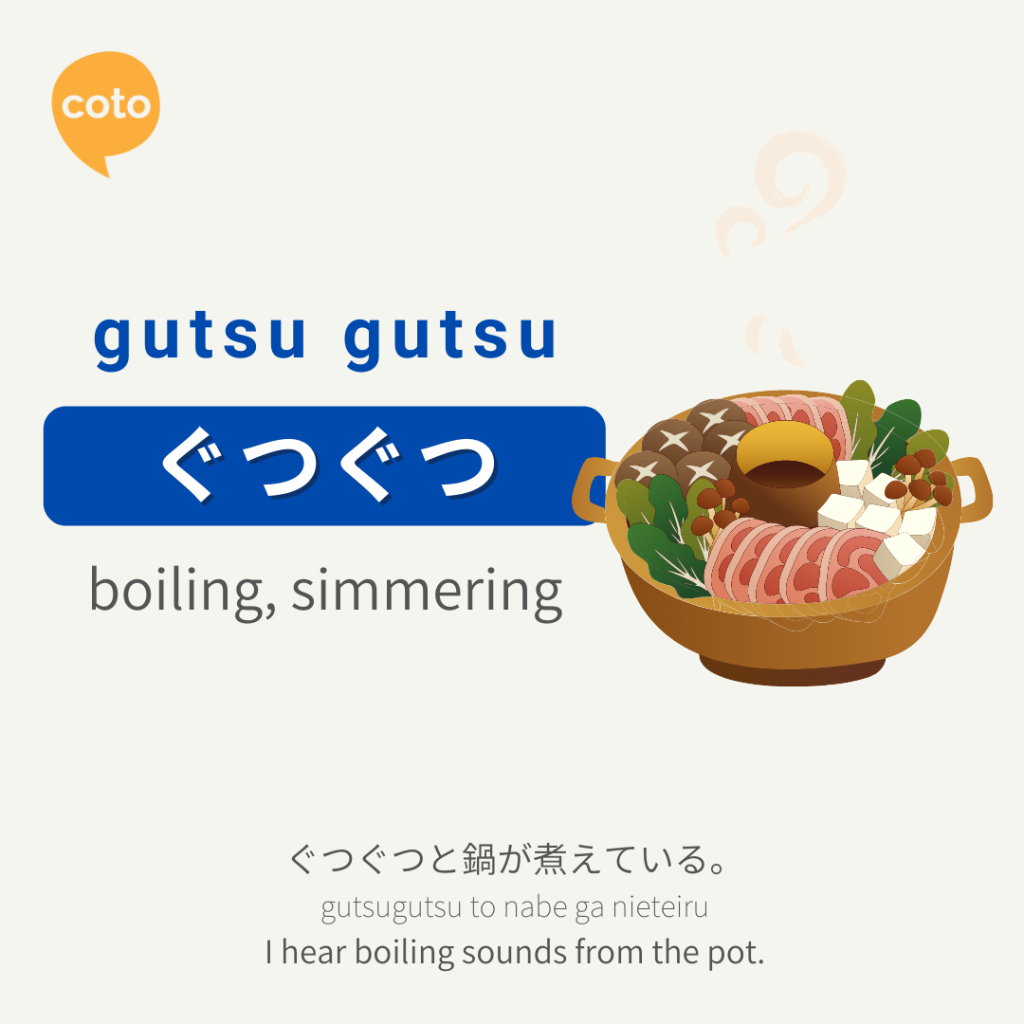
4. Gutsu Gutsu (ぐつぐつ)
Gutsu Gutsu, meaning boiling or simmering, sounds like water boiling.
Example Sentence:
スープがぐつぐつ煮えている。
suupu ga gutsu gutsu nieteiru
The soup is boiling.
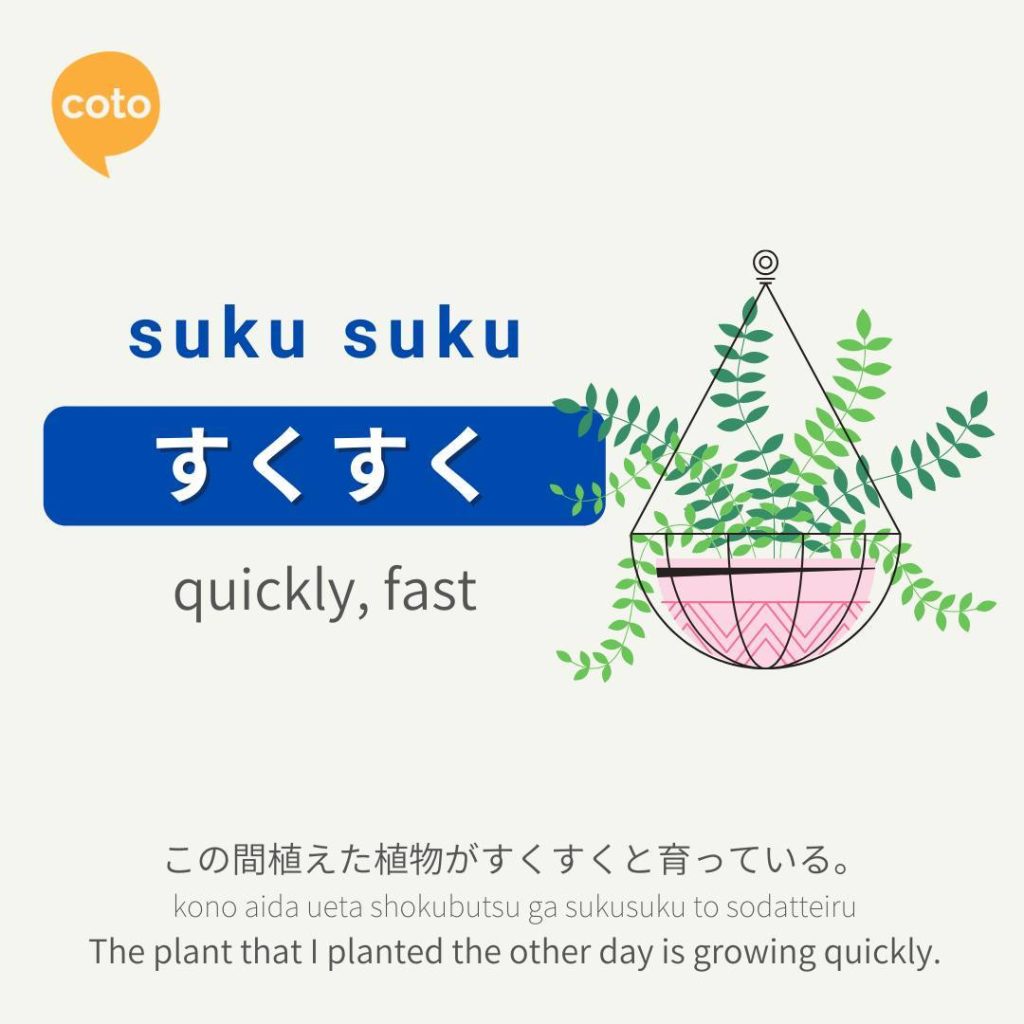
5. Suku Suku (すくすく)
Suku Suku, meaning quick or fast, is usually used when growing or getting up.
Example Sentence:
子供はあっという間にすくすくと成長する。
kodomo wa atto iu ma ni suku suku to seichou suru.
Children grow up so quickly (and healthily) in a blink of an eye.
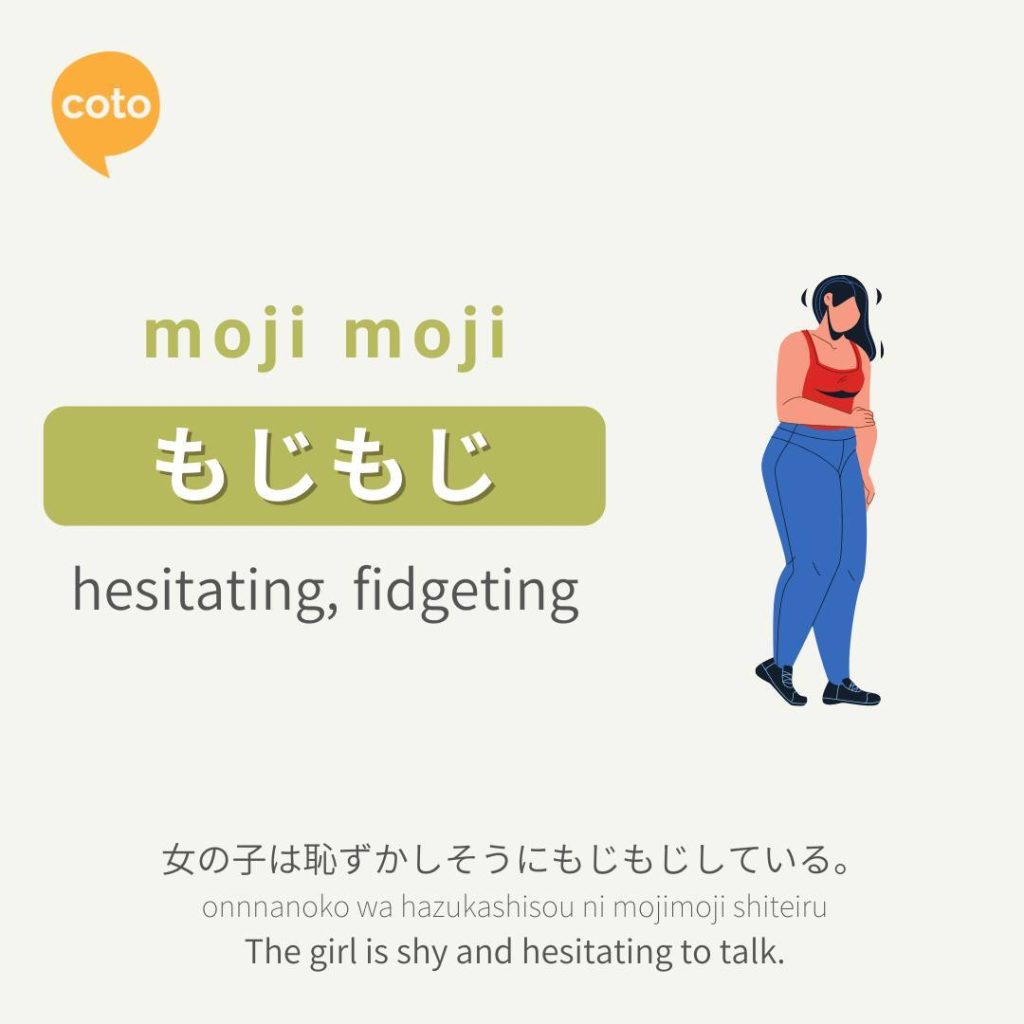
6. Moji Moji (もじもじ)
Moji moji, meaning hesitating or fidgeting, sounds like someone fidgeting.
Example Sentence:
大勢の前で話すので、緊張してもじもじしている
ozei no mae de hanasu node, kinchou shite moji moji shiteiru.
I fidget because I am nervous about speaking in front of a large crowd.
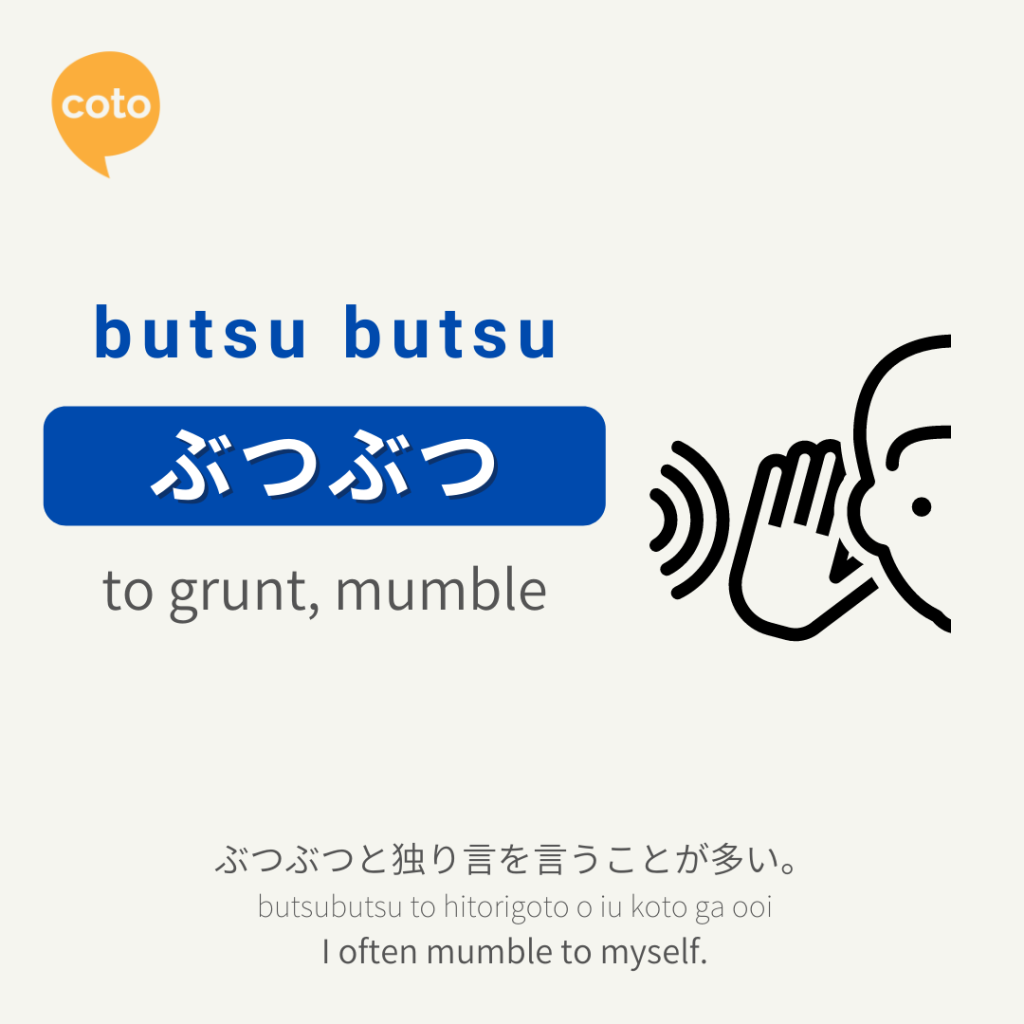
7. Butsu Butsu (ぶつぶつ)
Butsu Butsu, meaning to grunt or mumble, sounds like someone speaking in a low voice, or mumbling.
Example Sentence:
ぶつぶつと独り言を言うことが多い。
butsu butsu to hitorigoto o iu koto ga ooi.
I often mumble to myself.
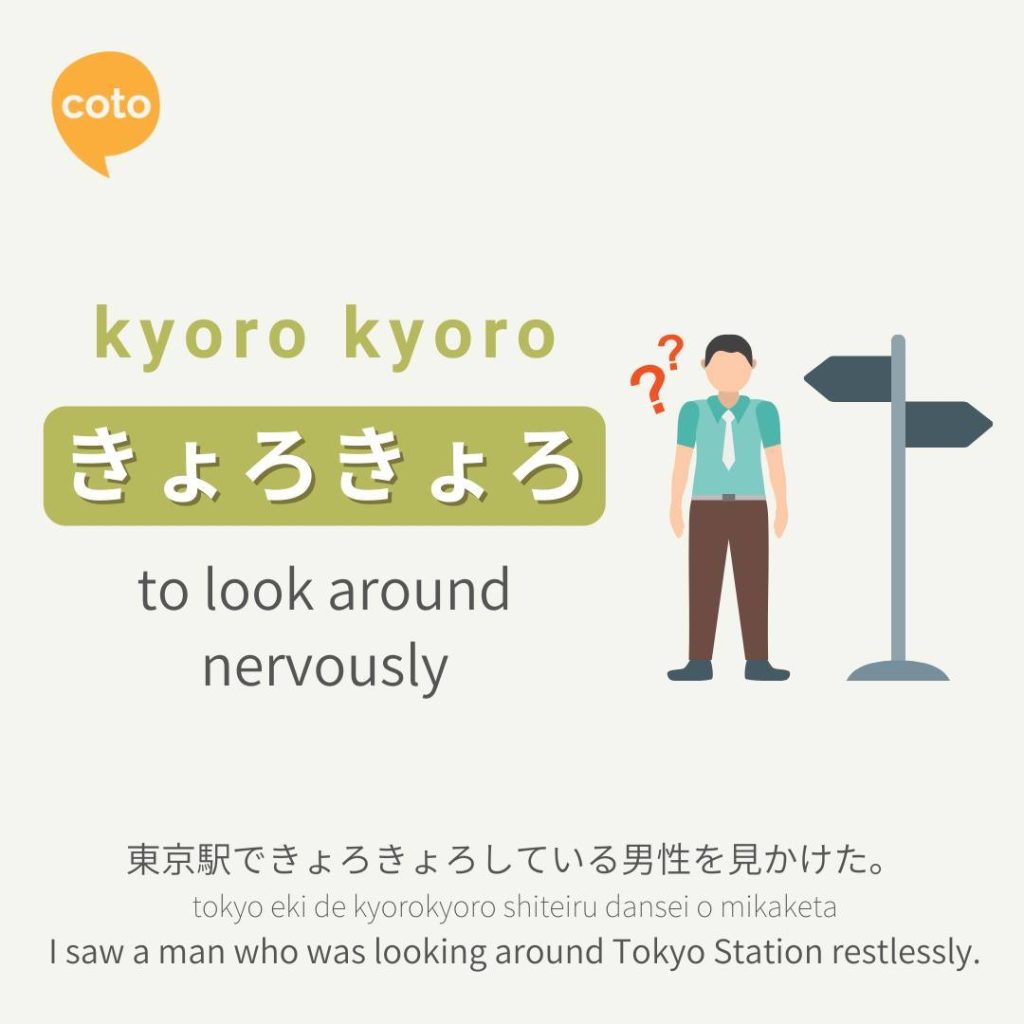
8. Kyoro Kyoro (きょろきょろ)
Kyoro Kyoro, meaning to look around nervously, is meant to sound like someone looking around.
Example Sentence:
お店の中できょろきょろしてたら、不審者に見えた。
o mise no naka de kyoro kyoro shitetara, fushinsha ni mieta.
If I had looked around nervously in a shop, I would look like a suspicious person
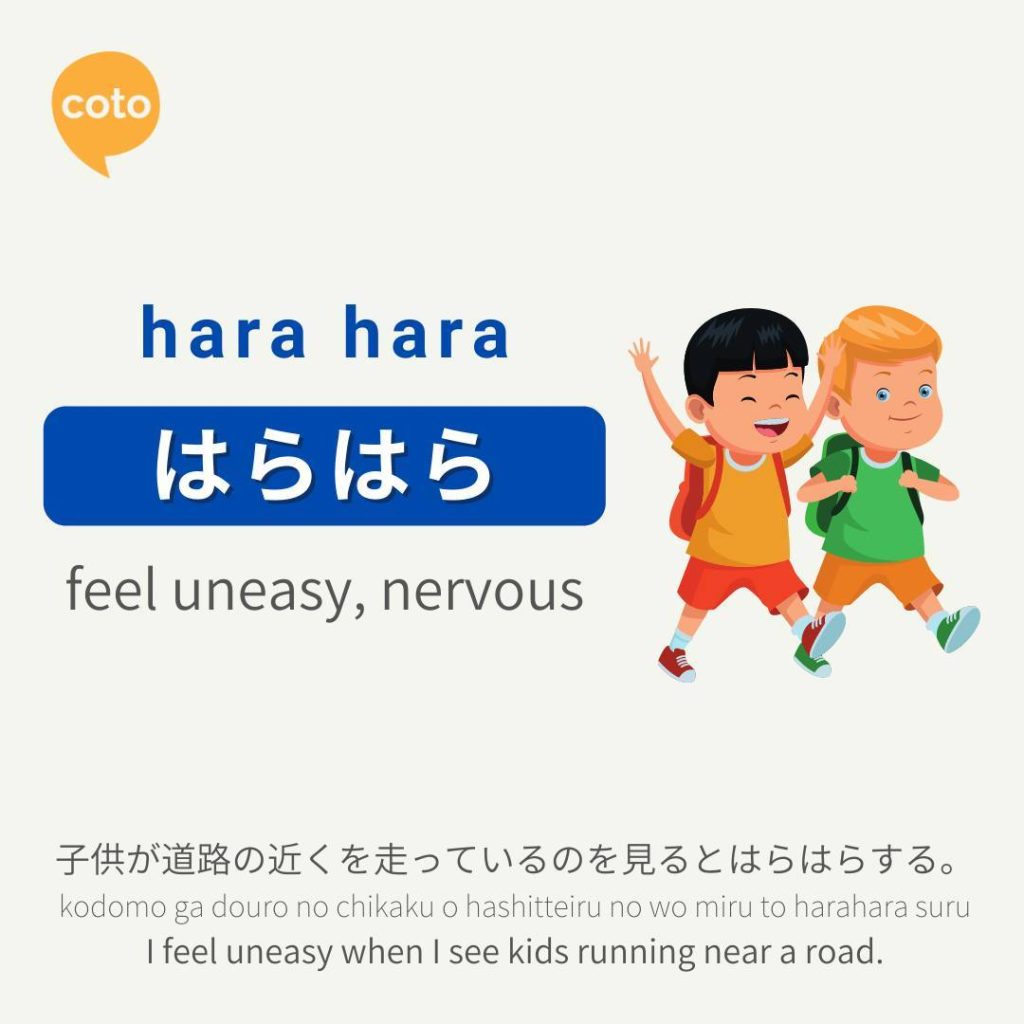
9. Hara Hara (はらはら)
Hara Hara, meaning to feel uneasy or nervous, sounds like a heart beating. Not to be confused with Hira Hira (ひらひら), meaning flutter.
Example Sentence:
偉い人が集まるパーティで自分が失礼なことしないかどうかハラハラする。
erai hito ga atsumaru pāti de jibun ga shitsureina koto shinai ka dō ka harahara suru.
It was a party with a lot of distinguished guests so I was nervous that I might screw something up.
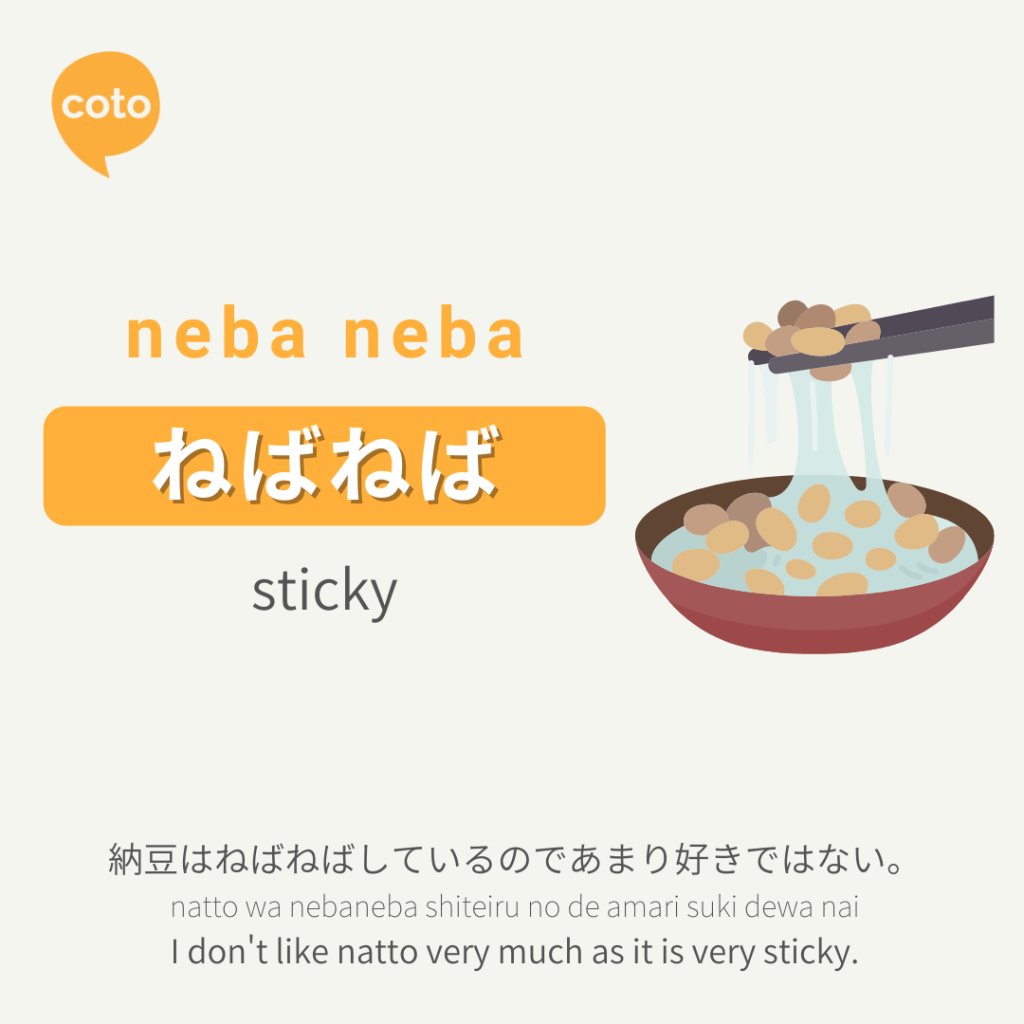
10. Neba Neba (ねばねば)
Neba neba means sticky or viscous. It’s commonly used to describe natto.
Example Sentence:
納豆、オクラ、山芋などのねばねばしてる食べ物はタンパク質が高いのだ。
nattou, okura, yamaimo nado no neba neba shiteru tabemono ha tanpaku shitu ga takai noda.
Sticky foods such as nattou, okura (lady fingers) and yam are high in protein.
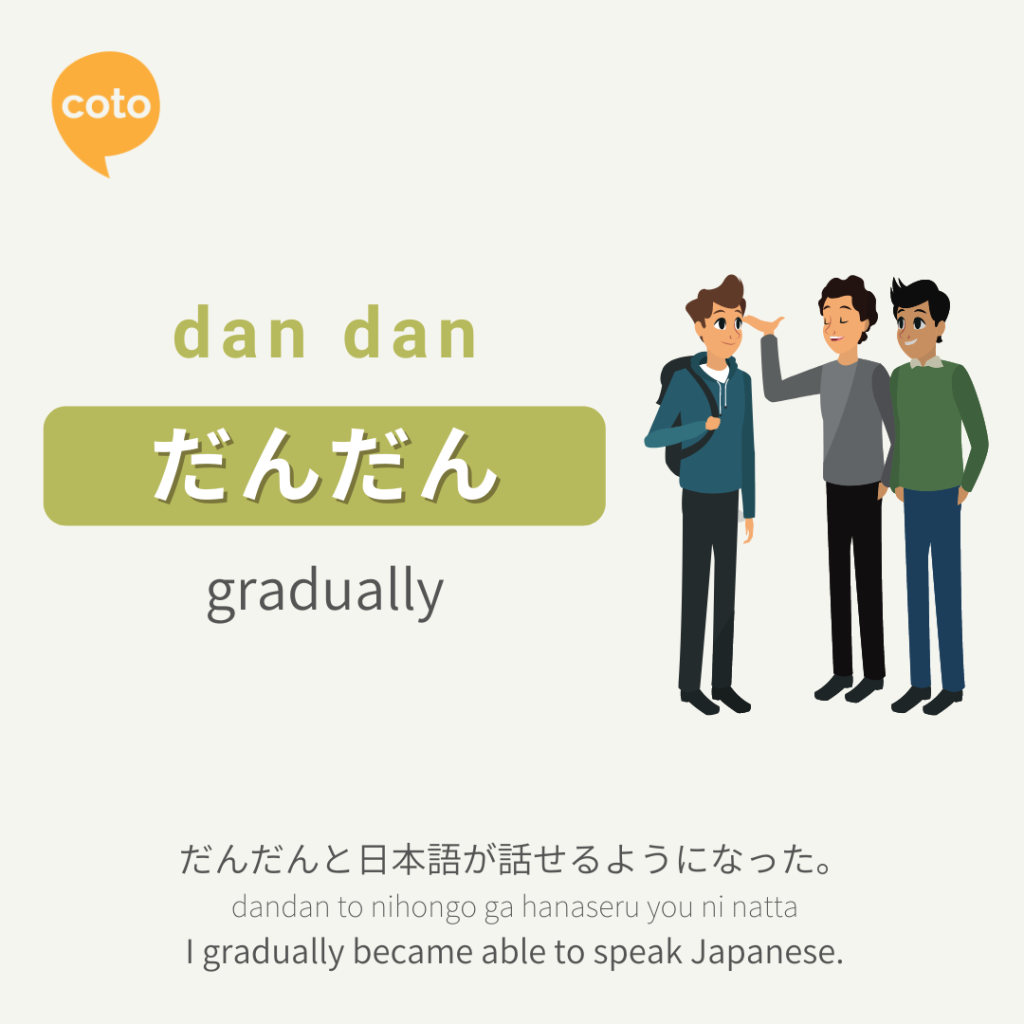
11. Dan Dan (だんだん)
Dan Dan, meaning gradually or little by little. As an onomatopoeia, だん is also used to describe a sudden impact like the English ‘bam‘ or ‘bang.‘
Example Sentence:
冬になるとだんだん暗くなるのが早くなる。
fuyu ni naruto dan dan kuraku naru no ga hayakunaru.
It gradually becomes darker more quickly during winter.
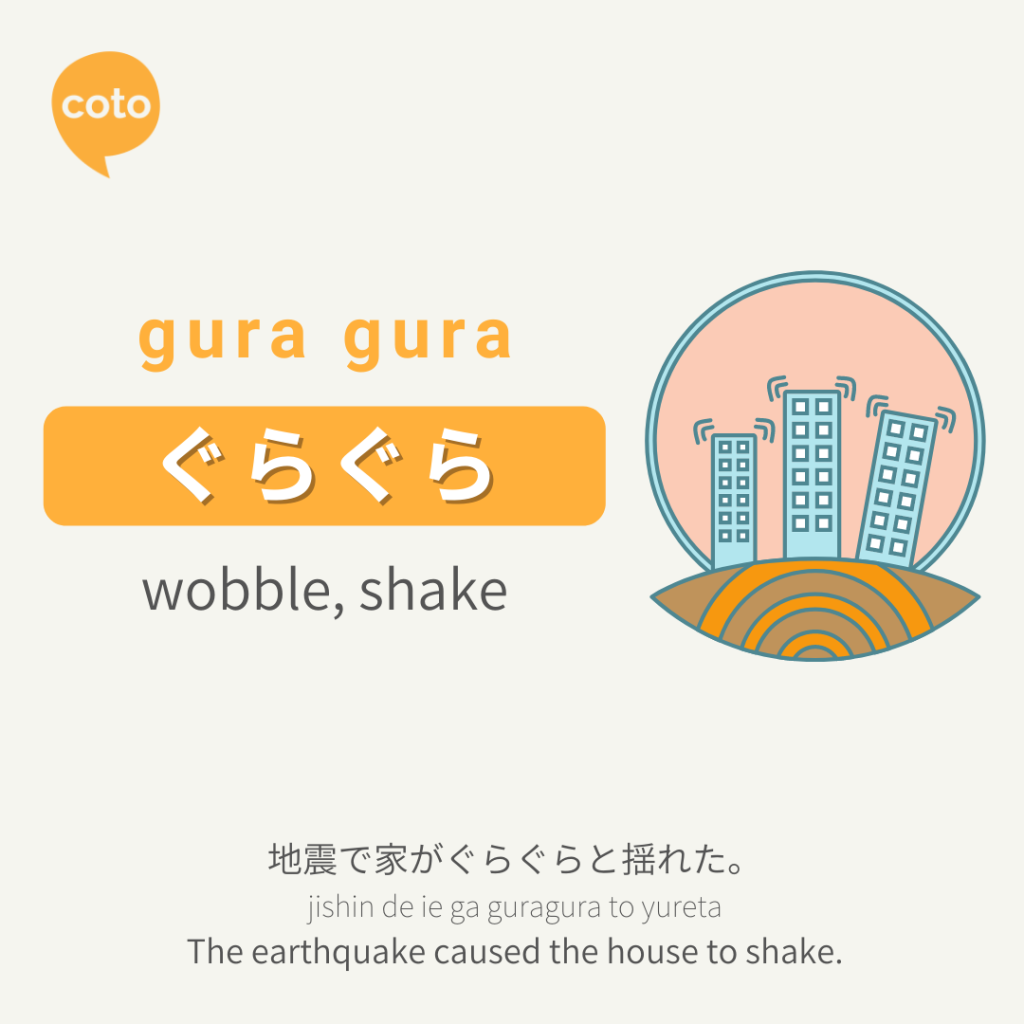
12. Gura Gura (ぐらぐら)
Gura Gura, meaning wobble or shake, is intended to sound like something wobbling or shaky.
Example Sentence:
お母さん見て! 歯がぐらぐらしてる!
okaasan mjite! ha ga gura gura shiteru!
Mom, look! My tooth is wobbling!
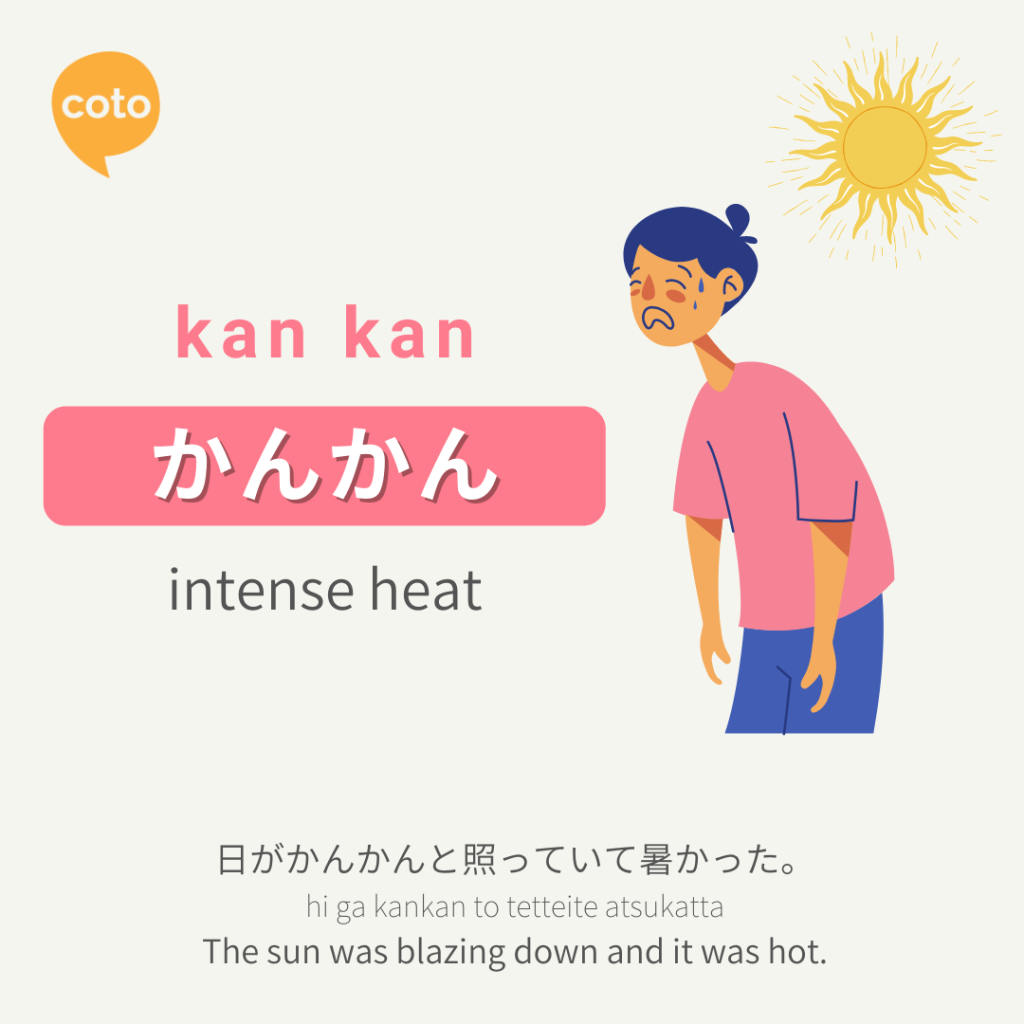
13. Kan Kan (かんかん)
Kan Kan, has multiple meanings, one of which is intense heat. Another meaning is two objects clanging, as it sounds like bells clanging. But it is also mainly used to describe someone angry.
Example Sentence:
今朝からお母さんはすごくかんかんだ。
kesa kara okaasan wa sugoku kankanda.
My mother has been mad since this morning.
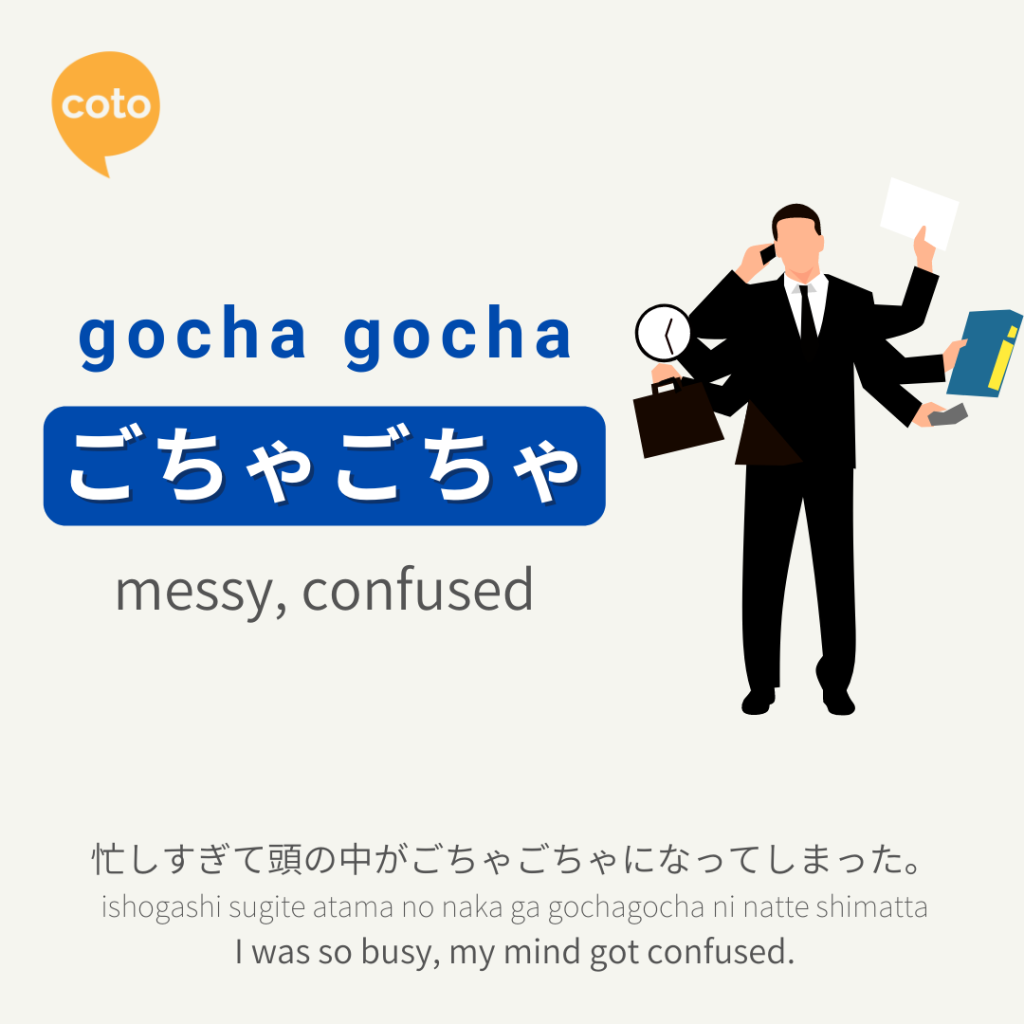
14. Gocha Gocha (ごちゃごちゃ)
Gocha Gocha, meaning messy or confused, is meant to sound like someone confused.
Example Sentence:
部屋はごちゃごちゃでしょ、早く片付けなさい!
heya wa gocha gocha desho, hayaku katadukenasai!
Your room is so messy, hurry up and clean it!
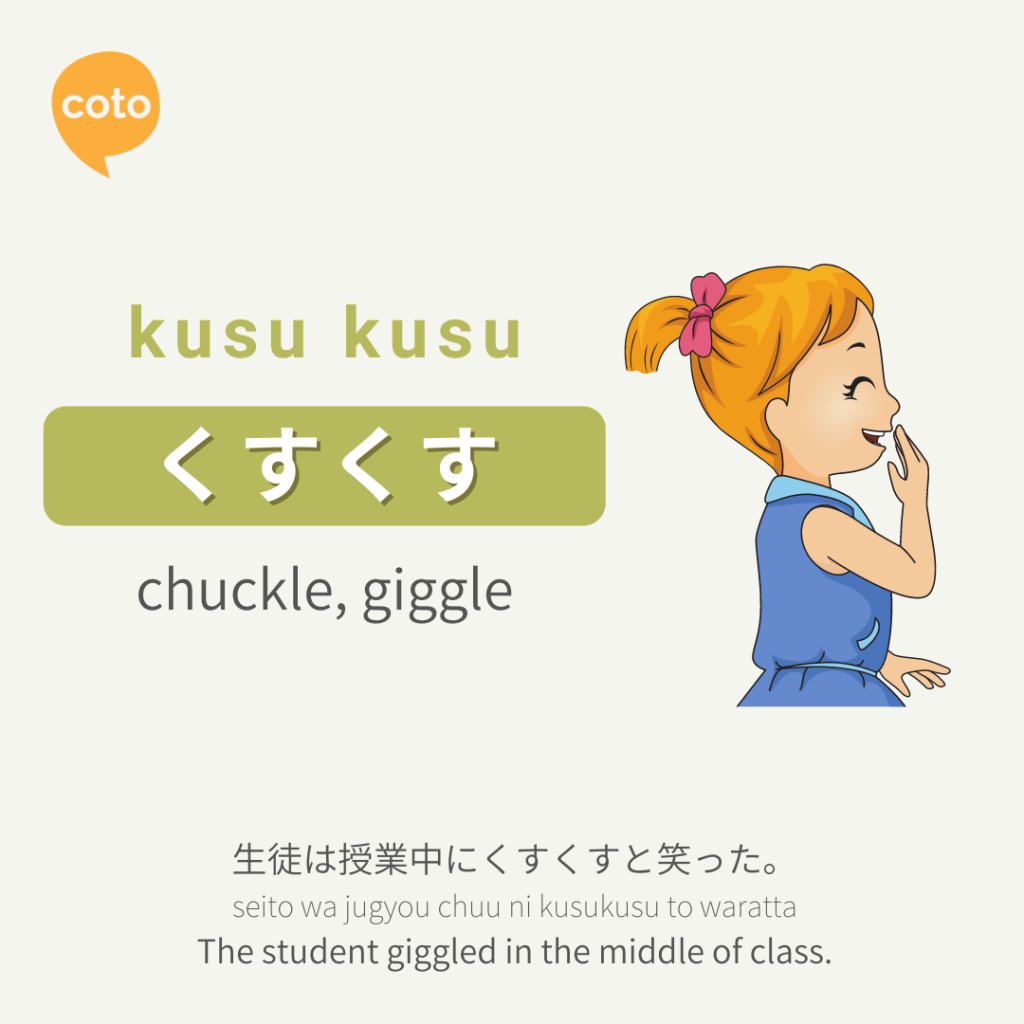
15. Kusu Kusu (くすくす)
Kusu Kusu, meaning to chuckle or to giggle, sounds like someone laughing. It’s commonly used with the kanji ‘笑’ (emi/wara).
Example Sentence:
何くすくすと笑ってるの?
nani kusu kusu to waratteruno?
What are you giggling about?
Want to study Japanese with us?
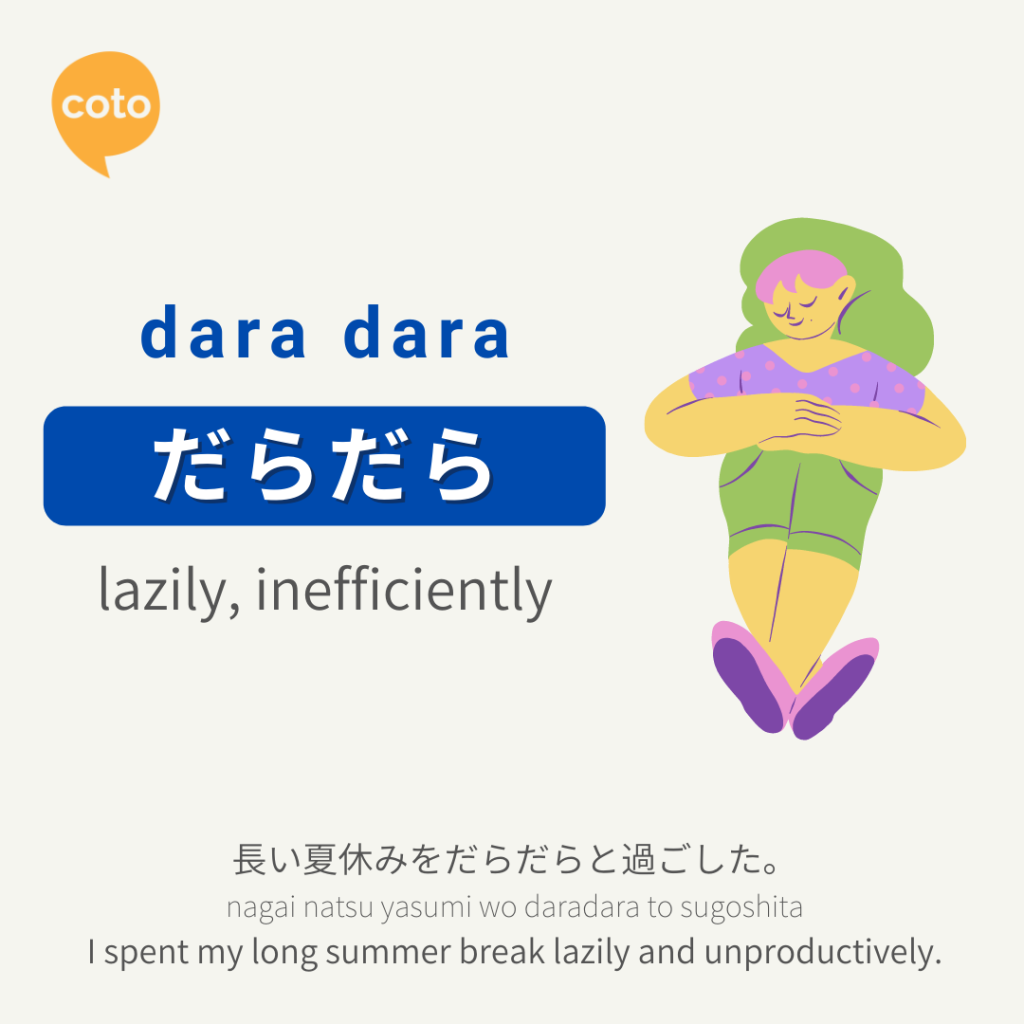
16. Dara Dara (だらだら)
Dara dara imitates the sound of liquid dripping slowly, but is used in conversation to describe actions being done lazily or inefficiently
Example Sentence:
だらだらしないで、早く宿題やって!
dara dara shinai de, hayaku shukudai yatte.
Don’t be lazy and hurry up and do your homework!
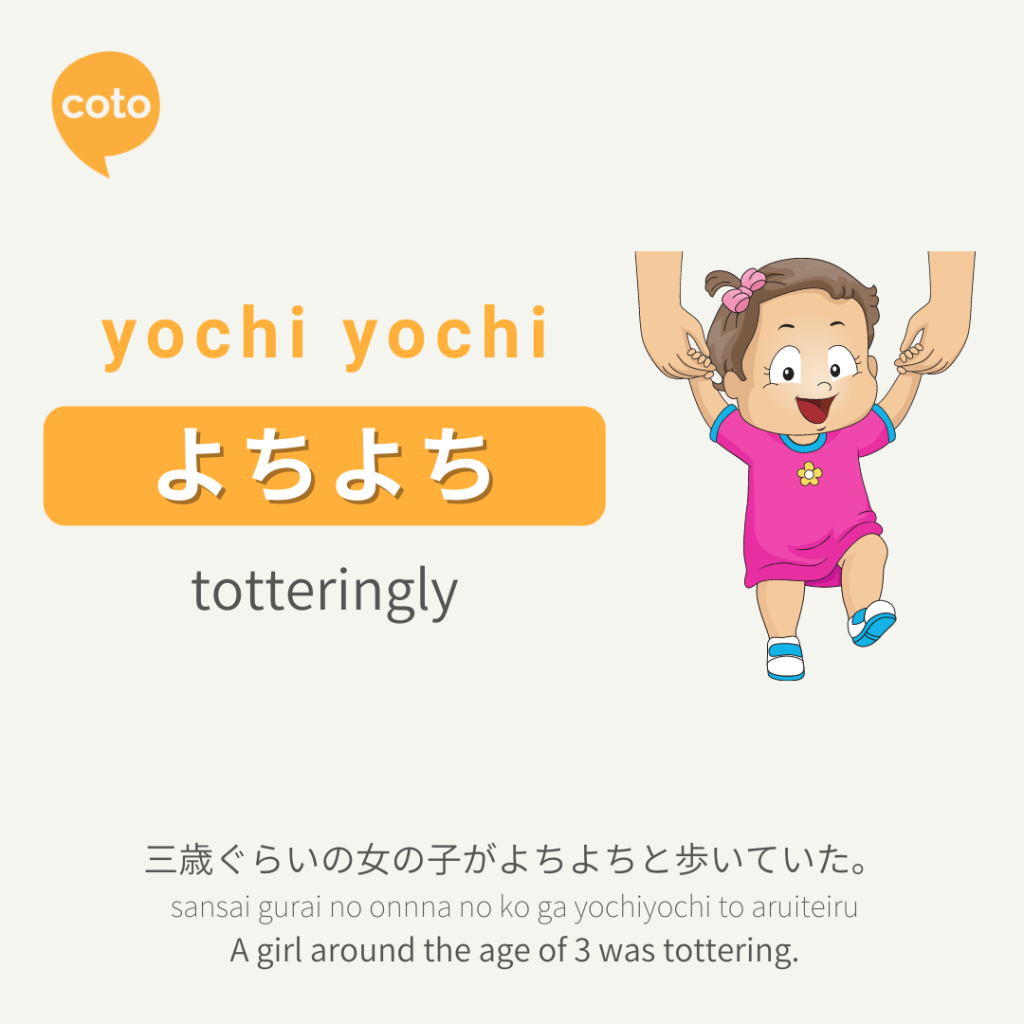
17. Yochi Yochi (よちよち)
Yochi yochi, meaning totteringly, or to walk in small steps. It’s usually used to represent a child walking.
Example Sentence:
よちよちと歩く女の子がとても可愛いらしい。
yochi yochi to arum onna no ko ga totemo kawairashii.
The sight of the girl tottering was very cute.
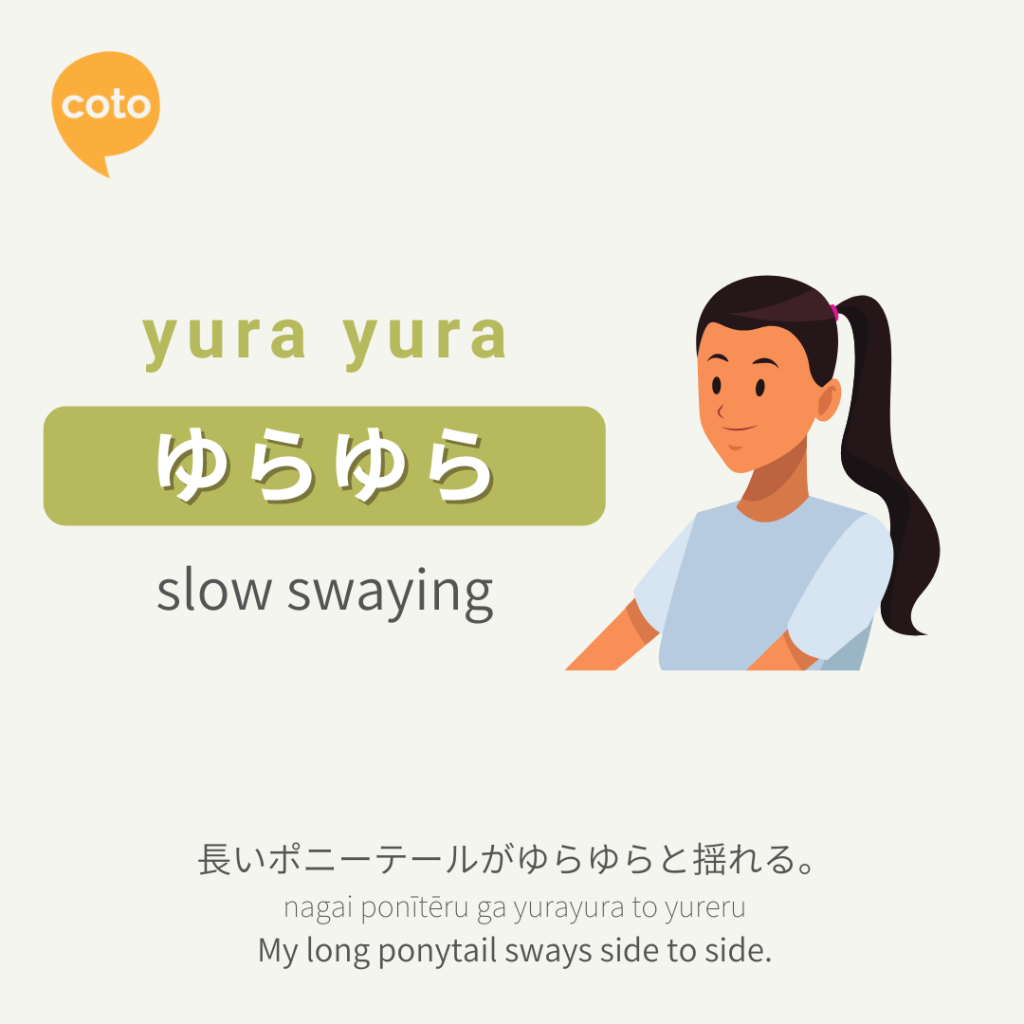
18. Yura Yura (ゆらゆら)
Yura yura, meaning slowly swaying, sounds like something swaying from side to side.
Example Sentence:
船がゆらゆらゆらと揺れる。
fune ga yurayura to yureru.
The ship slowly sways.
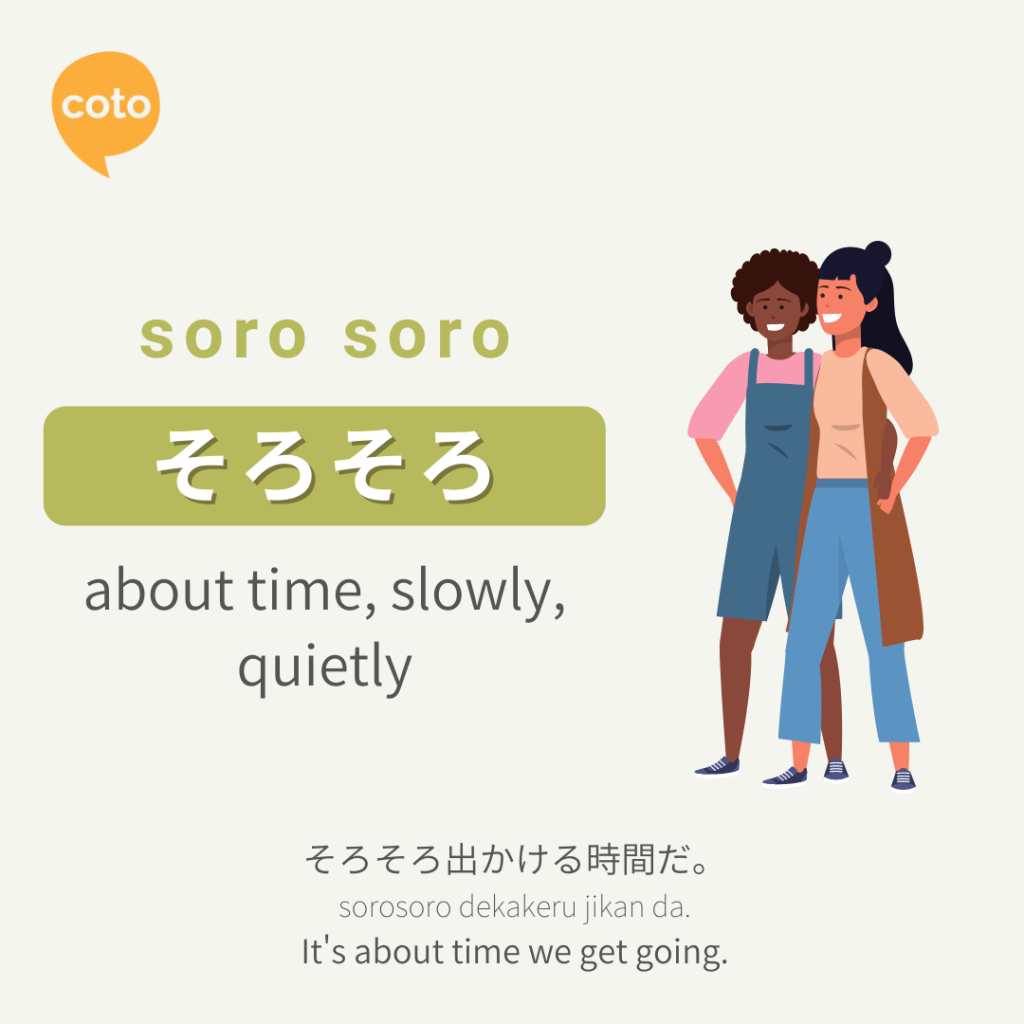
19. Soro soro (そろそろ)
Soro soro, meaning to do something slowly or quietly, or that it’s “about time” for something, most commonly the latter.
Example Sentence:
そろそろ家に帰らないといけない。
soro soro ie ni kaeranai to ikenai.
I have to go home soon.
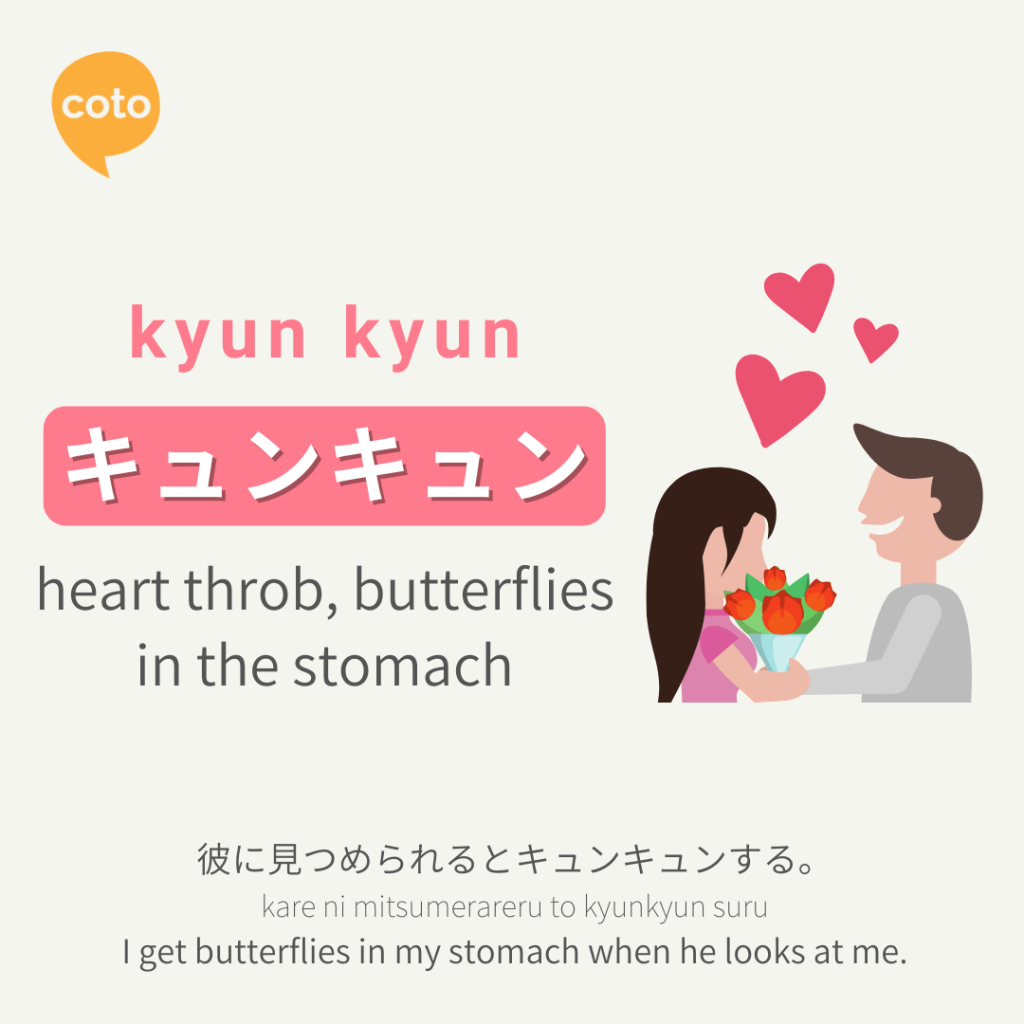
20. Kyun Kyun (キュンキュン)
Kyun Kyun, meaning heartthrob or your heart tightening. It is meant to sound like your heart is getting squeezed, and is used most commonly in a romantic context.
Example Sentence:
少女漫画を読んで、キュンキュンしました。
Shoujo manga o yonde, kyunkyun shimashi ta.
I read a girl’s manga, which made my heart ache.
21. Giri Giri (ギリギリ)
Giri giri mimics a grinding sound and is used to express doing something at the last moment or just barely finishing something on time. It’s commonly used in contexts when you almost miss something.
Example Sentence:
電車が遅れたので、仕事にギリギリ出勤しました。
Densha ga okuretanode, shigoto ni girgiri shukkin shimashita.
Since the train was late, I barely made it to work on time.
22. Dondon (ドンドン)
Don don often mimics pounding, knocking, or even loud noises in general. It’s often used to describe continuous noises like a beating drum or the knocking on the door. But it is also often used as a way of explaining something that is progressing steadily or rapidly.
Example Sentence:
毎日練習すれば、日本語の能力がドンドン成長できますよ。
Mainchi renshuu sureba, nihongo no noryoku ga dondon seichou dekimasuyo.
If you practice every day, your Japanese will rapidly grow.
23. Doki doki (ドキドキ)
Doki doki is supposed to imitate the sound of a heartbeat, so it’s often used to describe situations that make your heart beat faster. People often use it to describe when they feel excited, nervous, or in anticipation of something. It’s commonly used in romantic or suspenseful contexts.
Example Sentence:
いつも面接の前にドキドキしてしまいます。
Itsumo mensetsu no maeni doki doki shite shimaimasu.
I always get nervous before interviews.
24. Pika Pika (ぴかぴか)
You might know this onomatopoeia from the titular Pokémon character, Pikachu. As a matter of fact, Pikachu’s very name comes from 2 onomatopoeias: pika, from pika pika, and chu, which is the sound that mice make. So, Pikachu says pika pika, since it mimics the sounds of electric sparks. However, pika pika also means sparkling, glittering, shiny, or brand new.
Example Sentence:
新しい靴はぴかぴかしています。
Atarashii kutsu wa pika pika shiteimasu.
My new shoes are shiny.
25. Mochi Mochi (もちもち)
Mochi mochi describes a soft, chewy, and slightly bouncy texture, similar to mochi (rice cakes). It is commonly used for foods like bread, pancakes, or desserts, but can also describe soft and squishy things like skin.
Example Sentence:
このパンはもちもちしていて美味しいです。
Kono pan wa mochi mochi shiteite oishii desu.
This bread is chewy and delicious.
26. Kira kira (キラキラ)
Kira kira is used to describe something that is sparkling, glittering, or twinkling, like stars, lights, or anything that shines brightly. It can also describe someone’s eyes when they are full of excitement.
Example Sentence:
星がキラキラ光っています。
Hoshi ga kira kira hikatte imasu.
The stars are sparkling.
27. Fuwa fuwa (ふわふわ)
Fuwa fuwa describes something soft, fluffy, and light, like clouds, pillows, or freshly baked bread. It can also describe a floating or airy feeling.
Example Sentence:
このケーキはふわふわしています。
Kono keeki wa fuwa fuwa shiteimasu.
This cake is fluffy.
28. Goro goro (ゴロゴロ)
Goro goro has multiple meanings, but it commonly describes a rumbling sound (like thunder) or lounging around doing nothing.
Example Sentence:
休みの日は家でゴロゴロしています。
Yasumi no hi wa ie de goro goro shiteimasu.
I spend my days off lounging around at home.
29. Zaa zaa (ザーザー)
Zaa zaa describes the sound of heavy rain pouring down. It’s often used to emphasize strong rainfall.
Example Sentence:
外では雨がザーザー降っています。
Soto de wa ame ga zaa zaa futte imasu.
It’s raining heavily outside.
30. Pera pera (ペラペラ)
Pera pera describes someone speaking a language fluently and smoothly. It can also mean something is thin or flimsy, depending on context.
Example Sentence:
彼は日本語がペラペラです。
Kare wa nihongo ga pera pera desu.
He speaks Japanese fluently.
Putting Japanese Onomatopoeia to Conversational Use
Onomatopoeia is absolutely important in the Japanese language. It can almost bring the language to life. Let’s take a look at a short story of Toshio-kun’s morning and make a comparison between the two paragraphs!
| Without Onomatopoeia | With Onomatopoeia |
|---|---|
| Toshio-kun woke up and realized that he missed the alarm; his heartbeat went faster and faster. He rushed to the kitchen and gulped down a cup of water. Then he got out of his house, and the sun greeted him with blazing heat. He peeked at his watch as the time went by. Toshio-kun had 5 minutes before his class started. At full speed, he managed to arrive at class just in time. | Toshio-kun woke up and realized that he missed the alarm; his heartbeat went ドキドキ, faster and faster. He rushed to the kitchen, パタパタ, and gulped down a cup of water, がぶがぶ. Then he got out of his house, and the sun greeted him with blazing heat, かんかん. He peeked at his watch, チクタク, as the time went by, Toshio-kun had 5 minutes before his class started. At full speed, he managed to arrive at class ギリギリ, just in time. |
Can you feel the difference between the two paragraphs with and without onomatopoeia? Which one sounded more lively to you?
There are a few ways you can incorporate onomatopoeia. The longer you study Japanese, the more you realize that it’s actually easier (and more fun) to use Japanese onomatopoeia than its other normal word equivalent.
This is because they can capture more than just the literal meanings of words and describe sounds or how something looks or seems. Take a look at some of the situations where they are commonly used.
| Situation | Example |
|---|---|
| When you are studying Japanese | 日本語をペラペラになりたい。 Nihongo o pera pera ni naritai. I want to be fluent in Japanese. |
| When you see a cockroach, and your friend does not like it | ギャアギャア騒ぐな! Gyaagyaa sawagu na! Don’t make a fuss! |
| When you are hungry | お腹がペコペコだ。 Onaka ga peko peko da. I am hungry. |
| When you are full of excitement | あした日本に行くのでワクワクしています! Ashita nihon ni iku node waku waku shiteimasu. I am going to Japan tomorrow so I am excited. |
| When you see a couple | あの二人はラブラブだ! Ano futari wa rabu rabu da. That couple is so lovey-dovey. |
When your shoes are wet | 靴がビショビショ。 Kutsu ga bisho bisho. My shoes are drenched. |
Representation and Usage of Japanese Onomatopoeia
Japanese onomatopoeias are unique as they use not only words to mimic sound, but feelings and situations as well. They are heavily used in manga, but unfortunately, only those who have mastered the Japanese language would be able to understand the use of all onomatopoeia.
They may be translated into another language, but the humor or feelings behind them may be lost in translation. Thinking on the positive side, doesn’t this give you more motivation to master the Japanese language?
Conclusion: Onomatopoeia is Used all the Time in Japanese
Japanese onomatopoeias are unique as they use not only words to mimic sound, but feelings and situations as well. They are heavily used in manga, often to add sound effects as if you’re hearing the illustrations or create greater tension in the visuals. Japanese is unique in that onomatopoeia is just a normal part of the language, whether speaking or reading our favorite manga.
Additionally, even when translating them into other languages, the context, humor, or feelings behind them might get lost in translation!
So, to understand written or spoken Japanese, you should try to learn as many onomatopoeia as possible. Plus, adding them to your language repertoire will add so much flavor to your language, allowing you to express yourself more dynamically!
Learn to Speak Japanese Naturally at Coto Academy
Learn to use onomatopoeia naturally when speaking Japanese by taking classes with us at Coto Academy. We have classes that focus on conversation as well as reading and writing, helping you to learn every area of Japanese, including onomatopoeia. We have campuses in Shibuya, Iidabashi, Minato, Yokohama, and soon in Shinjuku!
Not in Japan? No worries, we also offer fully online courses as well! So, no matter your level, needs, schedule, or location, we will work with you to reach your Japanese language goals, from passing the JLPT to learning business Japanese.
FAQ
What is a Japanese onomatopoeia?
Onomatopoeia is a word created from the vocal imitation of the sound associated with it. Japanese onomatopoeia is taken from the sounds of animals and things, but they also describe feelings, atmosphere, and situation.
How many Japanese onomatopoeia are there?
There are 4,500 existing onomatopoeia.
Do Japanese people use onomatopoeia?
Japanese people use onomatopoeia in casual settings. They are heavily used in manga but unfortunately, the word may be lost in translation.
What are the types of Japanese onomatopoeia>
- Animal and human sounds: Giseigo (擬声語)
- Sounds made by inanimate objects and nature: Giongo (擬音語)
- Sounds to describe conditions and states: Gitaigo (擬態語)
- Sounds to describe movements and motions: Giyougo (擬容語)
- Sounds to describe feelings: Gijougo (擬情語)
We hope you enjoyed the list. If you liked this article, check out other articles:
- 25 Japanese Slang to Learn
- Top 30 Inspiring Japanese Proverbs and Sayings
- 26 Anime on Netflix to Watch
- What is Yojijukugo? Japanese 4-character Idioms
- Kotoba Asobi: Japanese Play-on-words