





Have you been to the doctor in Japan? Are you afraid not to be able to explain your condition in Japanese? Being sick in Japan is one stressful experience if you are not comfortable communicating in Japanese. The good news is that if you have a simple cold, you can skip the hospital and go to a drug store to find some common over-the-counter drugs.
At the drugstore, you can simply say:
“Excuse me, I do not feel well.”
すみません、ちょっと具合具合がわるいです。
If you would like to see a doctor, be sure to have your Japanese medical insurance card (保険証) or any insurance document issued for your travel. Bring cash as many Japanese medical institutions do not accept credit cards. As long as you have money, you will be accepted. We understand that it can be a stressful experience. Do your best!
Most hospitals and clinics have walk-in system. You can skip the call to make an appointment and go directly to the closest one. Search what clinic or hospital could be in your area.
Hospital: 病院
Clinic: クリニック
Reception: 受付
The first thing you need to find is the reception. Start the conversation like this:
“Excuse me, I do not feel well.”
すみません、ちょっと具合具合がわるいです。
They will most likely ask you if you have an appointment and if this is your first time in their clinic:
“Do you have an appointment?”
予約はありますか。
“No.”
いいえ、していません。
“Is the first time?”
初めてですか。
“Yes”
はい、初めてです。
You will be asked to fill out a questionnaire, most likely written in Japanese. Prepare yourself with the following questionnaire created for tourists. Do not hesitate to ask for help. Even if you can speak little Japanese, gestures can help a lot to understand what information is asked.
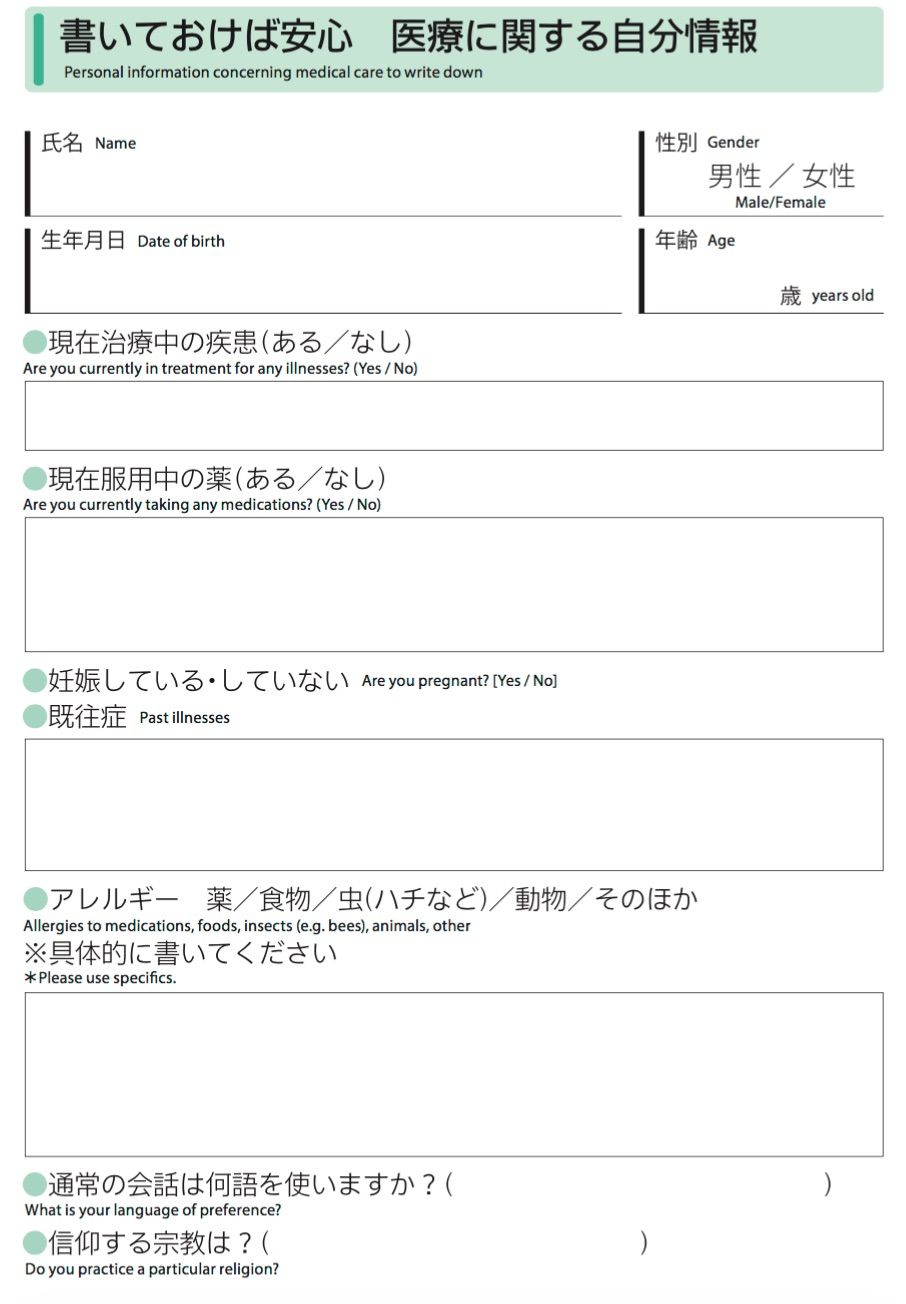
After waiting for your turn, you will be called to the examination room (診察室) to see the doctor. Here some useful sentences for you to explain your condition in Japanese:
Talk about your condition:
I have a fever: 熱がある
I feel sick: 気分が悪い
I feel nauseated: 吐き気がする
I have diarrhea:下痢です
I have constipation: 便秘です
Explain your pain:
I have a headache: 頭が痛い
I have a stomach pain: お腹が痛い
My throat hurt: 喉が痛い
My ear hurts: 耳が痛い
I have a toothache: 歯が痛い
The word for pain is easy to remember. You can simply show your body part, saying “it hurts here”.
Pain: 痛い
It hurts here: ここが痛いです。
Once your condition has been diagnosed, the doctor prescribes you some medicine or cold medicine. If you have some allergy, be sure to let the doctor know! If your pain is severe, you will receive some pain killers.
Medicine: 薬
Cold medicine: 風邪薬
Pain killers: 痛め止め
I am allergic to…: アレルギーがある
Pharmacy: 薬局
You are facing an emergency?
Ask for help to call an ambulance! Show them the following sentence: 「救急車を呼んでください。」.
We know that going to the doctor in Japan is not easy, but do your best!
お大事に !
Please take care!
Not to be mistaken with Ki o Tsukete, which can also be used to ask others to be careful in Japanese!
Want to find out more about Coto Japanese Academy? Try taking a look at the various Japanese Language Courses we offer!