






The JLPT N3 grammar 〜がち (~gachi) is a phrase you can use to describe something that tends to happen easily or often, closely meaning “tend to,” “frequently,” or ”to do something easily.” The phrase is mostly used in a negative context. The most common situations you can use this phrase:
- When you’re prone to doing something
- When something is prone to happen
- Something that happens often or easily
Make Sure to Watch Coto Academy’s YouTube Video About 〜がち
Before you continue reading, why not take a moment to watch a quick YouTube lesson with our Japanese teacher, Natsumi-sensei.
〜がち (~Gachi) Meaning
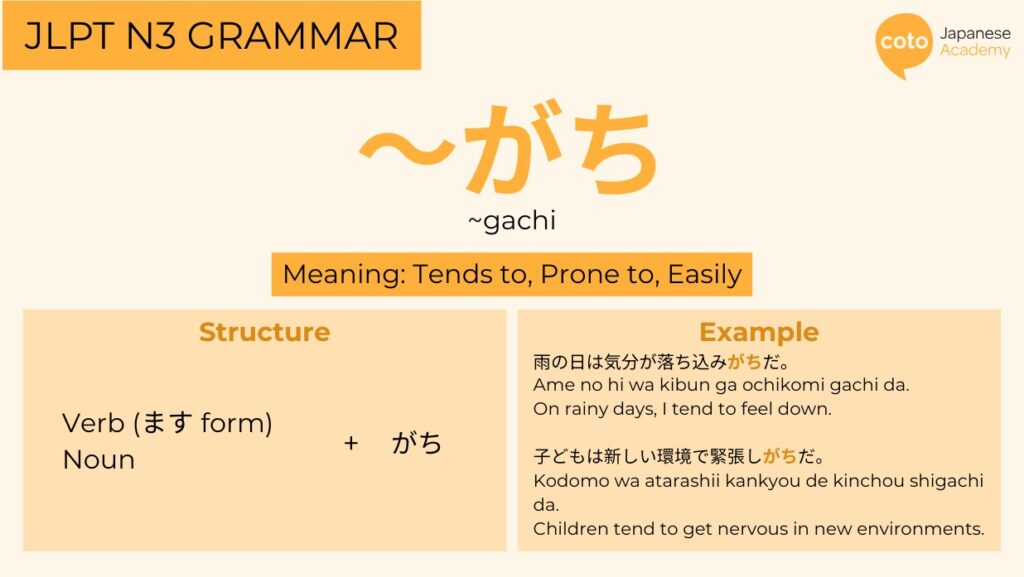
The phrase ~gachi most closely translates to “tendency to” or “prone to.” It often has a bit of a negative connotation, somewhat referring to a bad habit or a recurring situation that might be happening beyond your control. It generally doesn’t sound natural to use this phrase in a positive connotation.
The phrase is very similar to saying:
- “Tend to”
- “Often”
- “Frequently”
Want to study Japanese with us?
JLPT N3 〜がち (~gachi) Sentence Structure
〜がち (~gachi) is a suffix that attaches to the end of verbs or nouns. You often place it at the end of words.
| Type | Structure |
|---|---|
| Verb (ます form) | Verb (drop ます) + がち |
| Noun | Noun + がち |
You can only use gachi in the plain verb form, which is just dropping 〜ます (masu) and adding がち (gachi) without conjugating the verb. But, you can conjugate 〜がち (~gachi) itself based on past, present, positive, or negative:
| Form | Plain Form + がち | Meaning |
|---|---|---|
| Present | 雨が降りがち | Tends to rain |
| Past | 雨が降りがちだった | It did tend to rain |
| Negative | 雨が降りがちではない | Doesn’t tend to rain |
| Past Negative | 雨が降りがちではなかった | Did not tend to rain |
JLPT N3 〜がち (~Gachi) Examples
Let’s take a look at a few example sentences to really get a feel of how to use ~gachi.
Example 1:
雨の日は気分が落ち込みがちだ。
Ame no hi wa kibun ga ochikomi gachi da.
On rainy days, I tend to feel down.
Example 2:
彼は忙しくて、連絡を忘れがちです。
Kare wa isogashikute, renraku o wasuregachi desu.
He’s busy and tends to forget to get in touch.
Example 3:
在宅勤務だと、運動不足になりがちだ。
Zaitaku kinmuda to, undo fusoku ni narigachi da.
When working from home, you’re prone to not getting enough exercise.
Example 4:
子どもは新しい環境で緊張しがちだ。
Kodomo wa atarashii kankyou de kinchou shigachi da.
Children tend to get nervous in new environments.
Vocabulary List
Check out all the new words in the example sentences above, and try to remember new vocabulary alongside today’s Japanese grammar!
| Kanji / Writing | Furigana | Romaji | English |
|---|---|---|---|
| 雨の日 | あめのひ | ame no hi | rainy day |
| 気分 | きぶん | kibun | mood |
| 落ち込む | おちこむ | ochikomu | to feel depressed |
| 忙しい | いそがしい | isogashii | busy |
| 連絡 | れんらく | renraku | contact |
| 忘れる | わすれる | wasureru | to forget |
| 在宅勤務 | ざいたくきんむ | zaitaku kinmu | working from home |
| 運動不足 | うんどうぶそく | undou busoku | lack of exercise |
| 新しい | あたらしい | atarashii | new |
| 環境 | かんきょう | kankyou | environment |
| 緊張する | きんちょうする | kinchou suru | to be nervous |
Learn More JLPT Grammar with Coto Academy!
Try using 〜がち in your conversation in Japanese as much as you can; this way, you’ll permanently add it to your vocabulary. If you want to practice using this JLPT phrase and many more in real Japanese conversations, nothing beats practicing with a teacher who can offer practical guidance. Sign up with us at Coto Academy.
Coto Academy has been teaching Japanese for over 25 years, with campuses in Shibuya, Yokohama, Iidabashi, Minato, and online. Our courses focus on practical Japanese, so the grammar you learn is designed for real-life use.
We offer part-time, intensive, and fully online lessons to suit your schedule. Start learning Japanese effectively and confidently with Coto Academy today!
Why join Coto Academy?
- Over 60+ different Japanese classes over 18 levels
- Small classroom of only up to 8 students for personalized support
- Professional, native Japanese teachers
- Ready to get started? Fill out the form below to contact us!
FAQ:
What does 〜がち mean?
It describes a tendency for something (usually negative) to happen often.
Can 〜がち be used for positive situations?
Generally, ~がち is not used for positive situations; you mostly use it to describe undesirable habits or situations that were prone to happen.
What’s the difference between 〜がち and 〜やすい?
〜がち refers to a negative tendency or state where the phrase 〜やすい is used for describing ease or likelihood, often neutral or even positive.
Can 〜がち be used with adjectives?
〜がち cannot really be used with adjectives. It is mainly used with verbs (plain form) and nouns.
Is 〜がち formal or casual?
It is neutral and appears in both spoken and written Japanese, including news and essays.