





気味(ぎみ) is a JLPT N2 grammar pattern used to describe a tendency or slight condition. It translates loosely as “looks,” “seems,” or “tends to,” and often carries a slightly negative nuance. Because of this, we often use 気味 (gimi) to describe things like being prone to illness, feeling a bit tired, or having a mild but noticeable habit or condition.
This expression is especially useful when you want to:
- Describe how someone or something tends to be
- Express how something seems or appears
- Say that something is slightly or somewhat a certain way
Now, let’s take a closer look at the grammar pattern, example sentences, and common use cases of 気味.
Make Sure to Watch Coto Academy’s YouTube Video About 気味
Before you continue reading, why not take a moment to watch a quick YouTube lesson with our Japanese teacher, Ichikawa Sensei:
気味 (gimi) Meaning
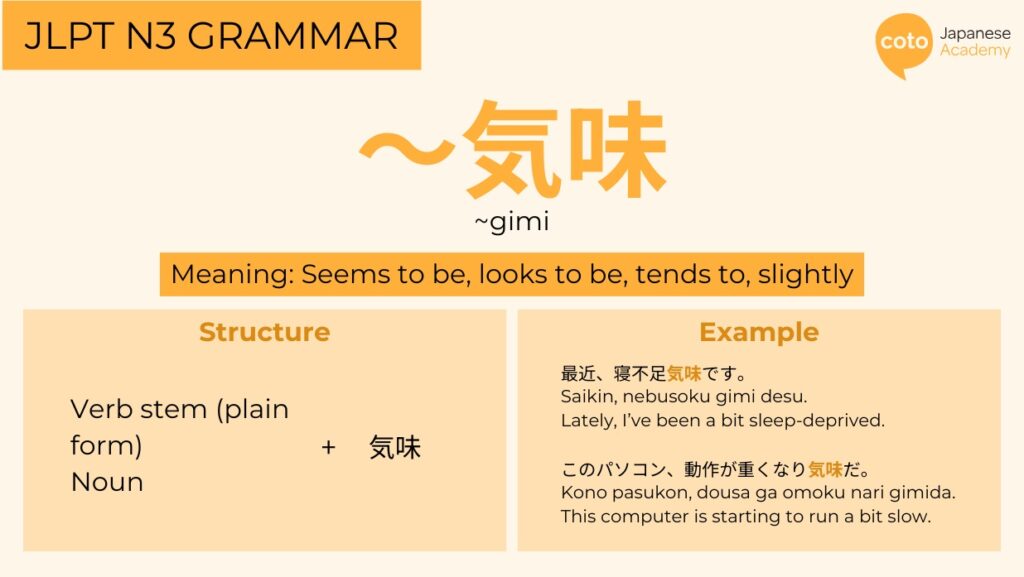
気味 (gimi) describes how a person or situation seems to be, looks to be, or tends to do. It expresses a bit of uncertainty and generally is said in a somewhat negative or concerning context, but not to an alarming degree. It most closely translates to:
- “Seems like”
- “Tends to”
- “Is a bit…”
- “Slightly”
- “Has a feeling of..”
JLPT N2 気味 (gimi) Sentence Structure
気味 is a suffix that attaches to the end of verbs or nouns. You can only attach 気味 to verbs in plain form, which is just dropping 〜ます (masu) and adding 気味.
| Type | Structure |
|---|---|
| Verb (ます form) | Verb (drop ます) + 気味 |
| Noun | Noun + 気味 |
You can only attach a verb stem in plain form, without conjugating, to 気味. You conjugate 気味 itself into positive, negative, past, and present:
| Form | Plain Form + 気味 | Meaning |
|---|---|---|
| Present | 寝気味 | Seems/tends to sleep |
| Past | 寝気味だった | Seemed/tended to sleep |
| Negative | 寝気味ではない | Does not seem/tend to sleep |
| Past Negative | 寝気味ではなかった | Did not seem/tend to sleep |
Want to practice Japanese in a practical, conversational setting? Click below to start your learning Japanese for daily life, passing the JLPT, and much more!
JLPT N2 気味 (gimi) Example Sentences
Let’s explore a few examples to really get a feel for how the grammar, 気味, works in actual Japanese conversation.
Example 1:
最近、寝不足気味です。
Saikin, nebusoku gimi desu.
Lately, I’ve been a bit sleep-deprived.
Example 2:
風邪気味なので、今日は早く帰ります。
Kaze gimi nanode, kyou wa hayaku kaerimasu.
I’m feeling a bit under the weather, so I’ll go home early today.
Example 3:
彼は緊張気味で、あまり話さなかった。
Kare wa kinchou gimi de, amari hanasanakatta.
He seemed a bit nervous and didn’t talk much.
Example 4:
このパソコン、動作が重くなり気味だ。
Kono pasukon, dousa ga omoku nari gimida.
This computer is starting to run a bit slow.
Vocabulary List
Check out all the new words in the example sentences above, and try to remember new vocabulary alongside today’s Japanese grammar!
| Kanji / Writing | Furigana | Romaji | English |
|---|---|---|---|
| 最近 | さいきん | saikin | recently |
| 寝不足 | ねぶそく | nebussoku | lack of sleep |
| 風邪 | かぜ | kaze | cold; flu |
| 今日 | きょう | kyou | today |
| 早い | はやい | hayai | quickly, early |
| 緊張 | きんちょう | kinchou | nervousness |
| あまり | あまり | amari | barely |
| 話す | はなす | hanasu | to speak |
| 動作 | どうさ | dousa | operation; movement |
| 重い | おもい | omoi | heavy; slow |
| 帰る | かえる | kaeru | to go home |
Learn More JLPT Grammar with Coto Academy!
Try using 気味 next time you speak Japanese! It’s great for expressing how situations seems like or tend to be. But if you want to practice using this JLPT grammar and many others in actual Japanese conversations, nothing beats practicing with a teacher who can offer practical guidance. So, consider signing up with us at Coto Academy!
Coto Academy has been offering Japanese classes for over 25 years, with campuses in Shibuya, Yokohama, Iidabashi, Minato, Shinjuku, and online. Our courses focus on practical Japanese, so the grammar you learn is designed for real-life use.
We offer part-time, intensive, and fully online lessons to suit your schedule. Start learning Japanese effectively and confidently with Coto Academy today!
Why join Coto Academy?
- Over 60+ different Japanese classes over 18 levels
- Small classroom of only up to 8 students for personalized support
- Professional, native Japanese teachers
- Ready to get started? Fill out the form below to contact us!
FAQ:
What does 気味 (gimi) mean?
気味 means “slightly” or “showing signs of”, describing a mild or developing condition.
Is 気味 usually used in a negative context?
It is indeed often used for negative or undesirable states, but depending on context, the phrase can be more neutral.
What’s the difference between 気味 (gimi) and がち(gachi)?
気味 can describe the tendency of a person or situation; however, it expresses temporary states or some sense of uncertainty, similar to “seems like” or “is a bit…” The phrase がち, on the other hand, is a stronger expression for a tendency someone or something has, describing a frequent occurrence or habit.
Can 〜気味 (~gimi) be used with adjectives?
気味 can only attach to nouns or verb stems, not adjectives directly.
Is 気味 (gimi) formal?
気味 is considered neutral and can be used in both spoken and written Japanese.
