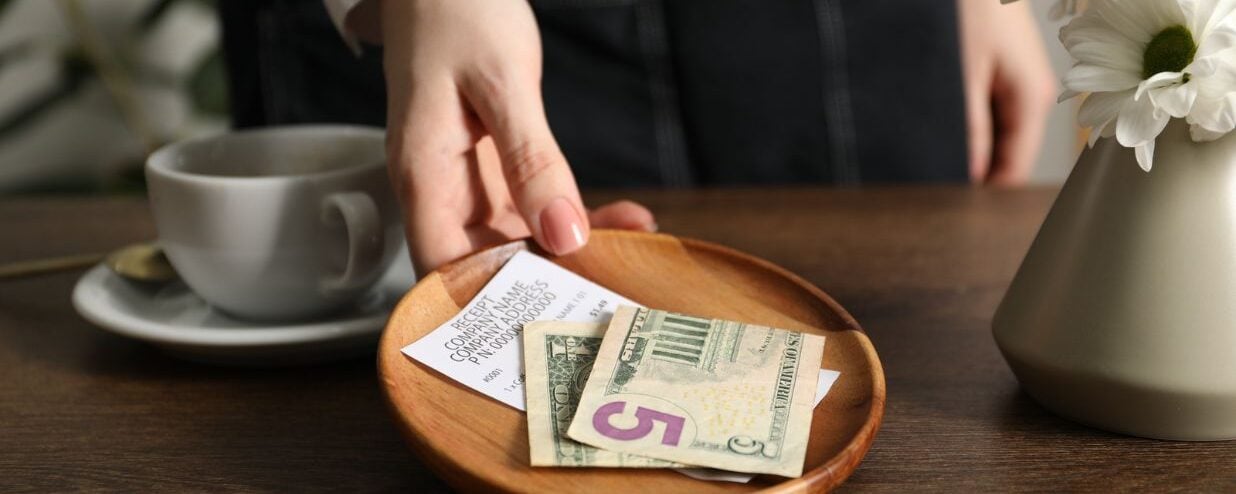


In the United States and many other countries, paying the bill without leaving a tip feels almost unthinkable. In Japan, it’s the opposite. Tipping is not part of the culture, and it can come across as awkward or even insulting. Many travelers find this a welcome change.
There are a few reasons for this. Many restaurants and hotels already include a service charge in the bill. Excellent service is also considered a basic standard rather than something that earns a bonus. And in Japan, appreciation is usually shown through polite words, a bow, or a thoughtful gift, not extra cash.
So let’s look at why you shouldn’t tip in Japan, and at the few exceptions, which still look quite different from the tipping you may be used to.
Why You Should Not Tip in Japan
Whether you’re at a restaurant, cafe, taxi, or accommodation, if you try to hand over cash as a tip, it will most likely be refused. This is because tipping, or gratuity, isn’t customary in Japan, and service staff may feel it’s out of place to accept tips. It really just isn’t done there. But there are a few reasons why.
1. Service Fees
Service fees are essentially supposed to cover the services you received at restaurants, cafes, and sometimes accommodations. They are usually included automatically in your total bill, so a tip isn’t really necessary.
Basically, you will have to pay the service fee no matter how well you felt the service was. But if you’re worried that workers won’t put in as much effort to provide high-quality service since you will pay the service charge anyway, you can put those concerns at ease! Japan is highly renowned for providing some of the best service in the world.
Now, you may be wondering if the service fees actually go to the service workers. While they don’t go directly to workers the same way tips do, they do help with the business’s operating costs, including workers’ wages, which leads to our next point.
2. Service Worker Wages
The reason why tips in places like the States are not only highly recommended, but even compulsory at bars and restaurants is that workers are not paid a “full wage.” So, you need to tip workers so that they are compensated for their work. But in Japan, workers are paid at least the legal minimum wage, but usually even more, especially during late hours.
Of course, average wages can vary by establishment and position in different service-providing establishments. Like most other workplaces, wages tend to be higher depending on position and contract; full-time staff generally earn more than part-time.
But tipping is common in other nations, where tips are not necessary, and workers are paid normal wages, as a way to communicate your appreciation to a specific worker or even the owner. However, in Japan, even giving tips as a “bonus” to express appreciation might not be recommended.
3. Tipping Could Be Seen as Confusing (or Even Offensive)
While in many places tipping is considered a nice gesture, in some cases in Japan, there are times when it could cause confusion or could even be seen as offensive, especially if you keep insisting. Of course, the perception of tips can vary based on the type of service, like at restaurants, hotels, and traditional entertainment.
Tipping at Restaurants and Cafes
While it’s normal to leave money on the table for the waiter or service staff, you should never do this at restaurants and cafes in Japan. Staff would most likely just be confused or think you accidentally left money at the table. In the worst-case scenario, it could unintentionally communicate that you don’t believe the restaurant or cafe is good enough to survive on its own.
Also, at restaurants, especially izakaya or Japanese pubs, you usually have to pay an otoshi fee, which is essentially the service fee that we discussed earlier. Otoshi refers to the small appetizer you receive as soon as you are seated, but the cost is meant to cover the staff’s service.
However, at bars, there is sometimes a tip jar near the cashier, so this is an exception to the general rule of avoiding tipping.
Tipping at Hotels & Accommodations
Similar to restaurants and cafes, you should avoid tipping at hotels as well. Some hotels have rules that prevent staff from taking tips, so trying to give one could get them in trouble, which is definitely not what we intend by tipping.
However, some high-end hotels have a personal attendant who specifically assists you during your stay. This could also be an exception where tipping could be seen as a polite gesture of appreciation. Keep in mind, if they refuse to take your tip, it’s best not to keep insisting.
Tipping Drivers
Whether you’re taking a taxi, a private car, or a bus, you don’t need to tip the driver in Japan. Taxi fares are calculated by the meter, and the price shown is the price you pay, including any late-night surcharge. Drivers are paid a regular wage, so there’s no need to round up or add extra. In fact, if you hand over extra money, the driver will probably try to give it back, and some will even go out of their way to return your change.
This also goes for chauffeurs, airport shuttle drivers, and tour guides. Their service is part of the price you’ve already paid, so tips aren’t expected, even for great service. Taxi drivers in Japan often wear white gloves and open the door automatically for you, so a friendly thank-you when you get out is the best way to show you noticed the care they put in.
What to Do Instead of Tipping
So, if you can’t leave a tip, how do you show your appreciation in Japan? The good news is that there are plenty of ways to say thank you that Japanese people will truly appreciate, and most of them don’t cost a thing. Here are some of the best alternatives to tipping.
1. Say Thank You in Japanese
A sincere thank-you is the most common way to show gratitude in Japan, and it goes a long way. When you finish eating at a restaurant, say ごちそうさまでした (gochisousama deshita), which means “thank you for the meal,” on your way out.
If you really enjoyed the food, you can add 美味しかったです (oishikatta desu), meaning “it was delicious.” At hotels and other places where you’ve been looked after, you can say お世話になりました (osewa ni narimashita), meaning “thank you for taking care of me.”
Example:
ごちそうさまでした。美味しかったです!
Gochisousama deshita. Oishikatta desu!
Thank you for the meal. It was delicious!
2. Bow and Be Polite
A small bow and a smile can go a long way to express your genuine appreciation. Staff in Japan are used to the kind of respect shown through manners, like greeting them when you enter, using polite language, and thanking them when you leave.
Small gestures like handing over your payment neatly, placing it on the tray provided, and being patient during busy hours also make a big difference.
3. Leave a Positive Review
If you want to support a place you really liked, a good online review is one of the most helpful things you can do. Many small businesses depend on word of mouth and reviews on sites like Google Maps and Tabelog to bring in customers, and a review that mentions a staff member’s great service shows your appreciation in a way they can see.
4. Come Back and Recommend It to Others
The best way to actually show your appreciation to a place you like is by being a repeat customer and bringing friends along. Japanese restaurants and shops especially treasure regular customers, called 常連 (jouren), and they’ll often remember your face and your favorite order.
5. Give a Small Gift (Omiyage)
If you’ve built a closer relationship with someone, like a host family, an owner of a small guesthouse, or a regular guide, a small gift from your home country is a thoughtful gesture. In Japan, this kind of gift is called お土産 (omiyage), and it’s often preferred over money, since it feels more personal. Sweets or snacks that are easy to share are a safe choice. Just present it with both hands and a polite word.
When Tipping is Appropriate and How to Tip in Japan
Tipping isn’t expected in Japan, but there are a few situations where a small gratuity is appropriate, and it’s done differently than at home. Instead of leaving cash on a table or adding a percentage to the bill, a tip in Japan is given discreetly, in an envelope, and usually at the beginning of the service, not the end.
So, if you do want to leave one, here’s how it works.
1. Giving a Tip at a Traditional Inn (旅館, Ryokan)
At some traditional inns, guests sometimes give a small amount of money to the attendant who looks after their room, called a 仲居 (nakai). This tip is called 心付け (kokorozuke), meaning something like “a token of the heart.” It’s optional and never expected, so if you’re not sure, it’s perfectly fine to skip it.
If you do give one, put the money in a small envelope, like a plain white one or a decorative pochi-bukuro (ポチ袋). Hand it over discreetly at the beginning of your stay, usually when the attendant first shows you to your room, rather than leaving cash on the table when you leave. Present it with both hands and a small bow. The amount is up to you, but a few thousand yen is common, with around ¥1,000 to ¥3,000 being typical.
Example:
心ばかりですが、お世話になります。
Kokoro bakari desu ga, osewa ni narimasu.
It’s just a small token, but thank you in advance for looking after us.
2. Tipping a Personal Attendant at a High-End Hotel
Most hotels in Japan don’t accept tips, and some have rules that prevent staff from taking them. However, some luxury hotels have a personal attendant or butler assigned to your stay. In these cases, a small gratuity can be a polite gesture of appreciation, and it should be given in the same way: discreetly, in an envelope, and with a thank-you.
If you’re unsure, ask the front desk what’s appropriate, since policies vary by hotel.
3. Using a Tip Jar at a Bar or Café
Some bars and cafés, especially ones that cater to tourists and international visitors, have a tip jar near the cashier. This is one of the few places where it’s completely fine to drop in some loose change or a small bill. Even then, it’s optional, and nobody will think less of you if you skip it.
4. Private Guides and Special Services
For services like private tours, drivers hired for the day, or movers, tips are generally not required, since the service fee covers the work. If you do want to say thank you for exceptional help, a small gift, like snacks or drinks, is often better received than cash.
Movers in Japan, for instance, are commonly given bottled drinks or snacks instead of money. If you give cash, put it in an envelope and hand it over politely.
Tour guides may be more accustomed to working with foreigners as well as certain gestures of appreciation like receiving tips. So, you could try giving a tour guide you enjoyed a tip, but as mentioned, in Japan it’s better to give money in an envelope rather than direct cash.
5. If Your Tip Is Refused, Don’t Insist
In Japan, it’s common for staff to politely decline a tip, and it doesn’t mean you did anything wrong. They may be following company rules or may feel uncomfortable accepting money. If it’s refused, say thank you, smile, and put it away without insisting, since pushing it on them could cause embarrassment.
Conclusion: Tipping Is Generally Not Necessary in Japan
Tipping is generally not necessary, nor recommended in Japan, because it’s not really a common custom, which may lead to more confusion than an acknowledgment of your appreciation. However, there are some exceptions to the rule, but if you’re not sure, you can skip the tip to be on the safe side.
Learn Natural Japanese with Coto Academy!
Whether you want to communicate your appreciation to staff or hold conversations in Japanese, join Coto Academy to learn how to speak Japanese naturally and fluently! We have courses covering hiragana, katakana, and useful everyday expressions. Our classes focus on developing a natural instinct for spoken Japanese rather than just memorizing from a textbook!
So, visit one of our campuses in Tokyo and Yokohama, or join us online from anywhere in the world! Ready to sign up, or just want to have a casual chat to discuss more details? Fill out the form below, and we will get in touch with you soon!
FAQ
Do you tip in Japan?
No. Tipping isn’t customary, and it’s usually refused at restaurants, cafes, taxis, and hotels. Staff are paid regular wages, and many places already include a service fee in the bill.
Is it rude to tip in Japan?
It’s not exactly rude, but it can be confusing or uncomfortable for staff. They may think you left the money by accident or feel awkward about accepting it, and they may have rules against taking tips, so leaving one could even get them in trouble.
Are there any times when tipping is okay in Japan?
Yes, in a few cases. At some traditional inns (ryokan), guests sometimes give a small amount of money in an envelope, called 心付け (kokorozuke), to the attendant who looks after their room. Some luxury hotels with a personal attendant and some bars with a tip jar are other exceptions. It’s always optional.