






The easiest way to say “I understand” in Japanese is 分かります (wakarimasu, meaning “to understand”), but it doesn’t always capture every nuance. Similar to English, the phrases “I know,” “I understand,” and “I comprehend” carry subtly different meanings despite their similarity. In Japanese, this complexity runs even deeper, since certain phrases can sound more polite or more casual depending on the context.
So let’s go over some common expressions for saying “I understand,” and when you would and wouldn’t use 分かります (wakarimasu).
1. 分かります (Wakarimasu)
分かります (wakarimasu) directly translates to “to understand” or “to comprehend” in a general sense. For example, if you are saying that you understand English, you could say:
Example:
英語が分かります。
Eigo ga wakarimasu.
I understand English
When Not to Use 分かります (Wakarimasu)
分かります describes general comprehension, not how well you understand a situation, new information, or a request. Using 分かります in this context would sound awkward and unnatural, even though the English equivalent “I understand” would work in these scenarios.
Instead, use the past tense: 分かりました (wakarimashita). It can be used to express your understanding in a wide variety of contexts; it serves as an excellent response to someone, such as public or service staff, who are explaining something to you.
Example:
新宿行きの電車は階段を上って右にあります。
Shinjuku yuki no densha wa kaidan o nobotte migi ni arimasu.
The train to Shinjuku is up the stairs, on the right.
あなた:分かりました!ありがとうございます!
Anata: Wakarimashita! Arigatou gozaimasu!
You: Understood! Thank you so much!
You can also use it to respond enthusiastically to commands from a colleague or senpai, similar to saying “understood” or “got it!” Beyond work, 分かりました is quite versatile, commonly used in daily life. You can use it to show your understanding of something, like a decision somebody made, how something came to be, and more. But it’s far from the only way to say “I understand” in Japanese.
Other Ways to Say “I Understand” in Japanese
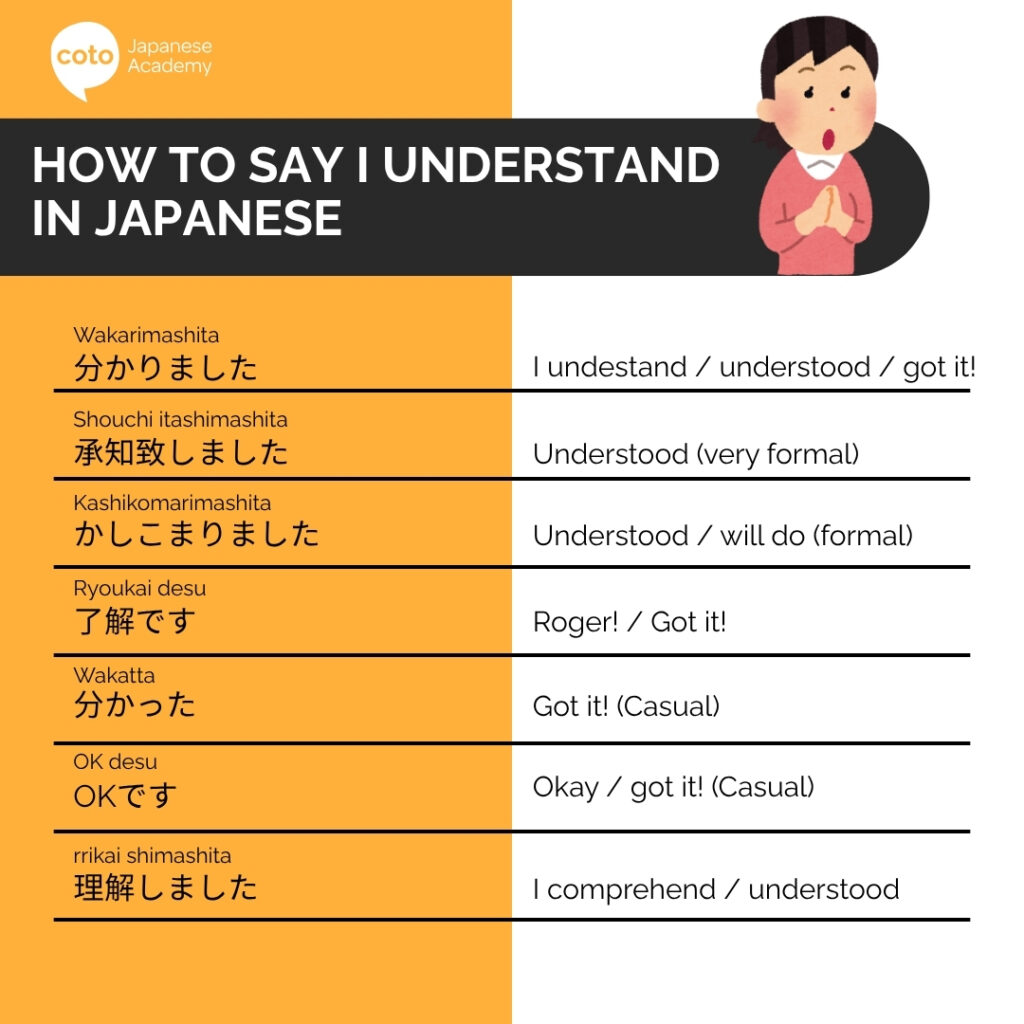
So what are some other ways to say “I understand” beyond 分かります or 分かりました? Some phrases fit better in formal or casual contexts and have different uses that work better in different situations.
It’s also useful to know how to say “I don’t understand,” so read our blog to find out everything you need to know: Wakaranai: 8 Ways to Say “I Don’t Understand” in Japanese
2. 承知致しました (Shouchi Itashimashita)
承知致しました (Shouchi Itashimashita) is a great Japanese business phrase you can use to express “I understand” in a professional setting. It’s an effective and polite response to a senior making a request or teaching you something new.
It conveys humility and respect to the person you’re speaking to. The phrase 致しました is actually the keigo humble form of します, which is used whenever you would like to lower your position in favor of the listener. So with keigo built into this expression, it’s perfect to use with your boss or anyone else deserving of high respect!
Example:
上司:この会議に前四半期の数字を報告して頂いてもいいですか?
Joushi: kono kaigi ni zenshigakki no suuji o hokoku shite itadaitemo iidesuka?
Boss: Can you report the numbers from last quarter in the meeting?
あなた:承知致しました!
Anata: Shouchi itashimashita!
You: Understood!
3. かしこまりました (Kashikomarimashita)
Another useful expression you will often use in Japanese business settings is かしこまりました (Kashikomarimashita), which means something close to “understood!”, “got it!”, or “will do!” It’s similar to 分かりました (wakarimashita), but it’s even more appropriate in business settings.
Just like 承知致しました (shouchiitashimashita), this phrase is great for responding to your boss or other colleagues.
先輩:新しいデザインを制作して頂いてもいいですか?
Senpai: Atarashii dezain o seisaku shite itadaitemo iidesuka?
Senpai: Can you please create a new design?
あなた:はい、かしこまりました!
Anata: Hai, kashikomarimashita!
You: Yes, understood!
4. 了解です (Ryoukai Desu)
了解です (ryoukai desu) means something like “roger!” or “got it!” but it works very similarly to 分かりまし
た (wakarishimashita). It’s a great enthusiastic response to a request, favor, or agreement to do something. You can use it among colleagues at work or even with friends when deciding to meet up somewhere. So, this phrase works in both casual and formal contexts.
In casual settings, you drop です (desu), so all you have to say is 了解 (ryoukai). So, use 了解 next time someone asks you to do something!
Example:
友達:今晩7時に渋谷駅で待ち合わせしよう。
Tomodachi: Konban shichiji ni Shibuya eki de machiawase shiyou.
Friend: Let’s meet at Shibuya station at 7 pm tonight.
あなた:了解です!
Anata: Ryoukai desu!
You: Got it!
5. リー
リー is actually a shortened, casual slang form of 了解, which means “roger!” or “got it!” It comes from the first character of 了解, written in hiragana as りょうかい.
りょうかい → り/りー
It shares the same meaning as 了解, but it’s used in a much more casual context, like texting between friends. It’s Gen Z slang that likely evolved from texting on social media apps like LINE. It is still mostly used on social media, but it has made its way to real-life conversation as well.
Example:
友達:渋谷のハチ公銅像に会おう!
Tomodachi: shibuya no hachiko douzou ni aou!
Friend: Let’s meet at the Hachiko statue!
あなた:りー!
Anata: rii!
You: Got it!
6. わかった (Wakatta)
わかった (wakatta) is the plain, casual past-tense form of 分かる (wakaru), and it’s what you’ll hear most often among friends or close coworkers instead of the polite 分かりました. Dropping the ます form makes it sound relaxed and natural, perfect for everyday conversations where formality isn’t needed.
Example:
友達:今日は忙しいから、先に帰ってもいい?
Tomodachi: Kyou wa isogashii kara, saki ni kaettemo ii?
Friend: I’m busy today; is it okay if I head home first?
あなた:わかった、また明日ね!
Anata: Wakatta, mata ashita ne!
You: Got it, see you tomorrow!
Because it’s plain form, save わかった for people you’re close to, like friends, family, or coworkers on equal footing with you. Stick to the polite forms with anyone above you or anyone you don’t know well.
7. OKです
OKです (OK desu) is a casual, borrowed-from-English loanword meaning “okay” or “got it” in Japanese. It doesn’t carry the same nuance of comprehension as 分かります; it’s more of a quick, breezy way to agree to something or confirm you’ve received a message.
Example:
友達:チケット2枚予約しておいたよ。
Tomodachi: Chiketto nimai yoyaku shite oita yo.
Friend: I already booked two tickets.
あなた:OKです、ありがとう!
Anata: OK desu, arigatou!
You: Okay, thanks!
Because OKです leans casual, it works well in texts and chats with friends, but it’s too laid-back for business settings. Save 承知致しました or かしこまりました for when you need to sound more professional.
8. ご存知です
ご存知です (gozonji desu) actually means “you understand,” not “I understand,” since you would only use it for the person you’re talking to. ご存知 is the honorific keigo form of 分かる (wakaru), so you would never use it to describe your own understanding. You usually use it to ask whether the listener understands or knows something.
This phrase is very respectful and raises the listener above your own status. It’s typically used when you are talking to your boss, a senior colleague, or a client/customer.
Example:
山田さんは今日休暇になるとご存知でしょうか?
Yamadasan wa kyou kyuuka ni naru to gozonji deshouka?
Did you know that Yamada-san is off today?
9. 理解しました (Rikai Shimashita)
理解しました (rikai shimashita) means “I have understood” or “I comprehend,” but it carries a slightly different nuance from 分かりました. While 分かりました often responds to instructions or facts, 理解しました is better suited for expressing that you’ve grasped something more complex, like a concept, an explanation, or someone’s feelings and circumstances.
Example:
上司:この状況が難しいのは分かっていますが、対応をお願いします。
Joushi: Kono joukyou ga muzukashii no wa wakatte imasu ga, taiou o onegaishimasu.
Boss: I know this situation is difficult, but please handle it.
あなた:理解しました。すぐに対応いたします。
Anata: Rikai shimashita. Sugu ni taiou itashimasu.
You: I understand. I’ll handle it right away.
理解しました works well in formal or written contexts, like emails, reports, or serious conversations, where you want to show that you’ve thought about what was said rather than just acknowledged it.
10. なるほど (Naruhodo)
なるほど (naruhodo) translates closer to “I see” or “that makes sense,” and it’s a great phrase to use when new information clicks for you mid-conversation. Unlike 分かりました, which confirms you’ll act on something, なるほど shows that you followed someone’s explanation or reasoning.
Example:
友達:このアプリ、住所を入力しなくても注文できるんだよ。
Tomodachi: Kono apuri, juusho o nyuuryoku shinakutemo chuumon dekirunda yo.
Friend: With this app, you can order without even entering your address.
あなた:なるほど、便利だね!
Anata: Naruhodo, benri da ne!
You: I see, that’s convenient!
Because なるほど is casual and conversational, it fits best in everyday chats with friends or family. Just be careful using it with superiors, since it can come across as slightly condescending, as if you’re evaluating what they said rather than simply acknowledging it.
Conclusion: There Are Many Ways to Say “I Understand” in Japanese
There are a plethora of ways to say “I understand” in Japanese, but generally you can use the phrase 分かりました (wakarimashita) or its casual counterpart 分かった (wakatta) to express your understanding in most situations!
But you will definitely hear and use the other phrases on this list, which are commonly used in different circumstances such as work or social media. Try to remember a few from this list and start using them in your daily life!
Learn How to Say “I Understand” in Japanese at Coto Academy!
If you want to express “I understand” properly in different contexts, take our conversation-focused Japanese courses at Coto Academy! Our classes ensure you get plenty of practice using natural Japanese that you will actually use in your day-to-day life! Our teachers will guide you to speak fluently, helping you develop the intuition to speak like a native.
We offer a wide range of courses to suit your goals, whether it’s JLPT, reading & writing, or speaking! So, come visit one of our campuses in Tokyo or Yokohama, or join us online from anywhere around the world!
“I Understand” in Japanese FAQ:
What's the difference between 分かります and 分かりました?
分かります describes general, ongoing comprehension (like understanding a language), while 分かりました confirms you’ve understood something just said, like an instruction or explanation
Which phrase should I use with my boss?
承知致しました or かしこまりました are the safest choices, since both use keigo and sound appropriately humble and professional.
Is わかった rude to use at work
It’s not rude, but it is casual. Save it for friends or close coworkers, and use 分かりました or a keigo phrase with superiors.
Does なるほど (Naruhodo) mean "I understand" in Japanese?
なるほど (naruhodo) actually translates closer to “I see,” but in many ways it can convey the same idea as “I understand,” with the nuance that the new information you gained just clicked for you.
What's the best phrase for showing I understood a difficult explanation?
理解しました works well here, since it emphasizes comprehension of something complex rather than just acknowledging an instruction.
