How to Ask Fundamental Questions in Japanese: Who, What, Where, and More? More commonly known as the 5W’s and 1 H, these are more or less the essentials to almost every language when it comes to asking questions. In this blog, we’ll cover how to express who, what, when, where, why, and how in Japanese!
Who
First, let’s look at how to express “Who” in Japanese! The word 誰 (だれ, Dare) can more commonly be used in the Japanese language to express “Who”. Below is a sample sentence in how 誰 (だれ) can be commonly used!
誰が好き?
Romaji: Dare ga suki?
English: Who do you like?
What
Next, let’s examine how to express “What” in Japanese. The word 何 (なに/なん, Nani/Nan) is commonly used to express “What” in Japanese and can be used in a variety of situations. From anime and television dramas to popular culture, this has got to be one of the most popular words that non-native speakers know about! Let’s now examine how we can use this!
何が可笑しいの?
Romaji: Nani ga okashii no?
English: What’s so funny/weird?
それは何?
Romaji: Sore wa nani?
English: What is it?
When
Now, let’s take a look at how to express “When” in Japanese with the word “いつ (Itsu)”. Unlike 誰 (だれ, Dare), attaching a “か (Ka)” to “いつ” makes it “いつか,” a word that indicates “Some time (in the future).” If you want to ask a question, look at the sample sentence later! As for attaching “も (Mo)” to “いつ”, the word “いつも” can be more or less translated to “Always, Usually or All the time”.
いつから漫画が好きなの?
Romaji: Itsu kara manga ga suki na no?
English: Since when did you like manga?
Where
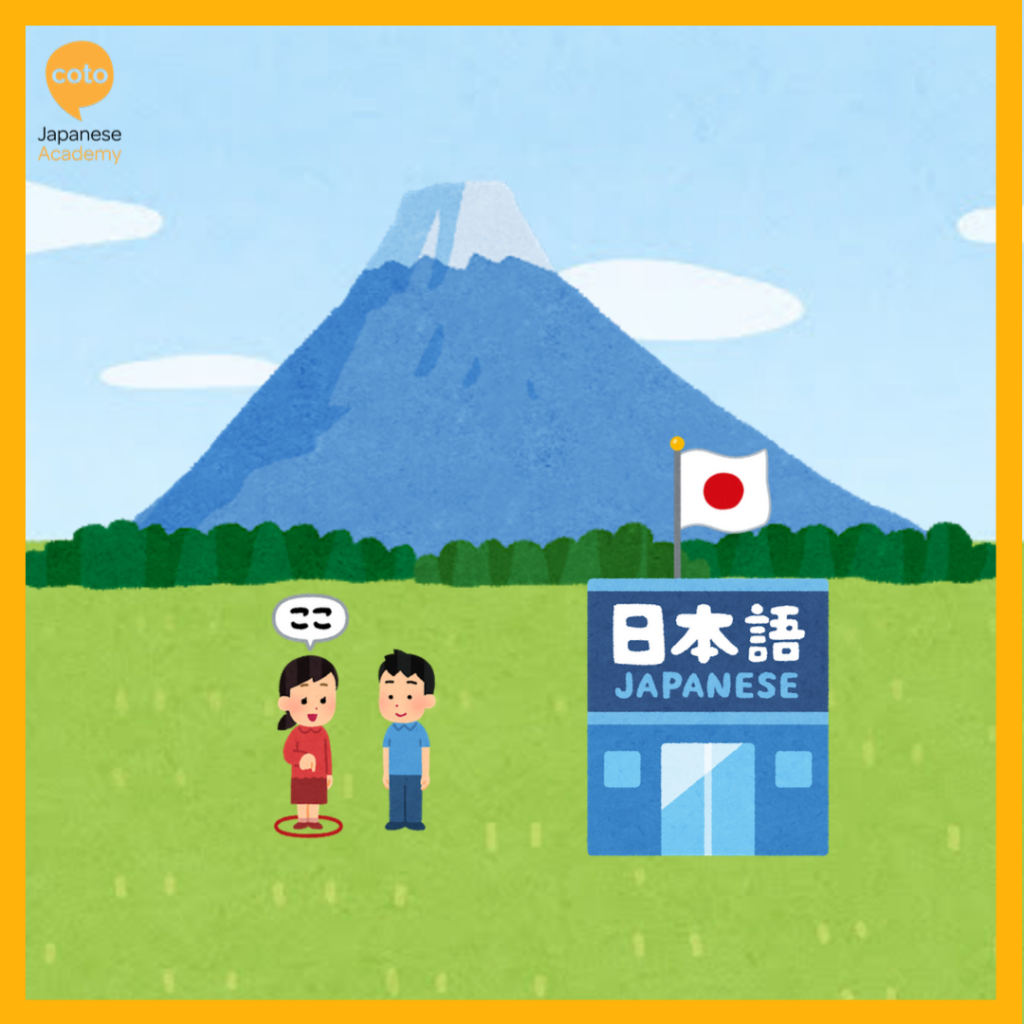
Moving on, we look at expressing “Where” through the use of the Japanese word “どこ (Doko)”! This word may often be familiar to those who love Doraemon! Why? Well, he has a door known as the “どこでもドア (Doko demo doa)” that can bring him anywhere, of course!
どこでその話を聞いたの?
Romaji: Doko de sono hanashi wo kiita no?
English: Where did you hear that from?
Why/How
Lastly, let’s examine expressing “Why” and “How.” In the Japanese language, some words have overlapping meanings, whereas some can mean “Why” and “How ” simultaneously. As such, it can be really hard to differentiate between the two sometimes. Nevertheless, some more common words can be used interchangeably to mean “Why” and “How”!
The first word, なぜ (Naze), can be used in various contexts to refer to “why” or “how.”
なんで(なぜ)お父さんがここにいるの?
Romaji: Nande (Naze) otousan ga koko ni iru no?
English: Why is dad here?
Note: なんで is used in a more Casual Setting.
The second word, どうして (Doushite), can be used in certain contexts to express “How/Why did that happen?” “Why?”
どうしてそう言ったの?
Romaji: Doushite sou itta no?
English: Why did you say that?
Last but not least, we have どう (Dou), specifically referred to as “How.” When used as a question, it can also mean “In what way/How was it done?” or “How was it?”.
そのドーナツはどう?
Romaji: Sono donaatsu wa dou?
English: How was the donut?
As confusing as it sounds, some Japanese words tend to have overlapping meanings. When to use them can largely vary and often depend on the context. Once you can familiarise yourself with when to use the word, we’re sure you’ll be able to ask questions in Japanese like a pro!
Let’s watch an animated video to revise what you have learned!
You use the interrogative pronoun “誰” (dare) to ask “who.” For example:
誰が来たのですか? (Dare ga kimashita no desu ka?) – Who came?
How do you express "what" in Japanese?
ou use the interrogative pronoun “何” (nani) to ask “what.” For example:
何を食べましたか? (Nani o tabemashita ka?) – What did you eat?
How do you express "when" in Japanese?
You use the interrogative pronoun “いつ” (itsu) to ask “when.” For example:
いつ出発しますか? (Itsu shuppatsu shimasu ka?) – When will you leave?
How do you express "where" in Japanese?
You use the interrogative pronoun “どこ” (doko) to ask “where.” For example:
どこへ行きますか? (Doko e ikimasu ka?) – Where are you going?
How do you express "why" in Japanese?
You use the interrogative pronoun “なぜ” (naze) or “どうして” (dōshite) to ask “why.” For example:
なぜ遅れたのですか? (Naze okureta no desu ka?) – Why were you late?
How do you express "how" in Japanese?
You can use different words depending on the context. For example:
“どのように” (dō yō ni) can be used for “how” in a general sense.
“どうやって” (dō yatte) can be used for “how” in a more specific sense, such as “how to do something.”
Learn more useful Japanese that you can use in daily conversations with Coto Japanese Academy – Send us an inquiry.
Are you going to live in Japan? Better prepare yourself with a Japanese self-introduction – a jikoshoukai. Early in your Japanese study, this language knowledge will help you establish yourself among Japanese friends and colleagues.
You will need to introduce yourself in Japanese in various contexts (such as school, work, parties, etc.). What should you say? How do you condense everything about yourself into just one or two minutes?
Do not be afraid; we will introduce the way to making a successful Japanese jikoshoukai step by step!
Starting A Conversation by Saying Nice to Meet You
Whether you are preparing to introduce yourself in Japanese to a curious crowd of classmates or an interviewer, saying hello first is very important! Depending on the time of the day, you may say ohayou gozaimasu, Konnichiwa, konbanwa. Do you know the difference? Or you can simply state はじめまして“hajimemashite” – “nice to meet you.”
Watch this video below to learn how to say nice to meet you!
Self-Introduction (Jikoushoukai 自己紹介)
You can politely say your name with the to-be verb “desu” or the verb “to say” (言います). You should use a more formal structure in a more formal context, such as an interview. Note that Japanese people are used to giving their family name first and their given name second.
Casual
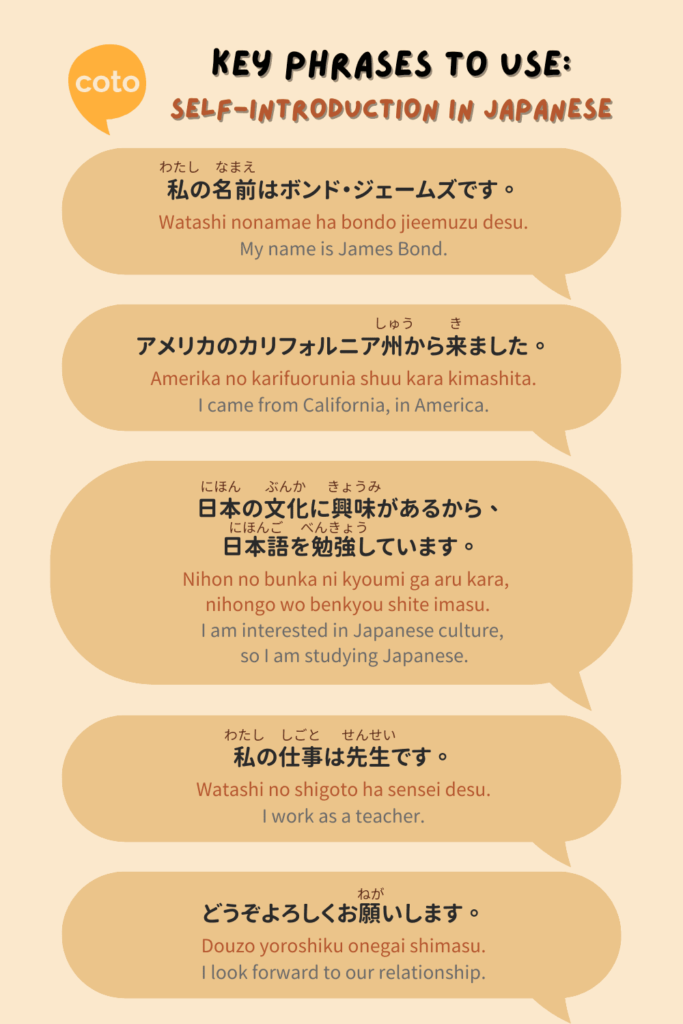
私の名前はボンド・ジェームズです。
Watashi nonamae ha bondo jieemuzu desu.
My name is James bond.
ボンド・ジェームズです。
Bondo, jieemuzu desu.
I am James Bond.
Polite
ボンド・ジェームズと言います。
Bondo, jieemuzu to iimasu.
My name is James Bond.
Formal
ボンド・ジェームズと申します。
Bondo, jieemuzu to moushimasu.
I am James Bond.
Where Are You From? ご出身はどちらですか?
Being a foreigner in Japan constantly stimulates the imagination of the Japanese. Whether you are from Spain, Germany, or Australia, they will more likely give some exotic origins and be surprised to hear the truth. So the next step in your jikoshoukai is to introduce your country and, eventually, your city! Tips: if you are American and wish to precise your state, you will have to use shuu (州, しゅう).
イギリス(のロンドン)から来ました。
Igirisu (no rondon) kara kimashita.
I came from London, England.
アメリカのカリフォルニア州から来ました。
Amerika no karifuorunia shuu kara kimashita.
I came from California, in America.
You can also tell where you are from with the word for origins (出身, しゅっしん), or an even easier way would be to give your nationality by adding jin (人, じん) after a country’s name.
マドリッド出身です。
Madoriddo shusshin desu.
I am from Madrid.
パリ出身です。
Pari shusshin desu.
I am from Paris.
ドイツ人です。
Doetsu jin desu.
I am German.
インドネシア人です。
Indoneshia jin desu.
I am Indonesian.
Why Do You Study Japanese? どうして日本語を勉強しているんですか?
This is the hot point of your introduction. Not only will the Japanese be flattered, but they will be eager to know why you are studying their language. If you are confident enough, you can speak about how long you have studied Japanese, how, where, etc.
日本の文化に興味があって、日本語を勉強しています。
Nihon no bunka ni kyoumi ga atte, nihongo wo benkyou shite imasu.
I am interested in Japanese culture, so I am studying Japanese.
字幕なしでアニメを見たいから、日本語を勉強しています。
Jimaku nashi de anime o mitaikara, nihongo o benkyō shite imasu.
I study Japanese because I want to watch anime without the help of subtitles.
Why Are You In Japan? どうして日本に来たんですか?
You could have closed earlier. But giving more details is the recipe for a good jikoshoukai, after which you will proudly answer the crowd’s questions. Many reasons might have led you to live in Tokyo, Kawagoe, or Sapporo. Whether you are in Japan for a short stay out of pure curiosity or a longer commitment, you should say…
日本語を勉強するために日本に来ました。
Nihongo wo benkyou suru tame ni nihon ni kimashita.
I came to Japan to study Japanese.
日本で働きたいから、日本に来ました。
Nihon de hatarakitaikara, Nihon ni kimashita.
I came to Japan because I want to work here.
旅行できました。
Ryoko de kimashita.
I came to travel.
卒業旅行できました。
sotsugyo ryoko de kimashita.
I came for the graduation trip.
新婚旅行できました。
shinkon ryoko de kimashita.
I came because of my honeymoon.
Introducing Your Occupation?日本で何をしていますか?
Whether you are a student or working, the “occupation” has an essential place in Japanese culture. Introducing yourself in Japanese about what you are doing will not be surprising. Students can say that they are studying at a University or in a school or state where they are (university or not) students.
大学/学校で勉強しています。
Daigaku /gakkou de benkyou shite imasu.
I am studying at a university/school.
(大)学生です。
(dai) gakusei desu.
I am a (university) student.
If you are working, the following examples should help you prepare your introduction:
エンジニアです。
Engina desu.
I work as an engineer.
英語の先生です。
Eigo no sensei desu.
I am an English teacher.
日本の会社で働いています。
Nihon no kaisha de hataraite imasu.
I’m working for a Japanese Company.
外資系の会社で働いています。
Gaishikei no kaisha de hataraite imasu.
I’m working for a global company.
Depending on your level, you can always give a richer jikoshoukai explaining in more detail what you are studying or exactly doing at your workplace.
Introducing Interests and Hobbies
This part would be wise in a friendly context. If you are meeting new people, sharing your passions in Japanese is always enjoyable. You can speak about your hobbies and what you like in various ways, but the two easiest ones are the expression to like (好き, suki) and the word hobby (趣味, shumi).
料理好きです。
Ryouri suki desu.
I like cooking.
趣味はスポーツです。
Shumi ha supottsu desu.
My hobby is sport.
趣味は漫画を読むことです。
Shumi ha manga wo yomu koto desu.
My hobby is to read manga.
The Final Step: よろしく Yoroshiku!
We have spoken before of the wonders of the Japanese yoroshiku onegaishimasu, an expression challenging to translate into other languages. A jikoushokai usually ends with this phrase, meaning in such context that you look forward to the relationship with your new friends.
Casual
よろしく!
Yoroshiku!
Nice to meet you!
Formal
今後もどうぞよろしくお願い致します。
Kongo mo douzo yoroshiku onegai itashimasu.
I look forward to our relationship from now on.
Polite
どうぞよろしくお願いします。
Douzo yoroshiku onegai shimasu.
I look forward to our relationship.
Free Infographics
Master the Art of Jikoshoukai: Essential Phrases for Introducing Yourself in Japanese.
Etiquette
Proper etiquette is essential for Japanese culture. When introducing yourself in Japanese, your manner should be professional and appropriate.
Japanese people usually do not shake hands in professional settings, so it is usually best to bow instead. People generally bow once at the beginning and the end of their jikoshoukai.
Handshakes are sometimes okay for casual interactions. Make sure to “read the air” of the situation to see if they are appropriate.
In many professional settings, it is best to keep your hands at your sides while you talk. Avoid crossing your arms, if possible!
In the case of business settings, you might also encounter exchanging business cards or meishi 名刺. Here is what you should do:
Prepare Your Meishi in Advance: Before the meeting, ensure your meishi are in a cardholder and accessible. This shows organization and respect for the person you are meeting.
Present Your Card with Both Hands: Hold your meishi to face the recipient, allowing them to read it easily. Extend it towards them with both hands, typically with the thumb and forefinger of each hand at opposite corners of the card.
Introduce Yourself (Jikoshoukai): As you present your card, briefly introduce yourself.
Receiving a Meishi: When someone offers you their meishi, accept it with both hands. It is polite to express your gratitude and acknowledge the receipt:
Review the Meishi: After receiving it, take a moment to look at the card carefully. Show interest and respect for the information provided.
Properly Store the Meishi: After examining it, place it in your cardholder or a respectful location, not in your pants pocket or anywhere informal.
If you are having a meeting with the person after changing the name card, you should place it on the table on the right or left side during the meeting!
Here are some blogs you can take a look on Japanese manners:
Now, you are ready for your very first 自己紹介 jikoshoukai! Always remember that a self-introduction with a group of friends or with your new boss will be different. You can be casual with people your age but should always be formal in a business environment. Be even more prepared to give a strong and polite self-introduction for a job interview! Need more tips on job interviews? Read the following blogs!
Once you’ve learned how to self-introduce yourself in Japanese, we recommend practicing them with immersive Japanese listening conversations. Our Japanese podcasts are a great way to do this. The NHK World Japan Audio Shows also offer excellent listening practice for learners at any level.
FAQ
How do I say "Nice to meet you" in Japanese?
“Hajimemashite” (はじめまして) is the most common way to say “Nice to meet you” in Japanese.
How do I introduce my name in Japanese?
You can use two common phrases:
“[Name] desu” (〇〇です) – This is the most straightforward way to say “My name is…”
“[Name] to mōshimasu” (〇〇と申します) – This is a more formal and humble way to introduce your name.
How do I say "I am from…" in Japanese?
You can use the phrase “〇〇から来ました” (〇〇からきました) where “〇〇” is the name of your country or region. For example, “Nihon kara kimashita” means “I am from Japan.”
How formal should my self-introduction be?
The level of formality depends on the situation. A simple introduction is okay in casual settings. However, a more formal introduction is appropriate in more formal settings like job interviews or business meetings.
What are some polite phrases to use in a self-introduction?
Some polite phrases you can use are:
“Yoroshiku onegaishimasu” (よろしくお願いします) – This phrase is used to ask for kind treatment or cooperation.
“Dōzo yoroshiku” (どうぞよろしくお願いします) – This is a more polite way to say the same thing.
Is there a specific order in which one can introduce oneself to Japanese culture?
Generally, you start with a greeting, followed by your name, where you are from, and occupation. You can also add information about your hobbies or interests.
Are there any cultural nuances to be aware of when introducing oneself in Japanese?
Yes, there are a few things to keep in mind:
Bowing: Bowing is a common gesture of respect in Japanese culture. A slight bow is usually sufficient for a casual introduction.
Eye contact: While maintaining eye contact is essential in many cultures, in Japan, it’s considered polite to avoid prolonged eye contact, especially with people of higher social status.
Humble language: Using humble language can show respect and humility, especially in formal settings.
Practice introducing yourself in Japanese with Japanese Courses at Coto Japanese Academy!
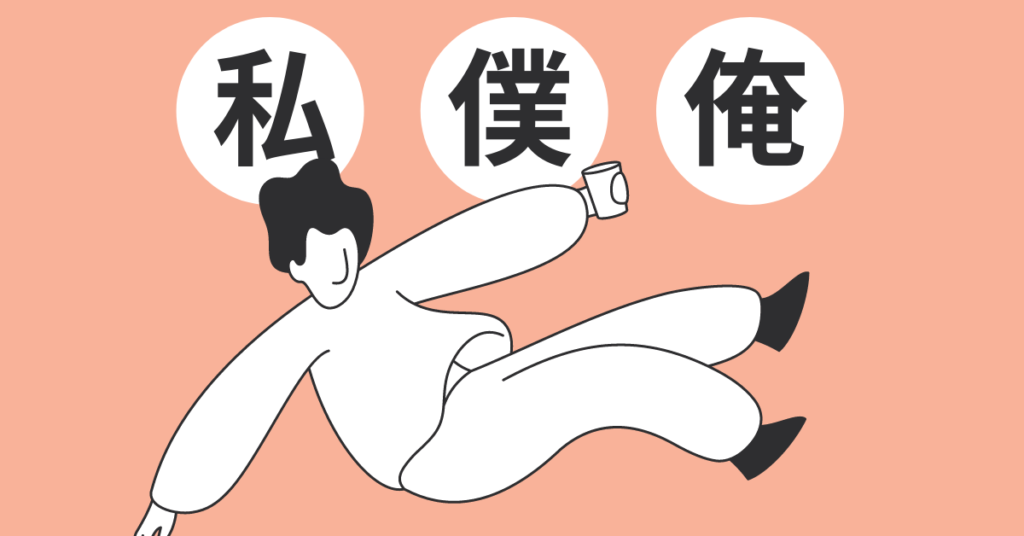
We want to make it clear that, despite the title, watashi, boku and ore aren’t the only ways of saying “me” in Japanese.
There’s only “me”, “myself” and “I” in English, but when it comes to Japanese first-person pronouns, the options are seemingly endless.
So how do you know you’re using the right “I” in Japanese? If you watch enough anime, films or even the news, you’ll notice a pattern: watashi (わたし) stands as the most basic form of the first-person pronoun. Boku (僕) and ore (俺) are next respectively.
Then again, there are layers of subtext, social factors and psychological distance taken into consideration. The Japanese culture is complex, and this complexity extends to the language, too.
Ultimately, we want you to avoid feeling overloaded. It’s just “I”, after all — why make things complicated? Thankfully, a lot of Japanese speakers don’t even stick to one pronoun. You’ll learn how to differentiate between the “I”‘s and find out which one is best for you.
About Watashi, Boku, Ore — and A Million Other Japanese First-person Pronouns
If English is your native language, here’s a did-you-know: a lot of languages have multiple first-person pronouns, like Vietnamese, Indonesian and Korean. Between all of these, Japan has the most first-person pronouns.
How and when you refer to yourself depends on the person you’re talking to, situation and context. In other words, it depends on how you want to present yourself.
For example, if you use watashi (わたし), it’s considered formal — polite, even. On the other hand, try using ore (俺) in front of your boss and you might risk losing your job in Japan (or, better yet, being told to voluntarily quit from the company).
This is why you’ll notice most Japanese people bouncing from one pronoun to another when they’re with their close friends, family or colleagues.
You’ll notice a lot of them have their go-to pronouns, too. When it comes to gender differences in spoken Japanese, men and women tend to favor different pronouns. Social standing also affects how people refer to themselves, as well as how they refer to other people.
For example, 72% of Japanese men will use “ore” (俺) with their friends. When they’re talking to a stranger, more than 60% of them will use “boku” (僕). On the other hand, to an unknown visitor, 75% of Japanese women will use “watashi”.
Of course, watashi, boku and ore aren’t the only first-person pronouns in Japanese, because they don’t include all the phonetic strains and regional differences.
Ever heard of ‘”ora” (おら)? It’s an informal Japanese personal pronoun from the Kanto dialect, similar to “oira” (おいら). The impression you’ll get when you use this is that of a “country bumpkin” — someone from a very rural area.
We’ll go over other ways to say “I” in Japanese as we dive deeper into the article.
Japanese Language Doesn’t Need First-Person Pronouns
Unlike most languages, Japanese grammar doesn’t require you to include first-person pronouns, so you can omit the watashi, boku or ore. This is because it doesn’t even need a subject in a sentence, to begin with. Let’s take a look at an English and Japanese example.
銀行へ行ってきます。 Ginkou e ittekimasu. I’m going to the bank (and returning again).
You’ll notice that, in the Japanese example, the typical watashi (わたし) is omitted. The textbook example should have been, “わたしは銀行へ行ってきます” — which would have made more sense of the English translation.
Here, the literal translation is “Going to the bank.” In this context, we know that the person saying that is referring to themself, so you don’t need to put an extra “I” for clarity.
A great rule of the thumb is this: When the meaning is still clear, you can remove pronouns that mean “I” or “you” in Japanese. As a comparison, let’s use the same example sentence from above and tweak the context a little bit.
A: 誰が銀行にいますか? A: Dare ga ginkou ni imasuka? A: Who is in(at) the bank?
B:銀行へ行っていますが、家にいます。 B: Ginkou e itteimasuga, ie ni imasu. B: Going to the bank, in the house.
In the dialogue above, it’s not clear who is going to the bank and who is in the house. In this case, you’ll need to include the pronouns. A better answer should be like the one below:
B:私銀行へ行っていますが、お兄さんは家にいます。 B: Watashi wa ginkou e itteimasuga, onii-san wa ie ni imasu. B: I’m going to the bank, but (my) brother is in the house.
On the other hand, there are verbs that imply the subject and object of the sentence. In English, we use “to give” and “to receive” regardless of who is giving and who is talking.
In Japanese, there are two verbs for expressing ‘to give’: あげる (Ageru), くれる (Kureru); while ‘to receive’ is indicated by もらう. Kureru (くれる) means to “give something from someone to me” (in other words, “receive”), while ageru (あげる) means “me giving something to someone else”.
This rule makes pronouns unnecessary because the subject (giver) and receiver is already insinuated. .
For now, let’s have a look at the different characteristics of watashi, boku and ore. Once your level in Japanese has improved, it may be a good idea to try and change the first-person pronoun you are using.
This can change depending on your character, the setting, or even your conversation partner.
Watashi: 私 (わたし)
It’s the safest choice when you’re a beginner. In formal situations, it’s the safest choice and doesn’t carry any gender nuances.
In casual speech, however, わたし can give off a “feminine” feel, and it’s typically only used by women. When men use it in a casual context — when talking with a friend or family — it’ll sound stiff.
A polite way to refer to yourself, 私 (わたし) is the most general expression that is used by both women and men everywhere from formal occasions to business and public situations. If you are not really close to the person you are talking to, this word would be your best bet to avoid any offense.
But as most Japanese typically avoid referring to themselves, they’d usually just drop the “watashi” from their sentences. Take a look at the example below.
私は和菓子が好き → 和菓子が好き。 Watashi wa wagashi ga suki → Wagashi ga suki. I like Japanese traditional sweets.
As explained before, as long as it’s clear the sentence refers to yourself, you don’t need to state that “you” like sweets — we know you’re talking about yourself, after all.
Watakushi: わたくし
You’ll hear this word straight out of historical anime, used by noblemen and women. わたくし, or watakushi, is the more polite version of わたし — the most formal Japanese first-person pronoun, even.
In fact, it’s so outdated that it’s not a part of modern textbooks.
Unless you’re working in a very uptight (or conservative) working environment in Japan, we don’t recommend you to use わたくし. It may be the most “civilized” choice — it sounds sophisticated — but if you use it in semi-formal situations, you’ll ironically sound stiff.
ですが、わたくしたちの思いは貴族には考えなのかもしれません。 Desu ga, watakushi tachi no omoi wa kizoku ni wa kangaena no kamo shiremasen. However, our thoughts may be that of an aristocrat.
One of the only times we hear someone use わたくし is in official announcements, like when politicians hit the street for their campaigns or when a big public figure apologizes due to a scandal. In other words, if you’re not saying sorry or dwelling in super-serious businesses, you can forget about わたくし entirely.
Atashi: あたし
あたし is not really a new type of pronoun. It’s a shortened, more feminine pronoun that strains from わたし, so it’s not used in written language. Instead, you’ll only hear it in conversations, among younger women and children, who generally have trouble pronouncing “w” from わたし. Because of this, あたし sounds cute and endearing.
Like わたし, there’s a feminine pronoun that strains from わたくし too: あたくし.
Boku: ぼく (僕)
Boku is an expression used by mostly men. Originating from words like geboku (manservant) and kouboku (public servant), this word’s popularity began to spread among the younger generation as they’d use this to refer to themselves in a humble manner.
Although technically ぼく is used to address someone equal or lower to you, you can think of boku as a gentler, semi-formal pronoun alternative. This is why it’s one of the first first-person pronouns Japanese boys learn and commonly use.
僕もわかんない。 Boku mo wakannai. I don’t know too.
Boku is perceived as humble, but can also carry an undertone of “feeling young” when used by males of older age. You’ll hear this used on boys among their coworkers, senpai or, yes, bosses.
In formal situations, most men use either 私 or 僕. Even though it’s a common choice for adult men, you may come off as sounding childish and immature — a “mama’s boy”, even. Most young boys use boku in classrooms, but later on, as they get older and more comfortable, they’ll use おれ.
Today, it is more commonly used in close relationships or as a softer alternative to the word “ore” (see below; it sounds more modest, reserved and polite. Because of this, you’ll notice more girls use boku (ぼく) too.
Boku for Young Boys
However, boku can also be used as a second-person pronoun for young boys. It’s a way to refer to a boy you don’t know. You’re basically calling him from his perspective, so the term can come across as endearing and affectionate.
僕は何歳ですか? Boku wa nansai desu ka? Boku (small boy), how old are you?
You’ll notice parents calling their young son by this pronoun, too, adding the suffix ‘chan’ after ‘boku’ (boku-chan). One of our host families once said that they do this to avoid their children using their first names when they want to say “I” — something that a lot of children do. To this, they train their kid to associate themself with “boku” (instead of their real name).
僕ちゃん、何を食べる? Boku-chan, nani o taberu? Boku-chan, what do you want to eat?
Ore: おれ (俺)
As a first-person pronoun with an extremely rough image, it is only used in a casual setting between people who are very close. おれ (俺) is written with hiragana or katakana, but you may often find them stylized in katakana, オレ, in manga panels and written Japanese as an emphasis.
You’ll see boys transitioning from using “boku” to “ore” as they grow up. Some people even use おれ (俺) informal sentences but keep in mind that you’ll risk sounding inappropriate.
You might also think that because おれ is the most popular first-person pronoun for Japanese men, you’ll need to jump to using the word as soon as you can speak Japanese.
A word of advice: unless you’re wholeheartedly confident that your Japanese is very, very natural, don’t. Even in close relationships, ore and boku create different images.
おれ can sound cocky, used to indicate aggressiveness and masculinity, so if you mix-and-match おれ with formal sentences (i.e. you’re not ready to speak Japanese effortlessly), you’ll risk sounding awkward. Take a look at two examples below for comparison.
俺は知らねえな。 Ore wa shiraneena. How the heck do I know.
俺は知りませんでした。 Ore wa shirimasen deshita. I do not know.
Both mean “I don’t know”, but think of 俺は知らねえな as the equivalent of “How the heck am I supposed to know.” If you mix 俺 with something formal like 知りませんでした, it won’t sound natural, like putting a slang in a formal speech.
As a heads-up for Japanese learners, be aware that using 俺 could make you sound inadvertently cocky. 俺 can also be tricky to master for second-language learners because it doesn’t sound natural unless you speak Japanese really fluidly and effortlessly.
俺 can sound awkward when other elements in a sentence don’t match the aggressiveness and masculinity of 俺.
You’ll need to “match” the rough vibe of おれ, so if your personality and fluency aren’t there yet, opt back to ぼく.
Uchi: うち
Another way to say “I” in Japanese is うち, a sister term to おれ. In Tokyo, it’s used by young girls. In Kansai, うち is used by both young and older women. In written form, it’s spelled with kana.
You can think of うち as the female version of 俺; it sounds more relaxed than the stiff わたし, so more young girls and women from elementary to college students begin to make this their default go-to pronoun.
In fact, うち is the most used first-person pronoun by female elementary school pupils. But be careful too. Like 俺, using うち can be inappropriate as it sounds slangy and strange when you use it outside the right context, social group and dialect.
うちのせいだ。 Uchi no sei da. It’s my fault.
More importantly, because うち means “one’s own” or “house”, using it creates a sense of unity or in-group, so you can use it to include your family, company our team.
うちの娘が迷惑をかけてすみません。 Uchi no musume ga meiwaku o kakete sumimasen. I’m sorry that my daughter caused trouble.
うち is also used in a less formal business setting as a way to say “our company”.
Jibun: じぶん (自分)
Technically, 自分 (じぶん) means “myself”, and it could be made into aJapanese adverb like this:
自分でケーキを作りました。 Jibun de keeki o tsukurimashita. I made that cake by myself.
自分 can be made into a first-person pronoun, but it does make you sound masculine, modest and distanced. It’s not traditionally used. the informal setting, but it does indicate you’re showing humility and respect to the opposite speaker. Because of this, you’ll hear 自分 used in a lot of sports and military groups.
自分は、嘘をついていませんよ。 Jibun wa, uso o tsuiteimasen yo. I’m not lying.
In the Kansai dialect, 自分 can also be used as a second-person pronoun, but you may come off as sounding too friendly and coarse. Think of it like saying “You, yourself,” which can carry an accusing nuance if not used correctly.
自分、どこの国なん? Jibun, doko no kuni nan? You, where are you from?
Using Your Name As Japanese First-person Pronoun
If you grow up speaking English, it might sound weird to hear that a lot of children from Asian households use their own names to address themselves — including us.
Usually, in Japanese, children tend to use their own name or nickname because that’s what their parents call them. It’s the first identity they associate themselves to, but as they grow up, they’ll transition to preferred Japanese first-person pronouns: boku, ore, watashi (atashi) or uchi.
Still, a lot of us switch to using our names as first-person pronouns when we’re around our family.
For boys who use boku, they risk sounding like a mama’s boy. For girls, it’s when they use their own name (with or without the ちゃん).
If you’re into the kawaii culture, go ahead, but we don’t recommend calling yourself outside of family interactions because people see it as childish or icky — like you’re trying too hard to be cute. Like this:
モエもほしい! Moe mo hoshii! Moe (I) want it too!
Adults — mostly women — who use their own name for themselves are considered as burikko (ぶりっ子), a Japanese slangterm for girls who pretend to be cute in front of guys to get their attention.
Using Family Role As Japanese First-person Pronoun
This applies when you’re speaking to someone younger, generally. For example, if you’re a mom or a dad, you can call yourself okaa-san (お母さん) or otou-san (お父さん) to address yourself in front of your children.
お母さんは駐車してくるから、ちょっと待ってね。 Okaa-san wa chuusha shitekuru kara, chotto matte ne. Mom (I) am going to park my car, so wait a moment, okay.
Nowadays, you’ll also find parents using the more-universal mama (written as ママ) and papa (パパ). Of course, family-role first-person pronouns aren’t just limited to moms and dads. As long as that family title can end with a ~さん or ~ちゃん, you can use them (check our article on main Japanese family terms).
It’s also not uncommon to use family terms to someone who’s not your family, but keep in mind that this is only when you’re talking to a child. For example, when you see a small boy seemingly lost in the park, you can call yourself a “Big Sister” (お姉さん・おねえさん).
ママはどこか?お姉さんが、手伝ってあげようか? Mama wa doko ka? Onee-san ga, tetsudatte ageyouka? Where’s your mom? Big Sister (I) will help you.
Social Titles As Japanese First-person Pronoun
If you’re a professional — like a teacher, doctor, author or even a manager — you can use that title as your go-to pronoun during work. Again, this really depends on the subcontext. If you call yourself “Sensei” (先生) in front of other teachers, you’ll sound childish.
Commonly, teachers will use 先生 when they’re in the classroom instead of watashi (わたし), boku (ぼく) or ore (おれ).
誰が先生を助けてくれる? Dare ga sensei o tasukete kureru? Who wants to help Sensei (me)?
Keep in mind that in the Japanese language, 先生 is used beyond the primary definition of “teacher”. Doctors, authors or judo masters — basically anyone with a specific skill, practical art or technique — use 先生.
Other than that, we’ve also heard store managers using their title tenchou (店長) to address themselves, especially when they’re talking to a young staff.
店長が明日休みだから、お店を頼むよ。 Tenchou ga ashita yasumi da kara, omise o tanomu yo. Tenchou (I) will take a break tomorrow, so I’ll leave the store to you.
What’s next after learning watashi, boku, ore and these Japanese first-person pronouns? Read more about:
Want to learn more Japanese like Watashi? Take our free Japanese language assessment test
Get in touch with us and find out how we can help you achieve your Japanese language target. If you’re unsure where you are, we provide a free Japanese level check. You can also contact us at info@cotoacademy.com for any questions about course options and details.
Coto Japanese Academy is a unique Japanese Language School in Iidabashi Tokyo. We offer relaxed and fun conversational lessons for all levels of Japanese learners. If you are interested in our courses, please visit our contact page.
Have you ever wonder how and where did the Japanese language come about? or any Japanese language facts?
Here are the top 10 mindblowing ones for you!
Different ways of saying “I”
1. There are many ways to refer “I” in Japanese
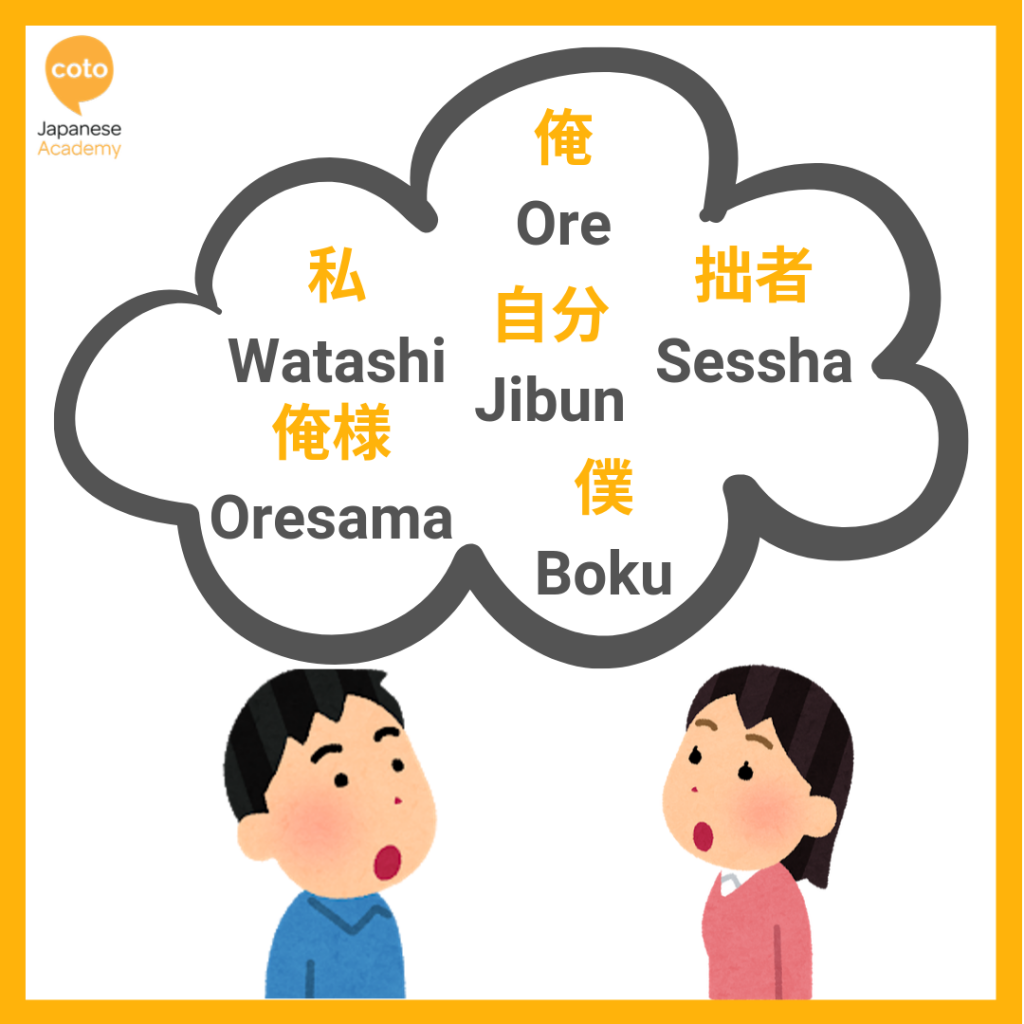
In English, you refer yourself as “I”. But in Japanese, there are many more ways to refer to yourself. Other than 私 (watashi), there are 僕 (boku), 俺 (ore), 俺様 (oresama), 自分 (jibun) and 拙者 (sessha).
“僕” (boku) ー It is often ussed by males. This is less formal than “私” but usually accepted in a business settling as well.
“俺” (ore) ー Similar to “僕””, it is often used by males. However, “俺” has a more aggressive tone than “僕”. I would not recommend using this word as it would be considered rude towards the Japanese.
“俺様” (oresama) ー You might have heard this word in a couple of animes like Dragon Ball. For this word, you should not use it in front of your boss.
“自分” (jibun) ー This word is referred to yourself. The interesting part is you can use “自分” as a second person too! Confusing right?
“拙者” (sessha) ー Another classical way of saying “I” which means “clumsy person”. You should use this word only when you are a samurai because being humble about their abilities was a samurai thing to do.
Japanese is the only official language in Japan
2. Japan is the only country to have the Japanese language as their official language.
But, this does not mean Japan is the only place where the language is spoken.
For example, in the Republic of Palau, Japanese is considered a minority language is spoken there. As of 2010, 1% of Californians and 15% of Hawaiian residents speak Japanese!
The most fast-paced language in the world
3. The Japanese language is one of the most fast-paced spoken languages in the world.
Compared to 6 other more major languages like English and Mandarin, the Japanese language definitely out beat them.
No relation to any other languages in the world
4. The Japanese language has no genetic relation to any other languages.
Kanji is adopted from Chinese characters and used as a Japanese writing system. Despite popular beliefs, Japanese is not related or derived from the Chinese language at all.
They do not belong to the same language family as Chinese. Considered to be one of the most unique languages in the world, the Japanese language is said to have no direct derivation! How interesting is that!
Romaji has its roots in Christianity
5. Romaji has an interesting origin.
During the 16th century, some may think Romaji came from the European countries. But, as a matter of fact, it does not!
Romaji has its roots in Christianity!
During the 1500s, the romaji is developed by a Japanese Catholic. They wanted to help European missionaries evangelize and promote their Jesuit religion in Japan without having to learn the complex character systems of Japanese. The oldest form of Japanese romanization is based on Portuguese.
Fun fact, the first Japanese-English dictionary to feature romaji was published by James Curtis Hepburn in the 1800s. Thus, Hepburn Romanization.
9th most commonly spoken language by native speakers
6. Japanese is the 9th most commonly spoken language by native speakers.
With around 130 million native Japanese speakers, this makes it the 9th most spoken language. It is most space-concentrated of all the most spoken languages.
Even though Through Globalisation Japanese cultures such as anime, manga and even JPop are becoming more popular. Thus, foreigners are interested in learning Japanese due to the spread of Japanese culture.
Katakana
7. The Japanese language boasts a specific alphabet system for writing foreign words.
During the Heian period, Kanji words are hard to read and to accommodate this, 片仮名 (カタカナ) is adoptedfor the purpose of aiding in the reading of Kanji. Thus, making it easier for the Japanese to read them.
Back to 951AD, 片仮名 (カタカナ) was used by Buddhist monks to annotate Chinese writing for Japanese readers, similar to 振り仮名 (ふりがな).
Over time, it became a way for Japanese officials to communicate with foreign traders. 片仮名 (カタカナ) consists of 48 syllabograms.
Japanese is not a tonal language
8. Japanese is not a tonal language.
The Japanese language is monotonous as compared to English. Many East Asian languages are toned in nature. For example, Mandarin and Thai rely on tone to convey meaning.
Like all languages, the Japanese do have a certain rhythm and cadence to its words and sentences. For non-native Japanese speakers, learning the cadence of the language can be difficult and challenging.
Little is known about Japan’s prehistory
9. Little is known about the Japanese language during their prehistory.
The Japanese language’s origins that came about is still unknown today. Some sources claim that the Japanese language was brought to Japan during the early-to-mid 2nd century BC.
Others say that Japanese is connected to the Ural-Altaic language family, which includes Turkish, Mongolian, Machu, and Korean. Japanese also shows similarities to Austronesian languages like Polynesian.
There is no direct evidence that can be discerned about this period of Japanese must be based on the reconstruction of the old Japanese.
No plural form in Japanese
10. The Japanese language does not have a plural form
Those who have studied the Japanese language would have noticed that they do not have a plural form. For example, in English, if it is in the singular form, we say “This is a book”. In plural form, we say “these are books”. But, Japanese is otherwise.
We say “これはほんです” (kore wa hon desu.) – This is a book, does not matter if it is singular or plural. Japanese have counters to explain if it is a lot such as ”たくさん” (takusan) – A lot or ”さまざま” (samazama) – Various.
Despite whether its singular or plural, the form of the word does not change.
Do you feel that your mind has been blown by these facts? Does it excite you to learn more Japanese? Click the link below for the different types of Japanese courses you can take,
If you are interested in studying Japanese in Tokyo, find out more about our school by filling out the form below.
Let’s face it: Japanese YouTube channels redefine what it means to go above and beyond for online entertainment.
Content creators in Japan wear a lot of faces — both literally and figuratively. They’re propelled by outlandish challenges, mukbangs and squeamish close-ups of fish cutting. We’re talking about consuming ten packs of fire noodles in one seating and cracking open sea cucumbers and poisonous starfish.
But behind the questionably thick veil of Japanese Youtubers, a lot of Japanese Youtube channels have dedicated themselves to helping their international audience learn the Japanese language and culture, proving that YouTube can be an educational platform, too.
So where do you go when you’re looking to climb out of the rabbit hole of freaky Japanese content — and into something more, say, digestible?
Of all the many gathered in the digital creative landscape, we’ve collected 50 of our top Japanese YouTube channels you should subscribe to. A lot of them provide free online Japanese learning resources.
Regardless of whether you’re a beginner, intermediate or advanced, there are Japanese YouTube channels waiting for you.
We’re breaking them down into three categories: Teachers, vloggers and Japanese culture content creators.
Don’t know where to start? Check out Coto’s YouTube account or Coto’s blog section for more helpful Japanese tips and learning materials.
Recommended for beginners, JapanesePod101 is a channel that covers topics ranging from grammar to vocabulary to reading and many more! It is a verified Japanese Youtube channel with over 2.3 million subscribers. They would host daily YouTube live streams for Japanese listening, speaking and writing.
This channel has listening practices. Not only that, the videos give you practice and they have romaji and Japanese words on the screen. It would be easy to follow. Their videos cater to both English and Chinese learners.
This channel has listening practices. Not only that, the videos give you practice and they have romaji and Japanese words on the screen. It would be easy to follow. Their videos cater to both English and Chinese learners.
Minori is perfect for beginners learning N5 and N4 who want to take a challenge. All of their videos are in Japanese to hone your listening skills, but you can always turn on their multilingual subtitles if the lesson goes a bit too hard. The YouTube channel uploads almost daily, and all of the Japanese tutorials are designed for students to map smooth progress. They break down vocabularies, grammar structures and questions. You will also have a practice session at the end.
There’s an ongoing debate among the Japanese learning community about textbooks: Minna no Nihongo, or Genki? Helmed by Rose, you pick the prior, then NihonGoal is the perfect YouTube channel to walk you through the book. They break down the study into three series: vocabulary, grammar and Kanji. Rose isn’t a native Japanese speaker, though, so if you are focusing on speaking and Japanese pronunciation, head somewhere else.
Andy’s presence is unmatched. Combining playful monologues and great presentation skills, Tokini Andy becomes a channel to help Japanese learners nail Japanese conversational fluency — all while having fun. The textbooks he uses are also the Genki books, and his videos are aptly slow and practical. You’ll get sample sentences, extra tips for Japanese grammar and useful vocabulary. He also has his own Patreon.
If you hear him blindfolded, you might assume he’s a Japanese — or at the very least, a hafu — but Dogen is one of the few talented international Youtuber who just so happens to nail that spot-on Japanese native-level accent. His YouTube channel primarily consists of comedic skits and quirky storytelling about very relatable Japanese antics that foreigners will understand if they live in Japan long enough. You can head to his Patreon for more thorough (and serious) Japanese phonetic lessons.
Japanese Ammo with Misa is flexible for both beginners and advanced learners. She gives lessons on Japanese grammar and vocabulary. There are also videos for useful Japanese phrases as well as topics on Japanese culture. The channel has many playlists that can help you enhance your Japanese learning.
Miku’s videos are a fun and effective way of learning Japanese. Her playlist has grammar and listening to videos for practice for beginner to intermediate learners. Not only that, you can practice your speaking skill, as well as she has a playlist called “speak with me”. She also does videos on learning Japanese with Terrace House as it would be interesting and fun to take it out of the classroom. You’ll also have access to extra videos if you sign up for her Patreon.
This is one of our recommended Japanese Youtube channels that’s perfect if you are considering taking the JLPT exam. The person goes through questions about how to answer and tips on how to answer them. He explains vocabulary to suit everyone’s needs. His videos have a variety of question papers from JLPT, kanji, grammar, hiragana, and katakana. As for JLPT, he has N5 to N2 practice papers which he goes through it. He also does a video on the MEXT scholarship exam.
Learn Japanese Online with BondLingo upload videos about the Japanese language and cultures. Not only are there online lessons, but there are apps on mobile as well. Their playlist consists of the JLPT practice exam – grammar, N5 to N2 but also pronunciation videos as well! They also have live streams for Japanese study sessions, and it’s always good to join the room to make your learning journey less lonely.
This Japanese Youtuber gives free videos for JLPT preparations ranging from all levels. His lessons are pretty laidback and chill, and he even has some content dedicated to learning Japanese from anime. He has a dedicated playlist called the Writing Systems for introductions to all aspects of the Japanese writing system: hiragana, katakana and kanji.
Learn Japanese From Zero is an informative channel that posts videos every Monday, Wednesday, and Friday. Every video goes through a respective lesson on the channel’s textbook, and materials are only available online. This makes it easy for anyone to learn Japanese and take notes. He also has his own Japanese textbook.
Yuko Sensei has been teaching Japanese at the university level for 20 years, so to say that she is a Japanese language expert would be a safe bet. Her videos discard any boring PowerPoint, and instead focuses on interactive color-coded animations to help you understand Japanese grammar, vocabulary, and scripts. For those learners who cannot attend classes or do not know where to start learning, this channel is good for online learning courses. She also offers free trial courses.
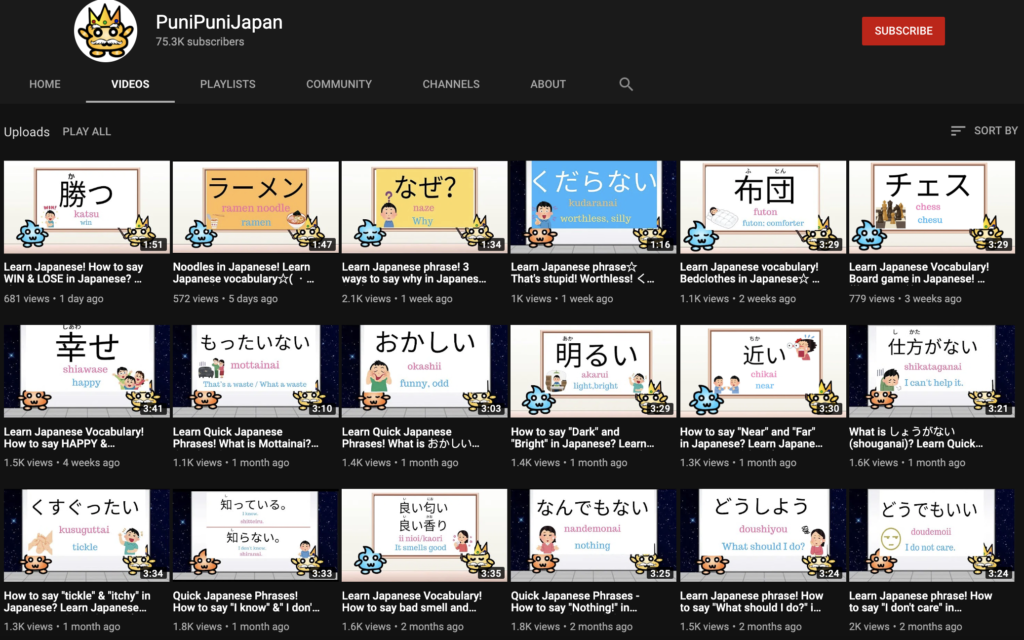
PuniPuniJapan’s videos are well-illustrated and narrated with clear explanations. It is more recommended for beginners who started learning Japanese. They cover topics such as katakana, grammar, vocabulary and more. Besides that, PuniPuniJapan also uploads videos about Japanese culture.
The channel provides step by step learning. They have different episodes and on the episodes, they teach learners different topics such as negative state, adjectives and sentence ending. This channel has a lot of different variables when it comes to learning Japanese. Their video areas are very classroom-based and it is very easy to follow.
ライト Japanese Library features Light, who is a foreigner who speaks Japanese, English, and Afrikaans. On his channel, he has videos teaching Japanese as well as some daily vlogs with his daughter. He also gives many different tips for living in Japan.
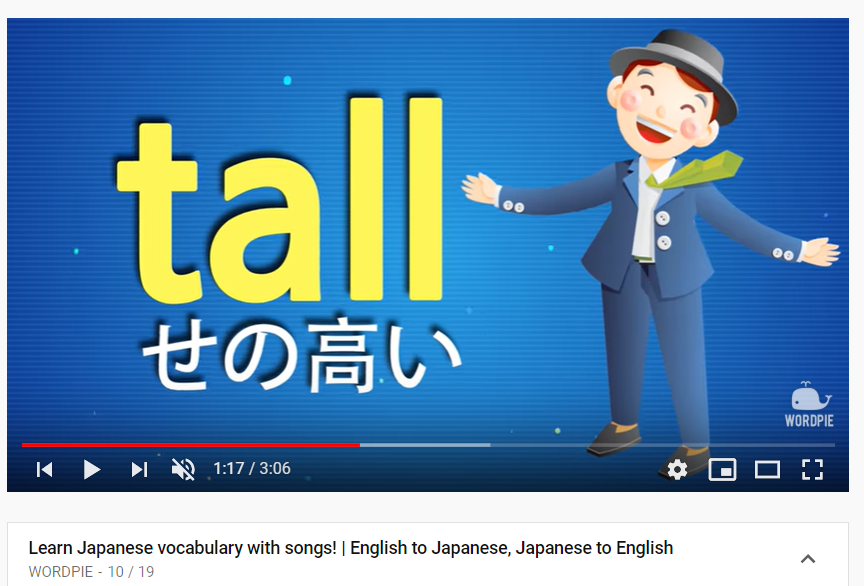
This channel is good to learn Japanese because their videos are in songs. Their videos are appealing and it is easy to follow as they have Japanese words plus English words are well. Not only that, their videos are all about Japanese vocabularies.
It is very easy to learn Japanese grammar and kanji on this channel. Their videos have an animation of a teacher teaching. Their video content is also very easy to understand. Their kanji videos are step by step and it teaches you basic kanji and how to write it.
This channel is very good at making simplifying Japanese and making it easier to understand. Their videos are taught by an “android sensei”. Their explanations are very good and their content is original and engaging. Her methods of teaching Japanese are a little unorthodox, but very effective. Unfortunately, the owner of the channel has passed away, but the channel remains up and is still a very good resource.
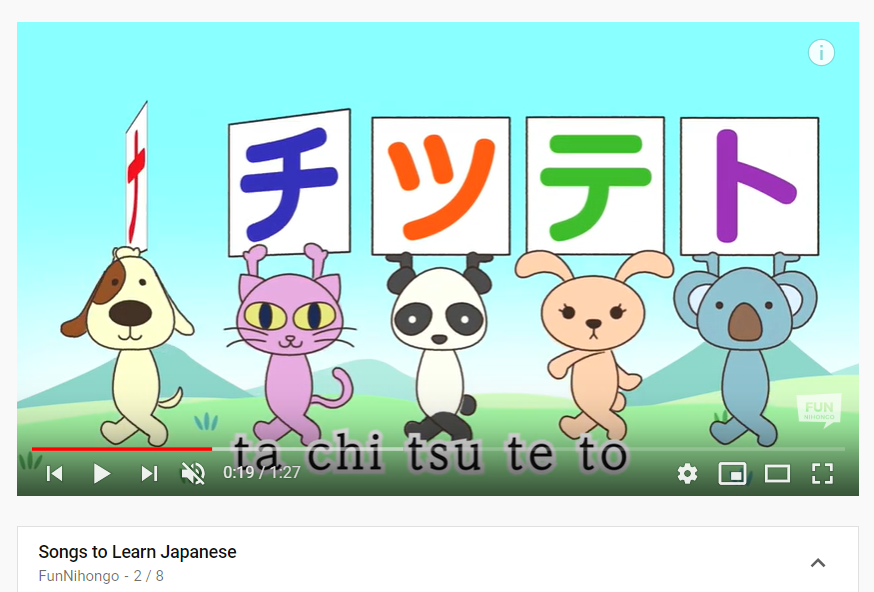
This channel is good to learn basic Japanese because they make learning videos into songs so it would be easier to learn. The videos are interesting as well. They only have 1 playlist of videos such as day of the week song or the hiragana song. This channel is good for both adults and children.
わさび or Wasabi is a Japanese Vtuber teacher that makes videos that are great for Beginner and Intermediate learners. She makes grammar and listening videos as well as a lot of YouTube shorts that go over vocab words. She is a much smaller creator, and is able to respond to a lot of questions in her comments.
Nami Ohara is another tJapanese grammar, vocabulary, and listening. Also, there are many videos on Japanese culture. Another feature of this channel is that there are many listening quizzes and tests for you to practice your listening skills. Not only that, they have many videos on learning Japanese through songs.
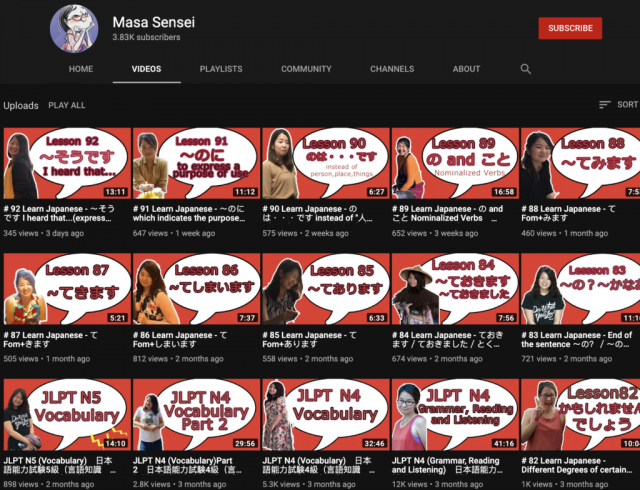
This channel is great for beginners in learning Japanese. Masa Sensei, the creator of this channel, makes weekly videos on Japanese grammar. In every video, she explains what grammar means and how to apply it. She also gives clear illustrations and examples in her videos.
This channel is very good for Intermediate and Advanced learners. Sambon Juku has multiple playlists for everything from Phrases to Hiragana. He also has series going over N3, N2 and N1. He has very clear explanations and example sentences. His videos are narrated in Japanese, but he also has English subtitles if needed.
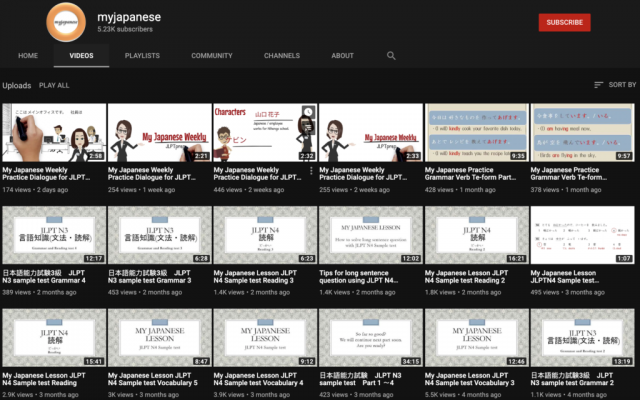
myjapanese is a channel covering levels from beginner to advanced. The topics covered are hiragana, kanji, JLPT, and business Japanese. There are many informative videos and are all well narrated and explained in English. The channel posts a new video every week.
Watching anime and Japanese TV programs is a great vehicle to accelerate your Japanese skill. Easy Peasy Japanesey disects scenes from iconic anime like Attack on Titan and Demon Slayer and breaks down the Japanese vocabularies and grammar structure involved. It’s a great, seemingly effortless away to learn Japanese — just don’t binge watch them all at once if you’re an anime fan who’s avoiding gut-wrenching, tear-inducing spoilers.
Yumi Ura is a channel that is especially good for Japanese students preparing to take the JLPT N2 and N3 level tests. All the videos in this channel are on topics for the N2 and N3-level tests. Their videos allow viewers to practice their listening skills as it is everything is explained Japanese.
Japanization is good for learning basic Japanese. Started by a native Japanese, he makes lesson videos on Japanese grammar and vocabulary, as well as on different aspects of Japanese culture. He explains well in English in every video too. Thus, making it easy for non-Japanese listeners to follow.
Registering for a JLPT exam can be unnerving, let alone preparing for it. Enter Clayton MacKnight, your perfect virtual study buddy. He’s currently residing in Osaka and has recently passed N2. His channel that features a variety of videos to help those taking JLPT. Expect all things Japanese covered in his channels, from grammar and kanji to study guides to Japanese culture. It’s also great to get a learning support from a foreigner. The videos have graphic illustrations to them more engaging. .
Michiyo Wojnovich is a good channel for those learning Japanese with Genki textbooks. All the videos on the channel cover topics from the Genki textbooks. The teacher, Michiyo, narrates and explains each topic in every video in English.
Japonin is a channel that can help learners to improve and enhance their Japanese reading skills. There are many videos that feature a text with clear narration. There are also various cultural topics such as ‘imported words’ and ‘origami’ for learners to enhance their Japanese culture knowledge.
Plain Japanese’s online lessons are being taught by a native Japanese teacher. Their videos are well-illustrated and explained, covering many different topics on the Japanese language such as grammar and kanji. There are also other informative videos such as ‘Japanese Greetings’ and ‘Counting Numbers in Japanese’.
You can leave it up to Jerome Polin to give you a full angle of what it’s like to live in Japan as a university student. As a MEXT scholarship awardee, Jerome is enrolled at Waseda University. His videos started from a humble ground: to help potential Japanese international students learn Japanese and kickstart their life here. It didn’t take long for his channel to skyrocket. After several vlogs, collaborations and fun challenges with his university friends, Jerome quickly grew to be the biggest star in Japan’s creator platform. Now, he has more than 7.5 million subscribers, and the numbers aren’t slowing down.
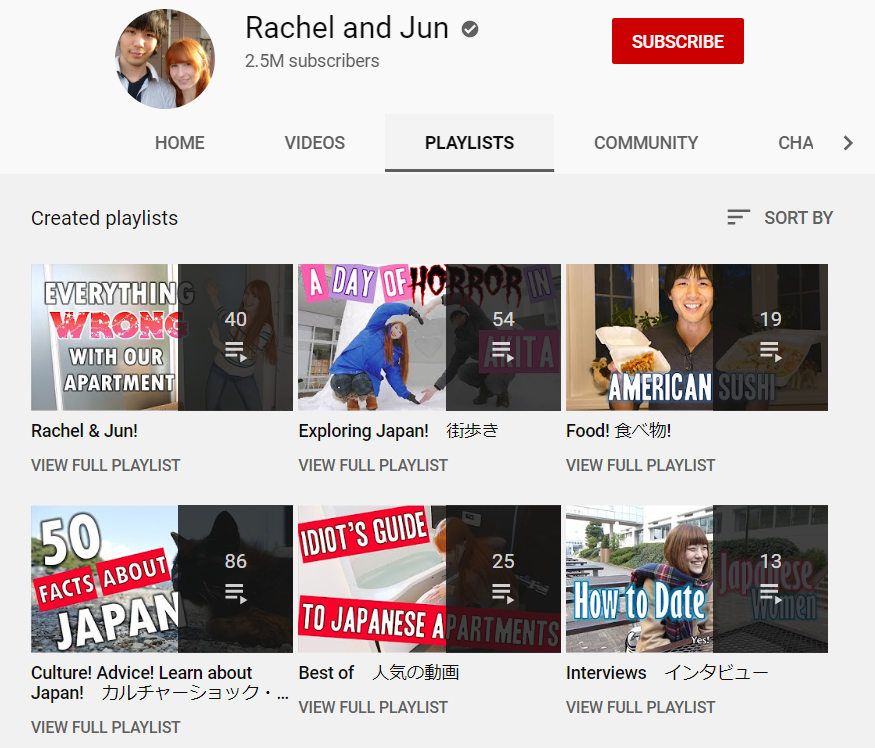
This channel is good for learning Japanese because they do vlogs about their daily lives. The channel, started by a Japanese husband and an American wife, who are both living in Japan. Rachel would speak in English while her husband would speak in Japanese. Sometimes both would speak each other’s languages. Their videos have Japanese subtitles so it would be easy to follow and learn about new words. Their videos are very interesting and sometimes funny too. They do not post on their main channel anymore, but still regularly upload on ‘Rachel & Jun’s Adventures!‘
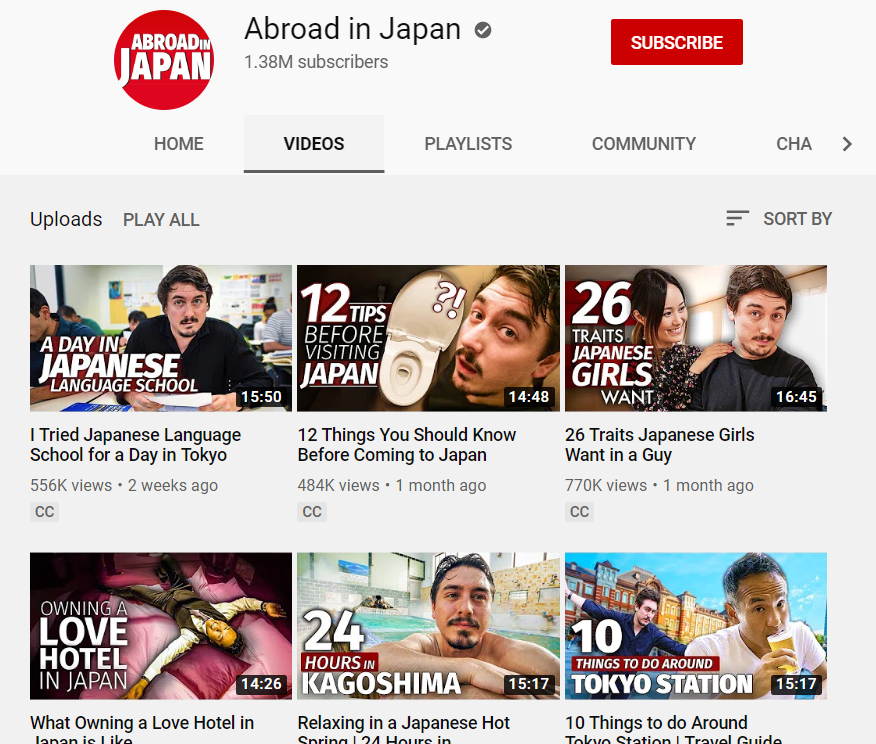
Abroad in Japan does vlogs which talk about how his interreaction experience with the Japanese culture and people here. Some of his interesting vlogs are “how to lose weight in Japan” and “Japanese thoughts on London magic man”
Life Where I’m From has a series of Japanese documentaries and life in Japan starring their children. They give interesting and educational insight into their everyday. They also show how is life in Japan through a series of vlogs.
A Japanese Youtube celebrity with over 1.4 million subscribers. Her channel has videos in both English and Japanese. Having moved to America at a young age, she has many things to learn about Japan and shares about them on her channel. She also shared many vlogs on her daily life.
The name of this Youtuber is pretty self-explanatory. Tokyo Lens offers an interesting, otherwise unseen, angle to Japan. From exploring Japan’s smallest apartment to visiting Japan’s most active volcano, his videos provide a unique take on living in Japan.
In this post – a learner of Japanese and polyglot, Teresa Tak will give us some tips on how we can practice Japanese daily!
From Teresa: Of all the languages I have studied before, Japanese is by far the hardest to get used to. Why? It takes some serious PRACTICE, and cannot just be memorized in a book. If you really want to learn Japanese, you need to use it every day! And in this post, I’m going to tell you exactly how.
Think in Japanese
This sounds scary, I know. But don’t worry, you don’t have to think about everything in Japanese. Start with small things like, ‘where did I put my phone again??’ or ‘This scene is very nice’.
Then, little by little, you can start understanding what things you want to say in Japanese and cultivate a stronger voice in the language also.
After all, we think over 70,000 thoughts a day on average! That’s a lot of practice time to add to your day.
Subscribe to Japanese Twitter Accounts
This is a good way to naturally introduce yourself to some Japanese. Without having to open a new tab or pull out a textbook, you can push yourself to read bits of Japanese all the time.
Since tweets are never really long, it’s a great way to practice without stressing yourself out. Plus, it may get you used to reading Japanese kanji!
Watch Japanese YouTubers
This is a really great way to practice listening. YouTubers speak to their audiences as if they are speaking to friends. The most natural Japanese isn’t found in a movie, on the news or in manga- it’s on YouTube!
Personally, I choose a few videos on a topic I like or by an interesting YouTuber and then I watch it over and over again until I can make more sense of it. I take notes while I’m watching too, and sometimes I revisit months later to see if my improvements have helped my understanding!
These applications won’t teach you the nitty-gritty grammar you need to take your skills to the next level, but they will help you keep your current skills fresh and Japanese on your mind!
Each lesson is usually no more than 10 minutes so it isn’t a burden. If you are looking for a Japanese learning app that fits your study style – we have also published a list of helpful Japanese learning Apps for you to use.
Read webtoons or Doujin
This one’s a bit more strenuous but can be very fun and very rewarding! Apps like LINE webtoon update thousands of short `manga` like stories every day.
Many Japanese people read them during their commute to work. If you find one you like or one correct for your level, you can create some fun and constructive Japanese practice time for yourself.
Keep a two-line journal
This is my most recommended tip. Absorbing Japanese from outside sources is great, but formulating your own sentences is irreplaceable for your Japanese journey.
Languages should be learned from the inside out: meaning you should start with the words you want to say yourself most! Writing a short journal will tell you every day, just which words you want to know how to say the most. The more often you bump into them, the faster you will learn them!
Interested in learning Japanese every day? Click the link below for more information on our intensive Japanese courses in Tokyo!
Japan has a unique naming system. In Japanese , pronunciation and the meaning of the kanji are the main considerations. Usually, one Japanese name can be written in different kanji.
When naming their children, pronunciation and the meaning of the kanji are the main considerations. For example, the boy’s name “かいと”(Kaito) can be written as 海斗, 快斗,魁人 and so on.
Due to this unique feature of the Japanese naming system, many Japanese names sound the same but are expressed in different kanji.
Hence, Japanese baby names all depend on the parents’ intentions and what they hope for their child to become.
In addition to that, most Japanese names are a combination of two kanji characters, which means you’ll likely get more combinations just from the possibility of matching one kanji with a different kanji.
Choosing a Japanese Name for Boys and Girls
Weird Japanese Names for Boys and Girls: Kira Kira
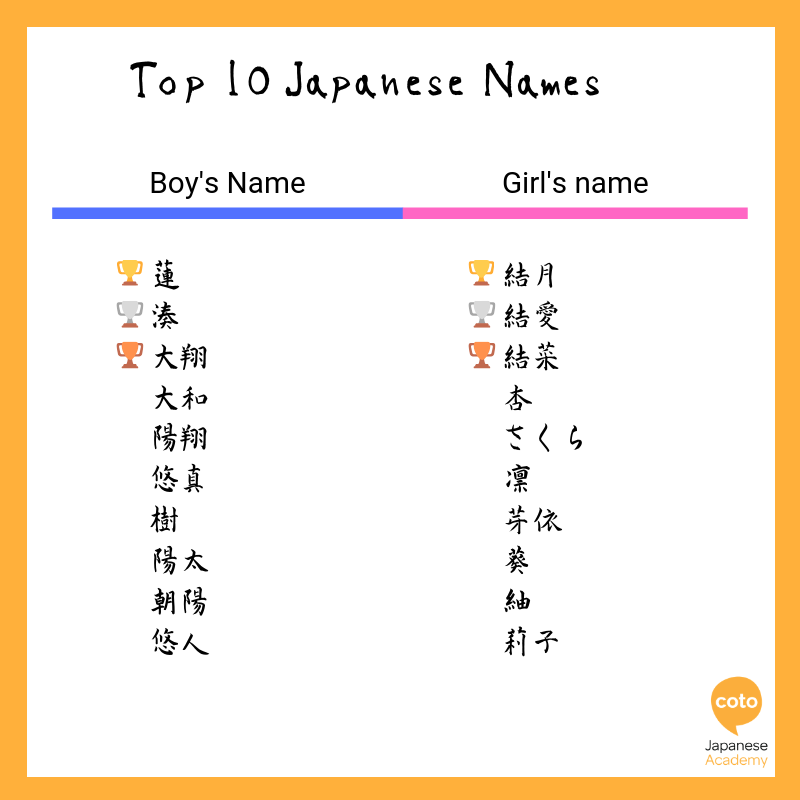
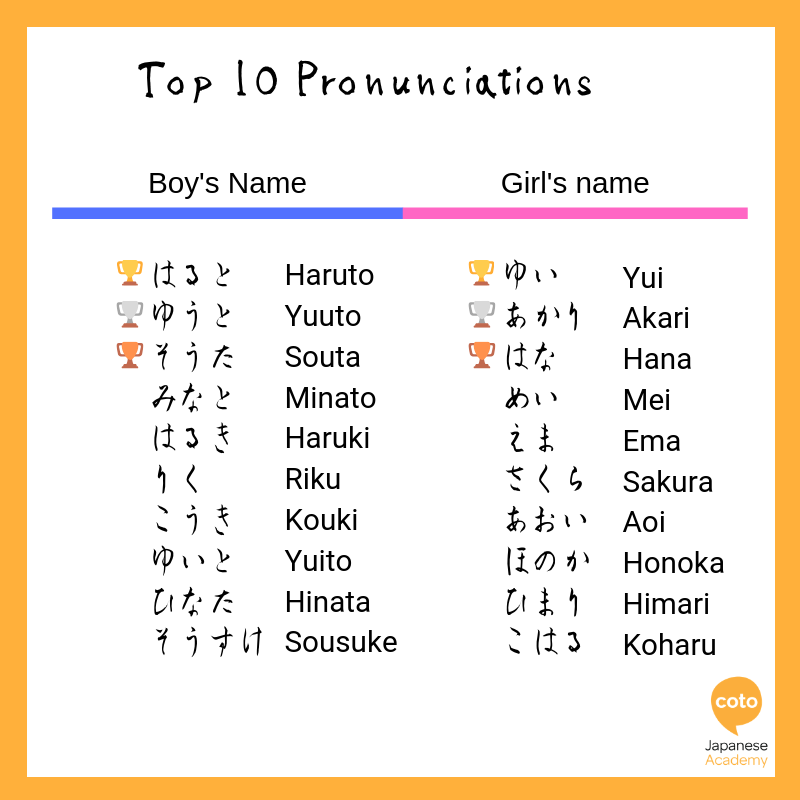
Top 10 Popular Japanese Names and Pronunciations for Boys
Top 10 Popular Japanese Names and Pronunciations for Girls
Choosing a Japanese Name for Boys and Girls
Generally, families will opt for names for their newborns that carry positive meanings: beauty, intelligence, strength and virtue. Other times, the kanji might have vague, basic meanings, like 月 (moon or month).
Either way, if you have upper-level Japanese skills, you’ll probably recognize the meaning of these Japanese baby names just by hearing the word or looking at the kanji.
Like Western names, Japanese baby name trends come and go. For example, during winter, parents can name their baby girl “yuki”, which can be written both 雪 (yuki) or 優希 (yuuki).
You might want to choose a Japanese name for different reasons. Maybe it’s because of the characters’ meanings, or family heritage.
Either way, we hope this list inspires you to raise a wise, strong and happy child.
Weird Japanese Names for Boys and Girls: Kira Kira
Recently, to make their child stand out from the crowd, some young parents name their child with rarely used kanji or unusual pronunciations which convey other meanings.
For example, 皇帝 (しいざあ, or shiizaa) sounds like the English word “Caesar”. Moreover, the Kanji word “皇帝” means emperor. Such names are called “kira kira names” “(キラキラネーム)”. Kira kira names are bizarre-sounding Japanese names that are completely different from traditional names.
So why would parents choose to name their kids with unconventional pronunciation?
We have to think about the incredible popular culture of Japanese anime, manga and movies. Similar to the TV shows in America, the Japanese subculture has influenced Japanese parents. Most of the time, the kanji of characters’ names are used as a phonetic symbol instead of for the meaning
The second reason would be the opening of Japanese culture to Western influences and the introduction of foreign names. Among the perfect example to underline this tendency, you will find “Makkusu” for Max (真九州) and “Mashyuu”, an equivalent of Matthew (馬周).
The Japanese parents believe that such names would, later on, have a positive influence on their children’s career.
Top 10 Popular Japanese Names and Pronunciations for Boys
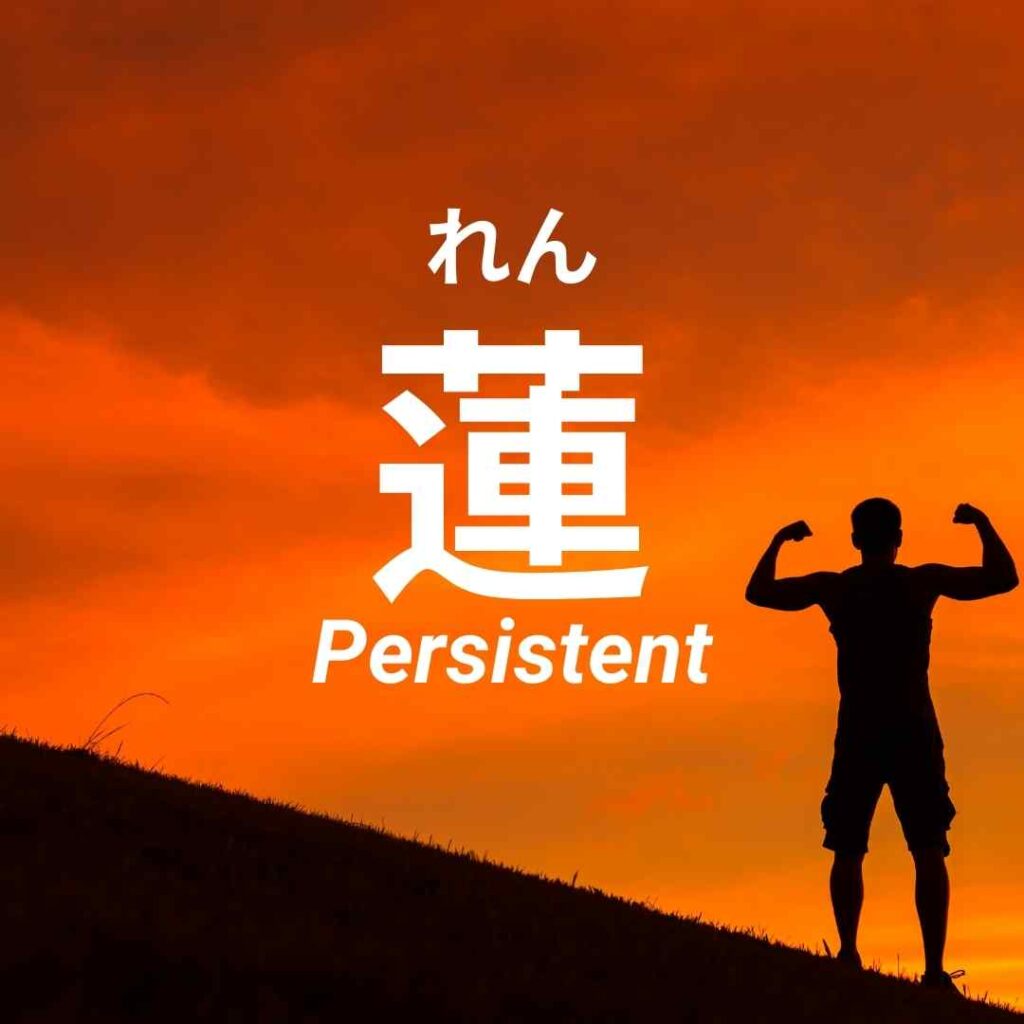
1. 蓮
The word 連 is usually red as Ren (れん), which is the onyomi version of the kanji character. The character translates directly to “lotus”, but it can also mean “persistence”.
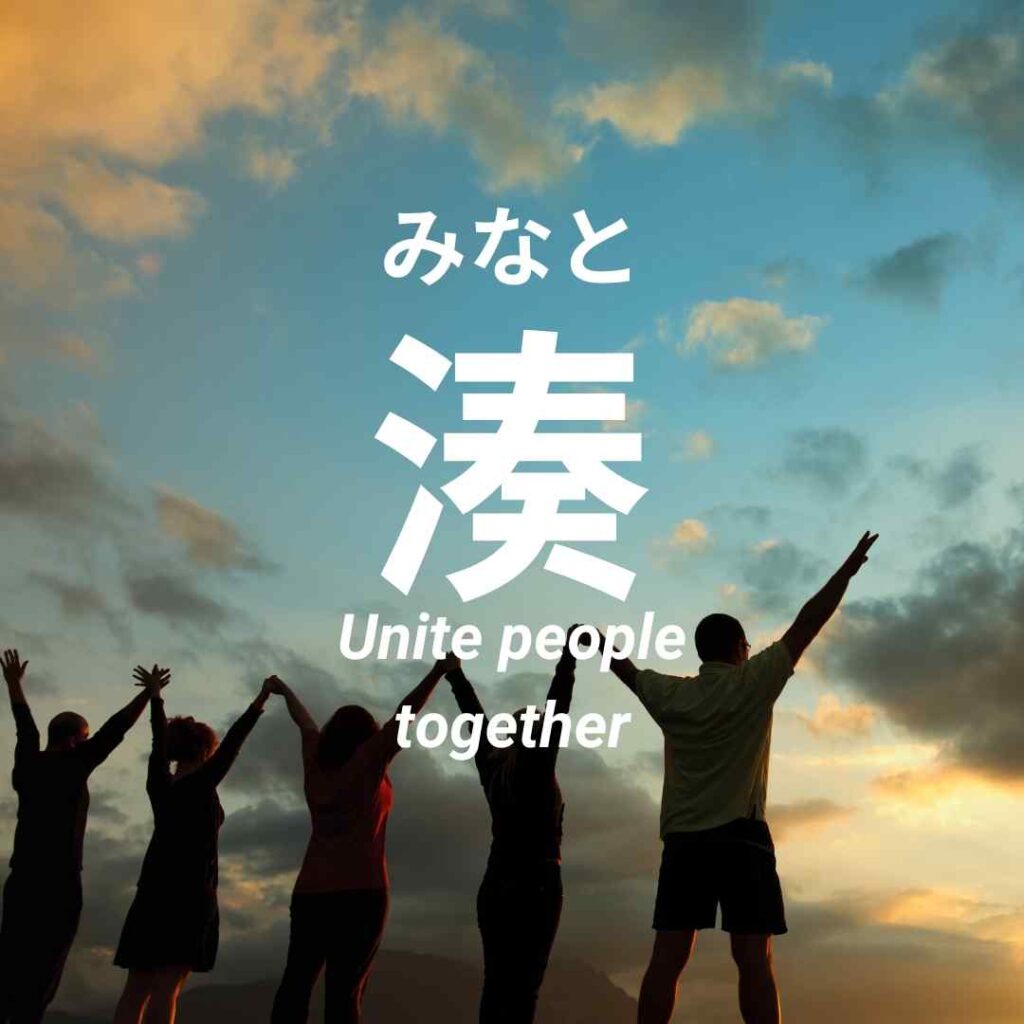
2. 湊
This Japanese word for this kanji is read as “Minato”, which is another popular first name for boys in Japan. The character means “harbor”, but just like its literal translation, parents give their son this name hoping that they can “unite people together”
3. 大翔
This name, which means “big heart”, can be pronounced in five different ways: そら(Sora), おうが (Ouga), たいが (Taiga), たいし (Taishi) and ひろと (Hiroto).
4. 大和
This Japanese baby name consists of two characters: 大, which means big, and 和, which means harmony, peace or soft. The combination can be pronounced as だいと (Daito), だいや (Daiya), なごみ (Nagomi), ひろと (Hiroto) and やまと (Yamato).
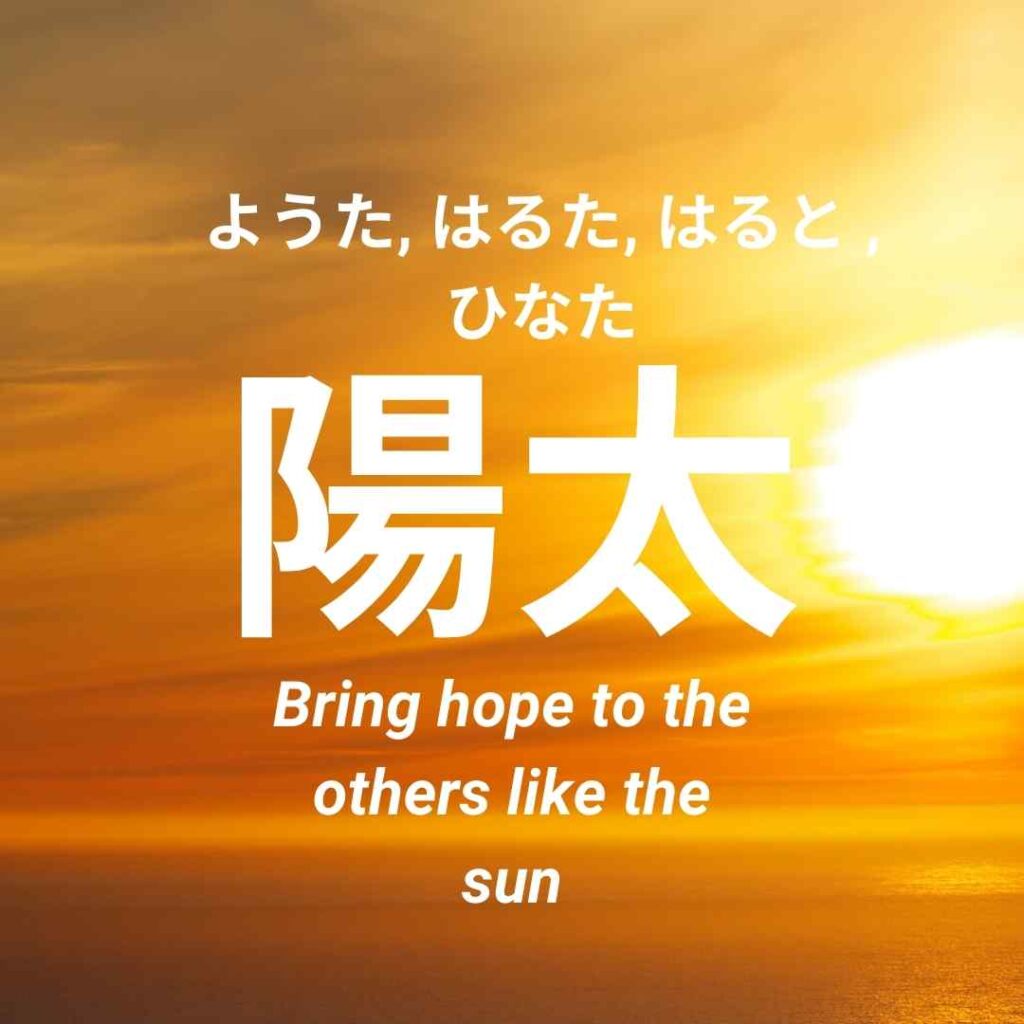
5. 陽翔
This name means “shine like the sun and fly high”. Variations of how to pronounce this Japanese name are: あきと (Akito), はると (Haruto), はるひ (Haruhi), ひかる (Hikaru) and ひなた (Hinata).
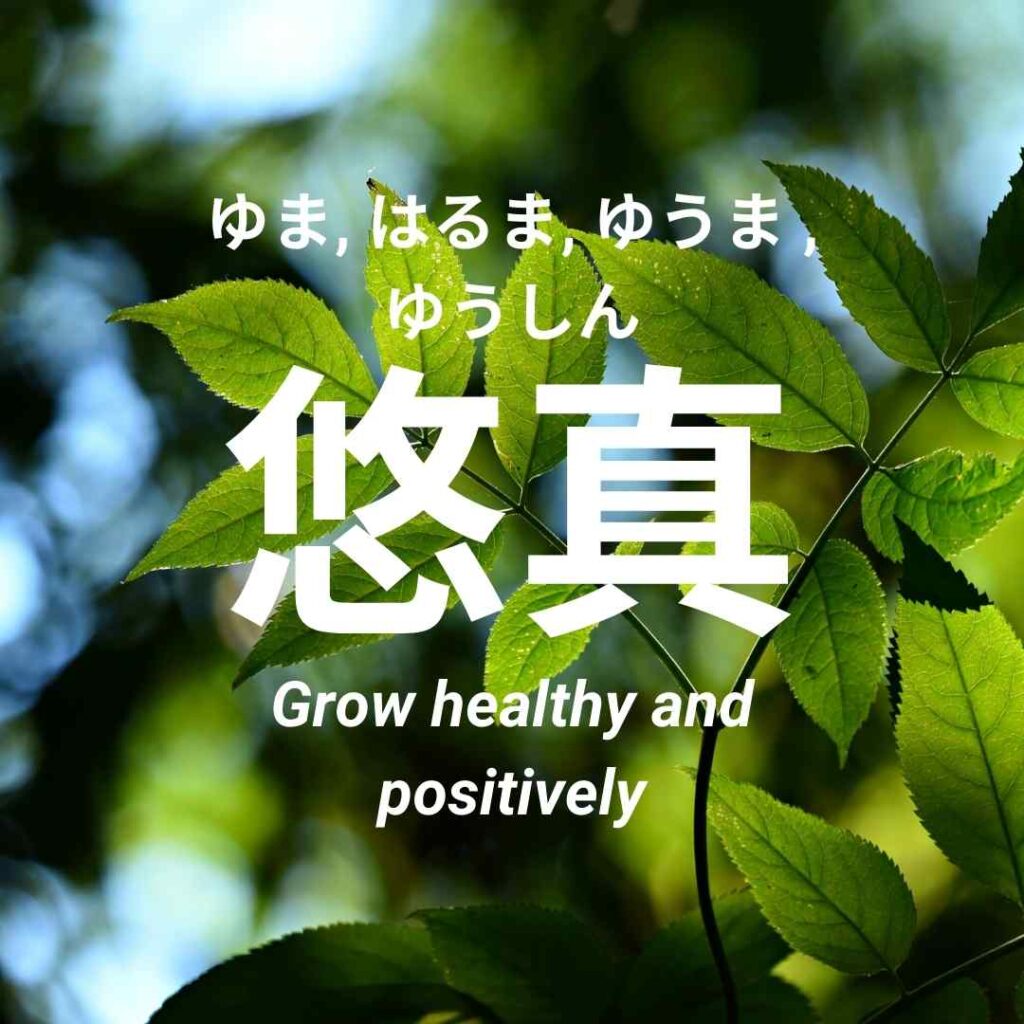
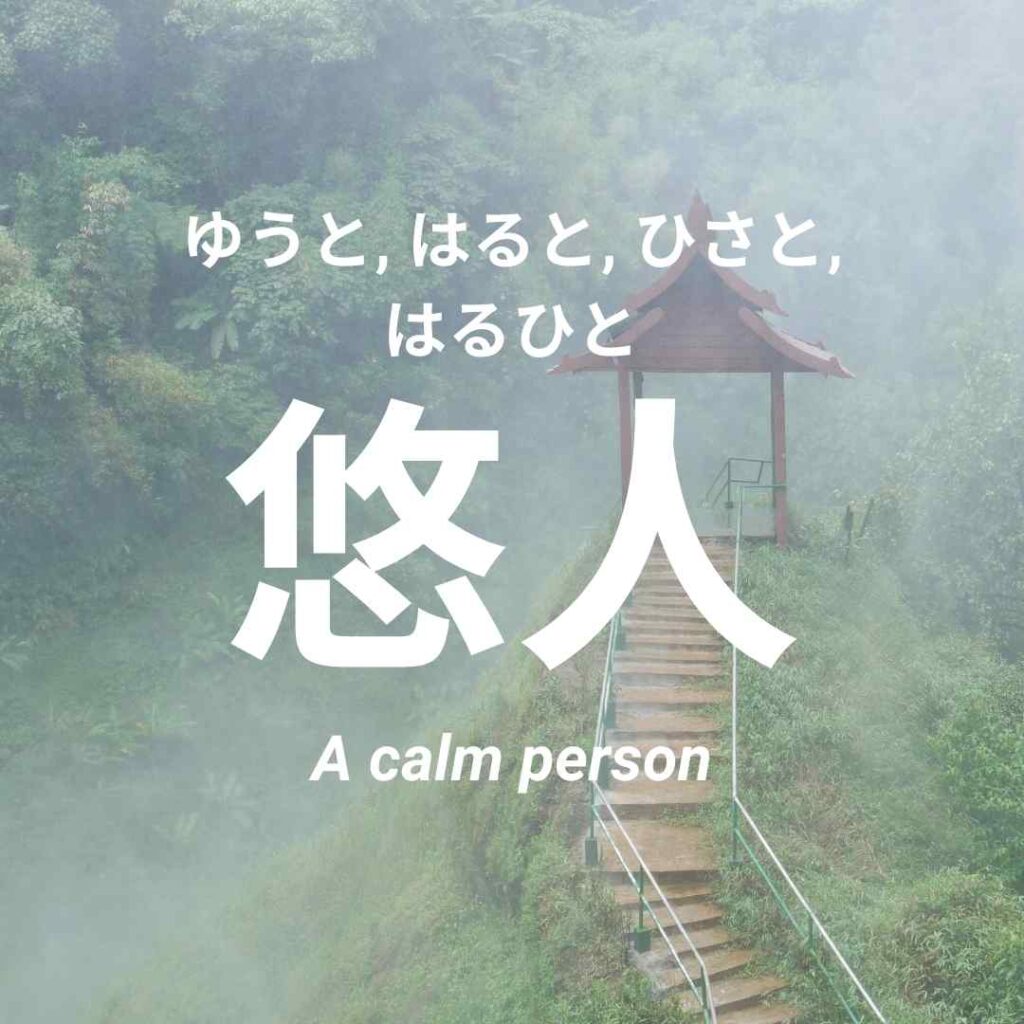
6. 悠真
Grow healthy and positively:(ゆま Yuma)、(はるま Haruma)、(ゆうま Yuuma)、(ゆうしん Yuushin)
They are Japanese names with weird pronunciation and very often surprising or confusing kanji characters, often time inspired by famous celebrities or brands.
If you are interested in studying Japanese and Japanese names, fill out the form below to learn more about our school.
One of the first words that you will learn when studying Japanese is さよなら (sayonara), the standard “Bye” or “Goodbye” in Japanese. It’s ubiquitous in phrasebooks and textbooks but as you might have noticed living in Japan, the Japanese people don’t use sayonara in everyday conversation that much.
So what expressions are used to say farewell, if not “さよなら” (sayonara)? It depends a lot on the context and the person you are talking to. To understand it better, let’s have a look at some natural Japanese!
Casual Conversations
The following expressions are used casually and if you enjoy watching anime or read manga then you’ve probably heard them before. You will typically use these expressions when you don’t know when you will meet your friend again.
じゃあね ー See you
またね ー See you
じゃあ、また ー See you
バイバイ ー Bye bye
If you do know that you will be seeing your friends again you can mention the time when you will meet again.
またあした ー (See you tomorrow)
またらいしゅう ー (See you next week)
In Formal Context…
In business situations, different expressions are used that emphasize the hard work done by all that day. おつかれさまでした: used in the working place, expresses the appreciation of your co-workers’ hard work when you leave for the day. The closest English translation would be “thank you for your hard work” or more simply saying “you worked hard”. To learn more about the use of otsukaresama desu. おさきに失礼します: used in the working place, expresses the regret to leave before your colleagues still working. Literally “I’m rude to leave before you”. Of course, if you are talking to a person of higher status you will need to use the proper level of polite Japanese.
今日はありがとうございました ー (Thank you very much for today) それでは失礼します ー (Please excuse me)
Not meeting for a while…
If you won’t be seeing someone for a while you would use the following: would say goodbye to somebody you won’t be meeting for a while (Casual/Polite): Casual:
じゃあ、げんきで(ね) ー (Take care)
また連絡するね ー (Keep in touch)
また会おうね ー (Let’s catch up again)
Polite:
お元気で ー (Take care of yourself)
また連絡します ー (Let’s keep in touch)
またお会いしましょう ー (Let’s catch up again)
Reading this article, you might wonder why is “sayonara” not used so much to say “goodbye” in Japanese for daily life. The reason has a lot to do with the nuances of Japanese culture as “sayonara” has a strong connotation of finality and implies that you will not see the person again. Therefore since it implies a more solemn farewell than a simple goodbye you should not use sayonara when leaving a place such as your home, work unless you are not planning to ever come back. Click to tweet this article and share it with others!
Coto Japanese Academy is a unique Japanese Language School in Iidabashi Tokyo, we offer relaxed and fun conversational lessons for all levels of Japanese learner. Coto Japanese Academy prides itself on its community atmosphere and fun lessons that focus on creation of opportunities to speak and learn Japanese. If you are interested in studying Japanese in Tokyo – please visit our contact page here.
Learn how to say more than just Goodbye with our Japanese course. Find out more by filling out the form below.