






If you’ve ever dined at a Japanese restaurant, you’ve likely seen people press their palms together and say “Itadakimasu” before eating and “Gochisousama deshita” afterward. In English, these are usually translated as “Let’s eat” and “Thank you for the meal.” But while they function like “saying grace,” the meaning goes much deeper than simple manners. These phrases represent a unique Japanese philosophy of gratitude, not just to the cook, but to the plants, animals, and nature that provided the ingredients.
In this post, we’re going to peel back the layers and nuance behind itadakimasu and gouchisousama deshita. We’ll explore the etiquette of how to say them properly, and the fascinating history behind the kanji!
What Does Itadakimasu (いただきます) Mean?
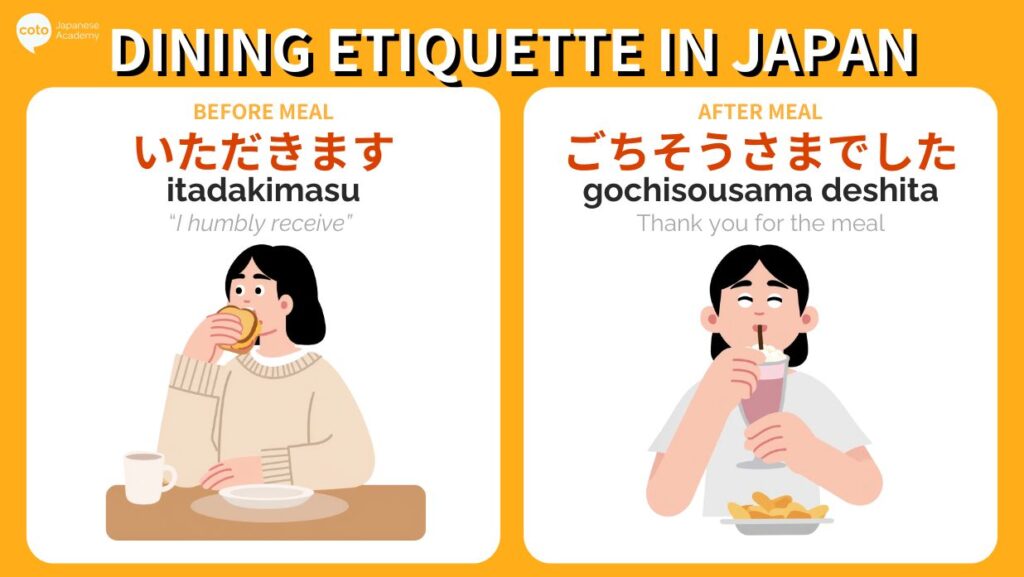
Itadakimasu (いただきます) means “I humbly receive.” It’s said before eating to express gratitude for the food, the ingredients, and the people who prepared or provided it. Its more popular translation, “let’s eat,” is inaccurate and misses the phrase’s deeper meaning.
The word itadakimasu itself is the humble form (kenjougo) of the verb morau (もらう), which means “to receive.” This is why its literal translation is “I humbly receive.” The phrase isn’t just for food, either. You can use it whenever you receive a gift, an award, or even a piece of advice from someone to whom you want to show deep respect.
The kanji of itadakimasu 頂 has several meanings, among which are “the top of the head” and “to receive”. The expression refers to the traditional way of showing gratitude by holding the gift above one’s head.
So why do Japanese people say itadakimasu before they eat?
In Japanese culture, it is believed that all living things, whether it’s a cow, a fish, or even a stalk of rice, have a spirit. When you eat, you aren’t just “consuming calories”. You are receiving the gift of life from those ingredients. By saying itadakimasu, you are thanking both the chef and acknowledging that the food on your plate is a sacrifice.
This concept differs significantly from the Western tradition of “saying grace.” In many Western cultures, there is a clear spiritual hierarchy: gratitude is directed upward to God, who provides for people, who then utilize animals and nature. When saying grace, the thanks are typically given to God. In contrast, Japanese culture is deeply influenced by Shinto and Buddhist beliefs, which view the world through a lens of interconnectedness and equality. Instead of a vertical hierarchy, there is a horizontal respect for all living things. By saying Itadakimasu, you are thanking the food, the people, and the creator.
From generation to generation, Japanese people are taught to clap their hands and say “Itadakimasu!” before savouring the delicious-looking food in front of them as part of their dining etiquette. Children learn the expression at a very young age at school, and no one would even think of starting a meal until everyone has received their share.
How to Perform Itadakimasu
To perform Itadakimasu properly, follow these simple steps to show you respect the meal:
- Press your palms together in front of your chest (this is called gassho). It should be a gentle movement, similar to a prayer position rather than a loud clap.
- Say “Itadakimasu” clearly. If you are in a group, it’s polite to wait for the host or the eldest person to say it first.
- Give a slight, respectful nod of the head while your hands are still together.
- After you have finished the phrase and the bow, pick up your chopsticks or utensils to start eating.
Want to study Japanese with us?
What does Gochisousamadesu mean? (ごちそうさまです)
After filling their stomachs, Japanese people thank those who prepared, cooked, and served the food by saying “Gochisousama desu!” (ご馳走様です). Gochisousama desu (ごちそうさまです) means “thank you for the meal.”
It’s said after eating to express gratitude for the food and for the person or people who provided it, such as a host, a cook, or restaurant staff. Unlike a casual “that was good,” it specifically acknowledges the effort and generosity behind the meal.
To understand the weight of this expression, we have to look back to its fascinating linguistic origins. The word is composed of a unique set of kanji. In the days before cars and modern convenience, a host who wanted to provide a quality meal for their guests had to travel long distances to hunt, fish, or forage. They would often head out on horseback to search high and low for the freshest ingredients. This physical effort is immortalized in the kanji for Gochisou (馳走). The first character, chi (馳), contains the radical for “horse” (馬), while the second character, sou (走), literally means “run.” Together, they paint a picture of a host “running their horse” or rushing about to gather a feast.
When a guest says “Gochisousama,” they are literally saying, “You were someone who ran around for me.” It is a recognition of the hard work and preparation that happened long before the food ever hit the table. While most people in modern Japan write the phrase in hiragana (ごちそうさま) rather than kanji, the sentiment remains the same. To a Japanese speaker today, gochisou means “a feast” or “a great meal.”
Gochisousama desu vs deshita
You might be confused when you hear people alternating between gochisousama desu and gochisousama deshita, with the latter being the past-tense form of the phrase. Gochisousama desu is used to express gratitude for a meal that is currently being enjoyed or has just been finished. On the other hand, gochisousama deshita is used to say “thank you for the delicious meal” in a more polite, formal way, typically directed at the person who prepared or paid for the meal. This form is commonly used when dining at a restaurant or when your boss treats you to a meal.
When to Use Itakadimasu
When it comes to the dinner table, Itadakimasu acts as a definitive marker that the meal has officially begun. However, there are a few specific “moments” during the dining experience where the timing matters.
1. When Food is Served
The most common time to say itadakimasu is when all the food has been served. For example, if you are a guest at a friend’s house and they serve you a meal, you would say it, even if they technically didn’t cook the food themselves (for instance, if they ordered it through a delivery app).
Over time, itadakimasu has also come to function as a kind of starting signal. When dining in a group, it marks the moment when everyone can begin eating together.
2. When You Eat Alone
Even when eating alone, many Japanese people still clasp their hands and quietly say itadakimasu. In this context, the phrase isn’t about social performance. Rather, because Japanese culture places strong emphasis on gratitude toward nature and ingredients, it becomes a personal moment of mindfulness.
3. When You Are Offered a Snack or Drink
Coffee or snacks may not be a full meal, but itadakimasu can also mean “I humbly receive.” When a coworker hands you a small candy or a friend pours you a cup of tea, saying itadakimasu as you accept it is a standard way to show appreciation. It signals that you’re not merely taking the item, but expressing gratitude for the act of being given nourishment.
4. Don’t Use When Receiving Non-physical things
While itadakimasu is a versatile phrase, it is specifically used for receiving tangible gifts or physical things (like food, a present, or a document). You don’t use it when you receive non-physical things, such as compliments, series, permissions, and favors.
For example, if someone gives you advice, you don’t say “itadakimashita” after they say it. If someone praises your Japanese skills, don’t say itadakimasu. Instead, use arigatou gozaimasu, or a more humble reply:
いいえ、いいえ、まだです。
Iie, iie, mada desu.
When to Use Gochisousama Deshita
1. When Leaving a Restaurant
You’ll notice Japanese people doing this often when dining out. Gochisōsama deshita is a warm and polite way to thank restaurant staff for the meal. For example, in a small ramen shop, you may hear customers calling out gochisōsama deshita toward the kitchen as they leave.
In other cases, people might say it directly to the cashier while paying, or simply say it aloud as they exit. The exact timing and direction can vary, but the meaning is the same: expressing gratitude to the restaurant as a whole.
2. Right After You Finish Eating
The most common moment to say gochisousama deshita is immediately after finishing your meal. Once you place your chopsticks back on the chopstick rest, you join your hands, give a small nod, and say the phrase.
The chopstick rest is called hashioki (箸置き): hashi (箸) means chopsticks, and oki comes from oku (置く), meaning “to place.” This gesture signals to your host or the restaurant staff that you have finished eating and are satisfied.
3. When Someone Treats You to a Meal
Similar to itadakimasu, gochisousama deshita isn’t only about thanking the cook or the food itself. It also acknowledges the person who provided the meal.
If your boss invites you out for a work meal and pays for it, saying gochisousama deshita is the standard and polite way to express thanks in Japanese. There’s no strict rule about timing: you can say it at the table after finishing, or later, once you’re both outside the restaurant.
Read More: Top Japanese Dining Etiquette to Know
Master Useful Japanese Phrases at Coto Academy!
Itadakimasu and Gochisousama deshita are essential Japanese phrases, but understanding their true nuance is what sets you apart. If you want to move beyond the basics and truly navigate life and work in Japan with confidence, Coto Academy is the perfect place to start. With convenient school locations in Shibuya and Shinjuku, we offer beginner-friendly, flexible Japanese lessons tailored to your needs. Ready to dive deeper into the language and culture?
Contact us below for a free Japanese level check and consultation!
FAQ
What is the difference between "Gochisousama" and "Gochisousama deshita"?
- Gochisousama: Casual. Use this with friends, siblings, or at home with close family.
- Gochisousama deshita: Formal/Polite. Use this in restaurants, at a friend’s house, or when a colleague treats you. The past tense (deshita) indicates that you have fully finished and appreciated the entire experience.
Can I use "Itadakimasu" for drinks?
Yes! If someone pours you a cup of tea, coffee, or even a beer, saying Itadakimasu as you accept it is very polite. It acknowledges the “gift” of the drink.
Should I still say "itadakimasu" and "gouchisousama deshits" it when eating alone?
Most Japanese people do this as a private moment of mindfulness to show respect for the food, regardless of whether someone is watching.
What is the simplest translation of these phrases?
“I humbly receive” (Itadakimasu) and “That was a feast” (Gochisousama).