






How do you say “I love you” in Japanese while hitting all the right nuances and intentions? In Japanese, romantic is often viewed through two distinct lenses: 恋 (koi) and 愛 (ai). 恋 (koi) refers to romantic love or the initial spark of attraction. Interestingly, Japanese uses the same figure of speech as English when describing the start of a romance: the term 恋に落ちる (koi ni ochiru) literally translates to “falling in love.” This type of love is often seen as something that happens to you. It’s exciting, and occasionally fleeting.
On the other hand, 愛 (ai) represents a deeper, more selfless, and enduring affection. While koi is the pursuit of a feeling, ai is the kind of love you commit to for a lifetime. Saying “I love you” when there are so many different levels and forms of affection can be difficult, so we are breaking down the most common ways to express your feelings in Japanese.
1. 好きです (Suki Desu): I Like You
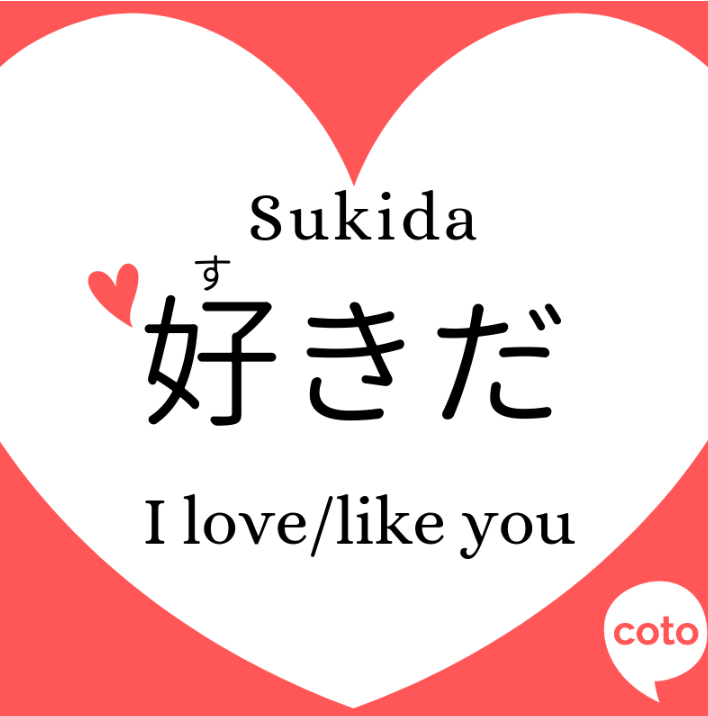
Is “love” in Japanese limited to 愛 (ai) and 恋 (koi)? Of course not. Readers of manga and lovers of anime will tell you that “I love you” in Japanese is most often expressed by the colloquial 好きです (suki desu).
“Suki” means “to like” most of the time, as in “I like chocolate” or “I like baseball”. But when used with regard to another person, “suki” is (roughly) translated as “I love you” in Japanese, in a softer way than “ai”.
This makes translating 好きだ (suki da) as a romantic “I love you” largely dependent on context, but you can think of this as the most common, entry-level way to express love in Japanese. In general, this is the standard phrase used when confessing your feelings — an act known as 告白 (kokuhaku).
But if you’re really into someone and would still like to show your affection, simply add a “とても (totemo)” as a suffix to indicate that you’d love someone very much. Nevertheless, use it sparingly, as it may come across as cheesy for some.
2. 大好きです (Daisuki Desu)
The adjunction of “dai” 大 to “suki” emphasizes the affection for the loved one: “I love you very much”. Don’t be fooled by Japanese popular culture, “suki da” is (really) not easy to tell when affection really matters.
3. 恋している (Koi Shiteiru)
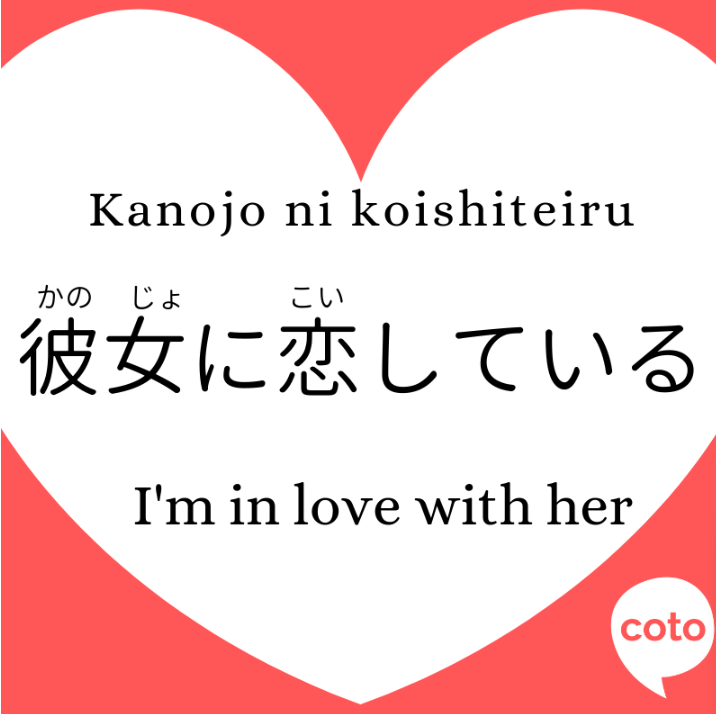
Romantic or passionate love is distinguished by the kanji 恋, which can be read as koi or ren. Much like suki, this word can be combined with the verb suru to describe the state of being in love. You will see this kanji appear in several romantic contexts, such as 初恋 (hatsukoi) for “first love” and 恋人 (koibito) for “lover” or “significant other.”
However, a crucial point for learners is that you cannot say “I love you” using koi. This is due to the grammatical nature of the word; it functions as an intransitive verb phrase. Instead of a direct declaration to someone, you use it to describe a state of feeling toward them, such as:
彼女に恋している。
Kanojo ni koi shite iru.
I am in love with her.
Because it focuses on the internal feeling of “falling” or “longing,” it is most famously used in the expression 恋に落ちる (koi ni ochiru), which literally means “to fall into love.”
4. 愛している (Ai Shiteiru)
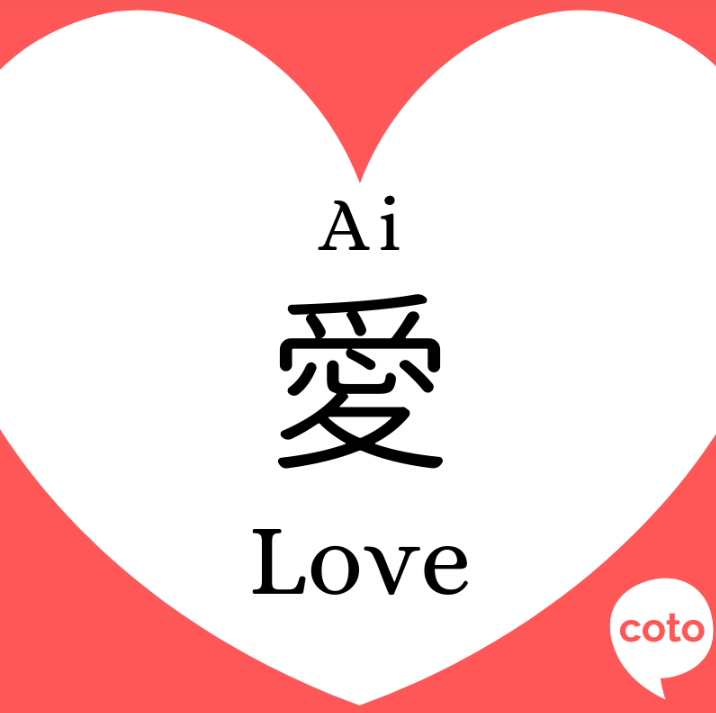
Perhaps the most intimate and deepest way to say “I love you” in Japanese involves one of the most beautiful kanji in the language: 愛, which symbolizes love, affection, and care. Read as ai, this word is combined with the verb suru (to do) to form the declaration of love.
Most of the time, the construction “Ai shite iru” is used to translate a foreign movie or book title “I love you”. This kanji expresses a strong and positive emotion of regard and affection. As it conveys committed feelings of love, the expression is used with care.
彼女を愛している。
Kanojo o aishiteiru
I love her.
Note that this phrase is extremely intimate and is usually only said between long-term partners or spouses. Unlike Western cultures, where “I love you” might be used casually as a daily greeting or a quick way to say goodbye on the phone, Japanese culture treats 愛してる with significant weight. You won’t often hear it used as a standard greeting; instead, it is reserved for life’s most serious and deeply emotional connections.
Other Forms of Love in Japanese
You might notice that 愛 and 恋 have for a component the heart, 心, but they do not convey the exact same love. One very important nuance is that “ai” implies a long-lasting love, maturity, and somehow the expectation of reciprocity. On the other hand, “koi” is a passion, a longing for the object of affection. In a way, “koi” is said to have a selfish aspect as the focus is on the expression of your feeling, more than on the object of the affection.
In many ways, koi is similar to what we call “puppy love” in English, but it can also encompass a more intense infatuation or sexual desire. Unlike 愛 (ai), which is built on a foundation of mutual care and longevity, koi does not necessarily expect reciprocity. This often leads to the concept of 失恋 (shitsuren), or “disappointed love” (a broken heart).
“Ai” is used when one finally gets the courage to declare one’s love:
愛の告白をする
Ai no kokuhaku o suru.
I am confessing my love.
Interestingly, while 愛している (ai shiteiru) is used between lovers, the love in “ai” is not limited to romantic love, but can express the affection for one’s family, as in parents’ love: “親の愛” (“oya no ai”). The word is finally a general expression of love.
Combined, the kanji 恋愛 is read “ren ai”, the tender affection two people can have, leading them to a marriage of love: “恋愛結婚をする” (renai kekkon o suru). The romantic “love poem” and the rather sulfurous “love affair” are both based on the word “renai”.
- 恋愛詩: love poem
- 恋愛事件: an illicit love affair
Reality of Saying “I Love You” in Japanese: Don’t Say It
You thought you were ready to declare your love to a Japanese person? Besides confession, the Japanese do not express their love openly, and when they do, they do not want to say it too lightly. Some will never meet the one to whom they feel inclined to tell “ai shite iru” or even “suki da”. The expressions analyzed earlier are actually barely used in natural conversations.
The idea that action speaks more than words is particularly true when it comes to the Japanese expression of affection. For example, a rather famous and traditional way to ask a woman in marriage consists of asking her “to prepare miso soup every morning”. The little things that you do every day for your lover are worth more than all the time you could say I love you. Japanese men will be even more reluctant than women to express it. If pushed to utter those words, they will wonder about what “love” really is.
Being Indirect About “I Love You” in Japanese
Japanese people can be cryptic as hell when it comes to feelings and emotions. A (very) twisted way to say “I love you” in Japanese would be “I do not hate you”: “嫌いではない”. Yes, you’ve read it right. Mainly used by men, this allows them to express the desire to be with someone without being too straightforward. This is because confessing one’s feelings may be considered way too embarrassing.
So embarrassing that actually, when Japanese people were confronted for translating foreign text into their language, they got lost with translating the expression “I love you”. In ancient times, it was uncommon forthe Japanese to use sweet words. Confused as to how to convey the nuance and connotation, Natsume Soseki, a famous Japanese writer from the Meiji Era, translated it as:
月がきれいですね
Tsuki ga kirei desu ne.
The moon is beautiful, isn’t it?
Such a poetic and beautiful way to declare one’s love is worth fewer words, is it not?
Understand the Nuance of Japanese Life at Coto Academy!
Mastering the subtle differences between koi and ai is essential for anyone wanting to truly integrate into Japanese society. At Coto Academy, we specialize in teaching these cultural “unwritten rules” alongside practical language skills.
With campuses in Shinjuku and Shibuya, our school provides a flexible, beginner-friendly environment where you can learn how the Japanese people actually speak. Whether you are navigating a new relationship or building a career in Tokyo, our expert instructors are here to help you find the right words for every situation. Click the button below to book your free level check and join our international community today!
FAQ
Do Japanese people say i love you?
Many Japanese couples express their feelings to each other by saying “i love you.” You may have heard many people use “ai shiteru” or “suki” as ways to express love in Japanese.
What is the difference between ai and koi?
“Koi” is a passion, longing for the object of affection, and “ai” means love.
What is the direct translation of “I love you” in Japanese?
The most direct translation is 愛してる (aishiteru). However, this phrase is very strong. It’s closer to “I deeply, eternally love you” and is rarely used in everyday relationships.
How to indirectly say I love you in Japanese?
In ancient times, it was uncommon for the Japanese to be straightforward with sweet words. Natsume Soseki, a famous Japanese writer from the Meiji Era, translated it as “the moon is beautiful, isn’t?”: 月がきれいですね.
Do Japanese people say “I love you” often?
Not really. In Japanese culture, love is often shown through actions rather than words. Saying “I love you” frequently (like in English) can feel excessive or unnatural.
Do Japanese people say “I love you” often?
Not usually, because Japanese culture tends to express love through actions rather than frequent verbal affirmation.
What’s the most natural way to say “I love you” in Japan?
In most contexts, 大好きだよ sounds affectionate, sincere, and culturally appropriate.
You might be interested in: