



The JLPT N3 grammar 切る (kiru) means “to do completely” or “to do to the end”. It’s also a verb meaning “to cut,” but as a JLPT N3 grammar point, it’s a phrase that you can use to express a sense of completion or accomplishment. It generally refers to:
- To do entirely
- To complete
- To finish
Make Sure to Watch Coto Academy’s YouTube Video About 〜切る
Before you continue reading, why not take a moment to watch a quick YouTube lesson with our Japanese teacher, Nami Sensei:
〜切る (~kiru) Meaning
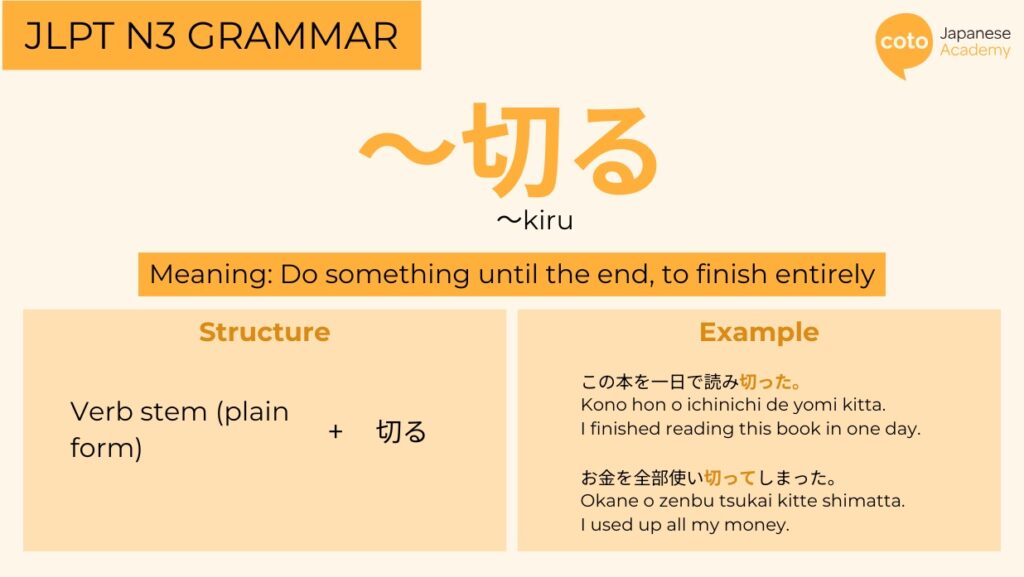
〜切る (~kiru) means to do entirely, used to express when you do something until completion, until the end, or all the way, often with a sense of accomplishment or finality. However, you can also use it to say you finished something uncontrollably (like a book you couldn’t put down).
The phrase closely translates to:
- To do something entirely
- To complete something
- To do something all the way
If you’re interested in learning more JLPT N3 grammar with native Japanese teachers, join fun, flexible lessons at Coto Academy, Tokyo and Yokohama’s no. 1 Japanese language school. Click the link below to take a free Japanese level check.
JLPT N3 〜切る (~kiru) Sentence Structure
〜切る (~kiru) is a suffix that attaches to the end of verb stems after dropping ます (masu). You can only use it with verbs that express direct, controllable actions (i.e., reading a book, watching a movie, making food).
Generally, it is used at the end of a clause or phrase. The sentence form follows:
ます form verb, ます + 切る/切ります
Likewise, this can also be used in the negative: 切らない/切りません.
| Type | Structure |
|---|---|
| Verb (ます form) | Verb (drop ます) + 切る |
You can only attach a verb stem in plain form, without conjugating, to 切る. You conjugate 切る itself into positive, negative, past, and present:
| Form | Plain Form + かける | Meaning |
|---|---|---|
| Present | 読み切る | Reading to the end |
| Past | 読み切った | Read until the end |
| Negative | 読み切らない | Not reading until the end |
| Past Negative | 読み切らなかった | Did not read until the end |
How to Use the JLPT N3 Grammar Point: 〜切る (kiru)
Let’s look at how to use it by examining some examples!
Example 1
昨日買った本を1日で読み切りました。
kinou katta hon o ichinichi de yomi kirimashita.
I read the book I bought yesterday in one day.
Example 2
たくさん注文したので、全部食べ切れませんでした!
Takusan chuumon shita no de, zenbu tabe kiremasen deshita!
I ordered so much that I wasn’t able to eat it all!
In this example, the speaker couldn’t finish all of the ramen. So, we have to conjugate 〜切る into potential from: 切れる, as well as negative, which is 切れない or 切れません. So, the full sentence is 全部食べ切れませんでした。
Example 3:
お金を全部使い切ってしまった。
Okane o zenbu tsukai kitte shimatta.
I used up all my money.
Example 4:
彼は責任を持って仕事をやり切った。
Kare wa sekinin o motte shigoto o yari kitta.
He completed the job responsibly.
Vocabulary List
Check out all the new words in the example sentences above, and try to remember new vocabulary alongside today’s Japanese grammar!
| Kanji / Writing | Furigana | Romaji | English |
|---|---|---|---|
| 昨日 | きのう | kinou | yesterday |
| 買う | かう | kau | to buy |
| 本 | ほん | hon | book |
| 一日 | いちにち | ichinichi | one day |
| 読む | よむ | yomu | to read |
| 読み切る | よみきる | yomikiru | to finish reading completely |
| 注文する | ちゅうもんする | chuumon suru | to order |
| たくさん | たくさん | takusan | many; a lot |
| 全部 | ぜんぶ | zenbu | all |
| 食べる | たべる | taberu | to eat |
| 食べ切れる | たべきれる | tabekireru | to be able to finish eating |
| お金 | おかね | okane | money |
| 使う | つかう | tsukau | to use |
| 使い切る | つかいきる | tsukaikiru | to use up completely |
| 責任 | せきにん | sekinin | responsibility |
| 持つ | もつ | motsu | to have; to hold |
| 仕事 | しごと | shigoto | work |
| やり切る | やりきる | yarikiru | to carry through; to complete fully |
Learn More JLPT Grammar with Coto Academy!
Try using 〜切る (~kiru) next time you speak Japanese! As you keep using it, it’ll naturally become a part of your vocabulary and be ingrained in your memory. So, if you practice using this JLPT grammar and many others in actual Japanese conversations, nothing beats practicing with a teacher who can offer practical guidance. Sign up with us at Coto Academy!
Coto Academy has been offering Japanese classes for over 25 years, with campuses in Shibuya, Yokohama, Iidabashi, Minato, Shinjuku, and online. Our courses focus on practical Japanese, so the grammar you learn is designed for real-life use.
We offer part-time, intensive, and fully online lessons to suit your schedule. Start learning Japanese effectively and confidently with Coto Academy today!
Why join Coto Academy?
- Ready to get started? Fill out the form below to contact us!
- Over 60+ different Japanese classes over 18 levels
- Small classroom of only up to 8 students for personalized support
- Professional, native Japanese teachers
FAQ:
What does the JLPT N3 Grammar 〜切る (~kiru) mean?
It refers to completing something until the end or finishing something entirely. You usually use it to emphasize how you did something until the end.
What is the difference between 〜切る (~kiru) and 〜終わる (~owaru)?
Both seem to have similar meaning, but there is quite a difference in nuance. 〜切る emphasizes effort and completeness (doing something until the end). While 〜終わる is more neutral, just meaning “finish” or “done.” For example:
読み終わる → finished reading/done reading
読み切る → finished reading completely/reading until the end
Can 〜切る (~kiru) be used with any verb?
It would not be natural to use 〜切る with any verb, especially ones that are not deliberate actions that can be completed. For example, it would be unnatural to use it with 死ぬ (shinu), meaning “to die.”
What are common mistakes people make when using 〜切る (~kiru)?
Some common mistakes often include: confusing 〜切る (~kiru) with 〜かける (~kakeru), using it with actions that can’t be completed deliberately, and forgetting that it implies full completion.