
Eating Sushi is a must when coming to Japan, but can you order Sushi in Japanese? We don’t want you to have that problem during this wonderful experience


Origins of Sushi
Walking into a Sushi Restaurant
Appreciating your Sushi
Types of Sushi Meals
Frequently Asked Questions regarding eating Sushi
Conclusion
 

Origins of Sushi

Sushi embarked its journey around the 8th century in Japan. Since then, it has reached the stomach of many people around the world. The word “Sushi” is definitely not foreign to you and me.

Nowadays, sushi restaurants can be seen around in most places and sushi can be found even in the convenience store. Are there times where you just want to treat yourself to some quality sushi?


Walking into a Sushi Restaurant

Assuming that you have walked into a sushi restaurant and the crews greeted you with a line that goes “いらっしゃいませ!” (irasshaimase) accompanied by a smile on their faces. Now, if they asked you, “Where would you like to be seated at?”

Would you choose the regular tables where you can easily reach out for the sushi on the conveyor belt or the bar counter where you can watch the chef in preparing various kinds of sushi?


Well… the best spot to sit in a sushi restaurant would be no other than the bar counter where freshly made sushi will be served in front of you. Witness and appreciate how your sushi is made would make your food taste better right?

However, if you see no point in wasting time to order sushi from the waiter, go ahead and sit at the regular tables to grab as many sushi as you want from the conveyor belt.

Appreciating your Sushi

Next step would be choosing what to eat. Looking at the restaurant’s menu which offers you a wide variety of sushi leaves you to be indecisive.

Eating in a sushi restaurant is not cheap, and you would want to make sure that every mouth you had eaten is worth your money.

With a wide variety of choices available on the menu, people would usually order the sushi that they are most familiar with or whichever they eyed on first.


Being able to truly appreciate the sushi is equivalent to recognizing the chef’s effort of choosing and picking the freshest fish in the market every morning. They worked hard to ensure that quality food is served to the customers. In return, we should learn to appreciate the sushi.
 

Types of Sushi Meals

If so, how would you order? Randomize your order? Choose set meals to be safe? Leave it up to the chef? Ultimately, the choice is still yours.

Okonomi お好み
Here, you can go freestyle in ordering the sushi. If you are a frequent customer of a sushi restaurant, you would probably opt for this option as you may have already tasted most of the sushi and know your own preferences well.

Okimari お決まり
Go for this option if you prefer set meals that have a fixed price. This is usually cheaper than ordering individual dishes. Not only can you get to enjoy a variety of sushi, but also eating at a cheaper cost.

Omakase お任せ
By saying “Omakase” means the chef would decide for your course. This is the wisest choice you could ever make in a sushi restaurant. The chef would definitely know the fishes and the ingredients well. From choosing to preparing to serving.

Each and every process involves the chef’s effort and definitely, he will know what would be the freshest and tastiest choice for the day. Of course, the chef would take it that you are flexible with the bill.

Have you decided which option you would opt for the next time you visit a sushi restaurant?

Frequently Asked Questions regarding eating Sushi

Apart from not knowing how to order sushi, many people are often curious about the following questions: 

“Should I eat the sushi with soy sauce and wasabi?”. 

Just a little will do. By dipping too much of the soy sauce and wasabi makes the taste of the fish to be overpowered by the sauce, which is undesired by the chef.

Remember how the chef goes to the fish market to search for the freshest fish in order to serve quality sushi to its customer? To enjoy the fish to the fullest, it is best not to dip too much soy sauce and wasabi.

“What is the ginger doing on my sushi plate?”

You have just tasted different kinds of sushi and you can’t enjoy the other sushi if you don’t clear the taste in your mouth. Use the ginger to help you to neutralize the taste of the sushi lingering in your mouth!

“Is it true that you must eat the sushi with the fish facing downwards?”


Fish plays a big part in the sushi and a good sushi means that the fish would stick to the rice. Facing downwards allows your tongue to taste the fish first which allow you to maximize the taste of the fish.

So, yes. Eat the sushi with the fish facing downwards, you may not see many people doing that but that is the correct way!

Conclusion

By learning how to order sushi gives you more confidence to dine in a sushi restaurant. Always remember these 3 O’s: “Okonomi”, “Okimari” and “Omakase” and of course the meanings!

After all, the purpose of food is to keep us full and happy. There is no absolutely right way in eating your food so long as you enjoy it!

However, you should constantly remind yourself the amount of effort it takes for the chef to create wonderful dishes for the customers and appreciate the food and their efforts!

Happy dining in the sushi restaurant next time! Follow us on Twitter @cotoacademy to get Japanese tips every day!
Credits: Norio NAKAYAMA
source: airoplane

Coto Japanese Academy is a unique Japanese Language School in Iidabashi Tokyo, we offer relaxed and fun conversational lessons for all levels of Japanese learner. Coto Japanese Academy prides itself on its community atmosphere and fun lessons that focus on creation of opportunities to speak and learn Japanese. If you are interested in studying Japanese in Tokyo – please visit our contact page here.

日本語を勉強している人、あるいは日本に住んでいる人なら、そう、みたい、らしい、っぽい、で終わる言葉を耳にすることでしょう。その中でも、らしい、みたい、っぽいは似たような意味を持つため、混乱する学生も多かったと思います。例えば、あなたが職場でお弁当を開けたとき、同僚が「おいしそう」と言う。それは、どういう意味なのでしょうか?

これらの接尾辞は全体として、ものごとがどのように見えるかを表します。「seems like」「looks like」という表現だと思えばいいです。これらの接尾辞はすべて、あなたが読んだり聞いたり言われたりしたことに基づいて判断したことを表しますが、そう、みたい、らしい、っぽいには、それぞれ異なるニュアンスや区別があります。 

日本語の初級学習者であれば、「そう」は最初に習うフレーズかもしれません。このフレーズは、たとえ日本語があまりわからなくても、多くの場面で使えるフレーズのひとつです(実際、私たちの「便利な日本語フレーズ」のリストにも入っています)。当然、私たちのサバイバル・ジャパニーズ・リストのトップは、オリジナルの形容詞「美味しい」でしょう。

この記事で取り上げた日本語の文法事項は、話し手の確信の度合いに応じて使い分けられます。どれを使うかは、話し手の確信度や情報量によって決まるのです。

次に、「~のようです」の正しい日本語の使い方を詳しく見ていきましょう!

日本語で「~のように見える」はどう言う?

会話相手の発言を肯定するときに使う「そうですね」「わかりました」とは、間違えないようにしてくださいね。ここでは、見た目から判断する「そうです」の意味です。。

最も一般的な「そう」の例として、「おいしそう!」。「そう」を使うときは、見た目の状況を説明したり、推測したりします。

「おいしそう」の例を見てみましょう。目の前にあるラーメンを見て、あなたは自動的に「これはどうか」という結論を出します。たいていの場合、この結論は見た目からものです。

例:

このオレンジはとても美味しそうです。
Kono orenji wa totemo oishisou desu
This orange looks really delicious

この本、面白そうです。
Kono hon, omoshirosou desu
This book looks interesting. 

田中さんは先週風邪を引いていましたが、今日は元気そうです。
Tanaka san wa sennshuu kaze o hiite imashita ga, kyou wa genkisou desu
Ms Tanaka had a cold last week, but she looks fine today. 

今週は仕事が沢山ありましたがもうすぐ終わりそうです
Konshuu wa shigoto takusan arimashita ga mousugu owarisou desu
I had a lot of work this week, but it looks like it’s almost over. 

Grammar Pattern for Sou (そう) Form

い adjectivesDrop the い,  add そう美味しそう
な adjectivesAdd sou right after the adjective元気そう
VerbsDrop the ます from the ます form, add そう終わりますそう

To make the negative form of this Japanese grammar point, use なさそう.

い adjectivesDrop the い,  add くなさそう美味しくなさそう
な adjectivesAdd なさそう元気なさそう

「そう聞きました」、伝聞の意味を日本語で言う

これは前述の「そう」と同じことばですが、使い方は異なり、実は別の文法事項です。この「そう」は、話し手が聞いたこと、つまり伝聞を表現するときに使います。「私はそう聞いた。」 と訳すことができます。

この「そう」を使うと、どこかで読んだかもしれない、別の情報源からのメッセージも伝えることができます。

どちらの場合も(小耳に挟んだことや読んだことについて話すときに使う)、伝える情報に自分の意見は含まれません。

例えば、あなたの親友がある人気レストランについて、そこの料理は美味しいと力説したとします。あなたの友人は次のように言ったでしょう:

新しいレストランは美味しかったよ!
Atarashii resutoran wa oishikatta yo!
The new restaurant is delicious!

後日、あなたは友人仲間を誘ってその料理を食べに来た。あなたは友人がこの店を気に入ったと言った。あなたは言うだろう:

新しいレストランは美味しいそうです。(友達から聞きました。)
Atarashii resutoran wa oishii sou desu (tomodachi kara kikimashita)
I heard that the new restaurant is good. A friend told me about it.  

テレビなど、どこかで見た情報を伝えるのにも使える。

朝、天気予報で見ましたが、今日は雨が降るそうです。
Asa, tenki yohou de mimashita ga, kyou wa ame ga furusou desu.
I saw on the weather report this morning that it’s supposed to rain today.

形容詞と動詞をそう形に変える方法

この機能を持つ「そう」については、平叙文の時制の最後に「そう」をつけるだけです。また、形容詞については、い形容詞は辞書形そのまま、な形容詞は「な」をとって、「だ」をつけます。

い adjectives美味しいそう (oishiisou)(Heard that) it’s delicious
な adjectives綺麗だそう (kirei da sou)(Heard that) it’s pretty
Verbs終わるそう (owarusou)
終わらないそう (owaranaisou)
(Heard that) it is over
(Heard that) it is not over. 

最初の(そう)と接続の形が微妙に違うことが重要です。 わずかな違いで意味が大きく変わってしまうので、十分注意してください。

美味しそう.
Oishisou.
It looks delicious! 

美味しいそう
Oishiisou
I hear it’s delicious.

雨が降りそう
Ame ga furisou.
It looks like it’s about to rain

雨が降るそう.
Ame ga furu sou.
I heard that it’s supposed to rain. 

Japanese Grammar: How To Use rashii, mitai and poi?

「らしい」の使い方: 似ている

「らしい」は、「そう見える」という意味でも使われますが、「推測」との違いは、話し手が入手可能な情報に基づいて、それに対する確信の度合いです。らしいは常に曖昧な情報源に基づいているため、発言の確実性や信憑性が低くなります。一方、前に取り上げた「そう」は、自分の観察または何らかの情報手段を通して、見たり聞いたりしたことを表現するのに使われます。

例えば、あなたの彼女が、あるレストランの営業日情報を、だれか第三者に伝えたかったとします。そして、その情報が、あなたから聞いたものである場合:

今日、お店は休みらしいよ
Kyou, omise wa yasumi rashiiyo.
It looks like the restaurant is closed today. 

情報が確かな場合は「そう」を使い、確かでない場合は「らしい」を使う。聞いた情報に確信がある場合は「そう」を使う。そうでないときは「らしい」を使う。これがこの2つの違いです。

確実性が低いため、「らしい」を使うと噂話や憶測のニュアンスになることが多いです。

例えば、同僚の田中さんが上司に辞表を渡しているのを自分の目で見たとき、あなたは「田中さんは仕事を辞めるのだろう」という趣旨のことを言うでしょう:

山田さんは会社を辞めそうだよ。
Tanaka-san wa kaisha o yame sou da yo.
It looks like Tanaka-san is going to quit his job.

シナリオを少し変えます。あなたは田中を見かけたことはないが、彼についての噂を耳にしています。すべて伝聞情報であるため、実際に確認することはできないですが、それでもあなたは同僚とこの件について話し合いたいと思っています。

山田さんは会社を辞めるらしいよ。
Shachou wa kaisha o yameru rashii yo.
I heard that the manager was going to quit his job (but I am not certain of it). 

形容詞、動詞、名詞をみたいな形に変換する方法

い adjectivesAdd らしい美味しいみたい
Oishiimitai
な adjectivesDrop the な, add らしい元気みたい
Genkimitai
VerbsAdd らしい to the plain form終わるみたい
Owarumitai
NounsAdd らしい豚みたい
Butamitai

もうひとつのよく使われる 「らしい 」は、予想できることや、典型的なパターン、定義に合うものとして確認することです。

この意味では、日本語では性別と一緒に使われることが多いです。女らしくない、男らしくない、男らしくない、男らしくない。逆に、「女らしくない、男らしくない」とも言います。

接尾辞の「〜らしさ」は、その特徴をよく表していることを表します。

男らしい男が好きだ。
Otokorashiiotoko ga suki da.
I like a manly man.

今日は冬らしい寒い日です。
Kyou wa samurashii samui hi desu.
Today is a very cold and winter-like day.

みたいの使い方:そのように見える、思われる

「みたい」は、その確からしさの度合いから、目で見て何かを判断し、現在の状態を表現するときに使います。では「そう」と、どう違うのでしょうか。

そのように思われることを表現するために「そう」を使い、現在の状態に対する問題を見たり読んだりすることで、将来の可能性について意見を述べることができます。

雨が降りそうだという予測のために「そう」を使う例文を先に挙げました。その状況の結果として「みたい」を使うとこのように言えます:

雨が降ったみたいだね。
Ame ga futta mitai da ne.
It sems like it rained (just now). 

それは確信の問題でもあります。例えば、夕食のレストランを調べているとします。グーグルは、あなたが興味を持っているレストランの1つが閉店しているかもしれないと言う。しかし、あなたは公式ページを見ることができないし、レストランの近くにもいない。
今日はお休みのようです:「 休みみたいだよ。」

レストランに電話をして、「はい、確かに定休日です」と確認すれば、より詳細な情報を得ることができ、ディナーデートの相手に確信を持って、こう言うことができます。「休みだそうだよ」

みたいな感じも広く使われます。日本の夏祭りで踊っている姿を「夢みたい」ということもできます。他にも「鶏肉みたいだけど、豚肉かもしれない」「鶏肉みたいだけど豚肉かも」など。

っぽいの使い方: -っぽい, ちょっとだけ(そう思う)

その質について話すときに使います。「っぽい」には主に3つの意味があります。

1. どんなものであるかを言う。

これは英語の-ishや-lyに似ていると考えてください。食べ物が油っぽいとか、クリームスープが水っぽいとか。肯定的な意味では使われません。名詞や形容詞と一緒に使われます。安っぽい、安っぽく見える…など。

2. 期待とは正反対のことを言う。

ある人の振る舞いを、子どもっぽいと言うことがあります。ここで言っている人は実際には子どもではありません。もし実際に彼らが子どもであり、子供のように振る舞っている、あるいはそうすべきであると言いたいのであれば、「子供らしい」と言います。名詞と一緒に使います。もし実際に子供であれば、逆に「(あの子は)大人っぽい」つまり大人のように振る舞う、と言うことができます。

同じように、「女っぽい」と言う場合、その表現の対象は「男の人」になります。そこでは、もっと「男らしい manly」が期待されているのです。日本語では、この文法は、特定の性別に対する期待について話すときによく使われます。

3. 誰かがやりそうなこと、よくやることを表現する。

よく使われる動詞は 忘れる と 怒る です。これは性格を表す動詞によく使われます:忘れっぽい、怒りっぽい(どちらも「ます形」につく)

最後になりますが、「〜っぽい」は英語で「like」と訳されることが多いです。ネガティブな意味で使います。以下の例は、そのニュアンスをより明確に理解するのに役立つかと思います:

  • 子供こどもっぽい: speaking of an adult, saying he is childish.
  • ねつっぽい: speaking about yourself, being feverish.
  • わすれっぽい: having a tendency to forget

まとめ

日本語を読み、日本語を練習すればするほど、ニュアンスを区別できるようになることを忘れないでください。「そう、みたい、らしい、ようだ、っぽい」は同じ系列の日本語文法です。似ているところもあるが、違うところもあります。これらはすべて、あるものがどのように見えるかを、確度の違いや肯定的・否定的なニュアンスで表現するために使われます。日本語を使えば、時間の経過とともに主な違いがはっきりしてくるはずです。とはいえ、これらの文法項目は混乱しやすいので、時々見直してみてください。

Click to tweet this article and share it with other Japanese learners!

Updated on January 2023 by Kerry Furukawa.

Have you ever heard the word “oishii!” in Japanese?  It’s a common adjective found in Japanese media, like anime, comics, TV, as well as in everyday life in Japan.
“Oishii” is an easy-to-use Japanese word. In other words, once you understand the meaning and how it’s used – you will be able to immediately add it to your daily Japanese vocabulary!
In this blog article we are looking at the meaning of the Japanese word “oishii” (おいしい) – and how you can start using it right away.

What Does “Oishii” Mean in Japanese?

“Oishii” is a Japanese i-adjective which means “delicious” or “good-tasting”. It is written in either hiragana as おいしい, or in kanji as 美味しい.
The kanji that make up “oishii” are: 美 which means “beautiful”, and 味 which means “taste/flavor”. These kanji can also be read 美味い (umai) which also means delicious or good tasting. 美味い (umai) is a more masculine sounding expression.
Because it is an i-adjective (いー形容詞), it can be modified to describe something that looks delicious. In this case, you say 美味しそう (oishi sou). For more information on this adjective modification, check out this Youtube video!
You can also use it in past tense by replacing the い ending with かった  →  美味しかった (oishikatta – it was delicious). To make this polite, simply add です (desu) to the end.
Additionally, if you want to learn even MORE vocabulary to talk about food, check out this blog article full of useful words to describe food!

When Can I Use “Oishii”?

The short answer is – anytime the food is おいしい!
Just like in any other culture – this is a great way to compliment the chef.  Like if you are doing a homestay with a Japanese family, you can tell whoever prepared the food that it is おいしい!
Japanese people enjoy food – and they like commenting on it as well.  So if you are out with your friends at a restaurant or cafe, you can tell them if you think the food is delicious, and see if they agree!
Can you think of any other situations where you might use “oishii”?  Let us know on one of our social media outlets, like twitter!

Learn more Japanese phrases like “Oishii” with our Japanese courses! Find out more by filling out the form below!

Sushi is a landmark food in Japan and Japanese culture. For centuries, the people of Japan have eaten raw fish in various forms. Today, sushi is a popular Japanese dish around the world!

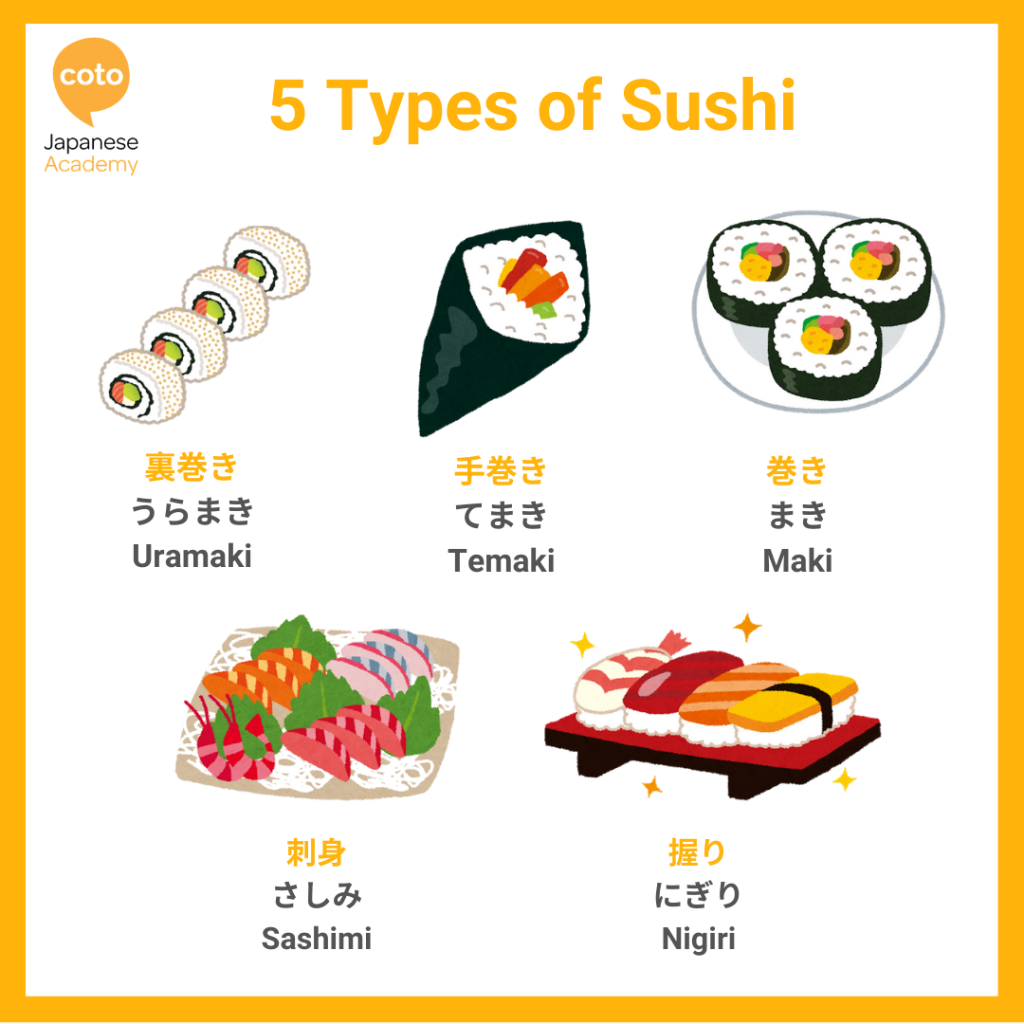
In this article, we will look at some different types of sushi – and how to say them in Japanese!

5 Types of Sushi

5 types of sushi in Japanese

1) Uramaki Sushi 裏巻き寿司/うらまきずし

Although Uramaki sushi (uramakizushi) is very popular in the west – It is actually not very common in Japan.

The word Uramaki is 裏 → back and 巻き → roll. This is because the rice is on the outside and the seaweed on the inside. Popular Uramaki zushi rolls in the west are California rolls, dragon rolls, and others like them!

2) Temaki Sushi 手巻き寿司/てまきずし

Temaki sushi 手巻き寿司 (temakisuzhi) means “hand rolled sushi”. It is a popular house-party food, due to it being easy to serve.

As the name implies, Temaki sushi is rolled up by hand. The seaweed is on the outside, and people can often customize what they want to put inside it. Next time you need to prepare dinner for a lot of people – consider serving Temaki sushi!

3) Maki Sushi 巻き寿司/まきずし

Similar to Temaki sushi, Maki sushi (makizushi) is rolled with the seaweed on the outside, with rice inside and fish in the middle. Maki sushi is far more popular at sushi restaurants in Japan than uramaki sushi – and Maki sushi rolls are often eaten last due to their rich flavor.

4) Sashimi 刺身/さしみ

Sashimi is not quite sushi – it is raw fish (or meat), thinly sliced and often served on ice with soy sauce and wasabi.

However it is often served at Japanese sushi restaurants – as well as Japanese Izakaya! For this reason, we have included it in our list!

5) Nigiri 握り寿司/にぎりすし

This is the most popular form of Japanese sushi in Japan. Often prepared by hand, and served as 2 pieces. Nigiri sushi is raw or cooked fish on top of a small ball of rice, sometimes with some wasabi inside.

Maguro Sushi – Tuna

sushi and sashimi japanese tuna

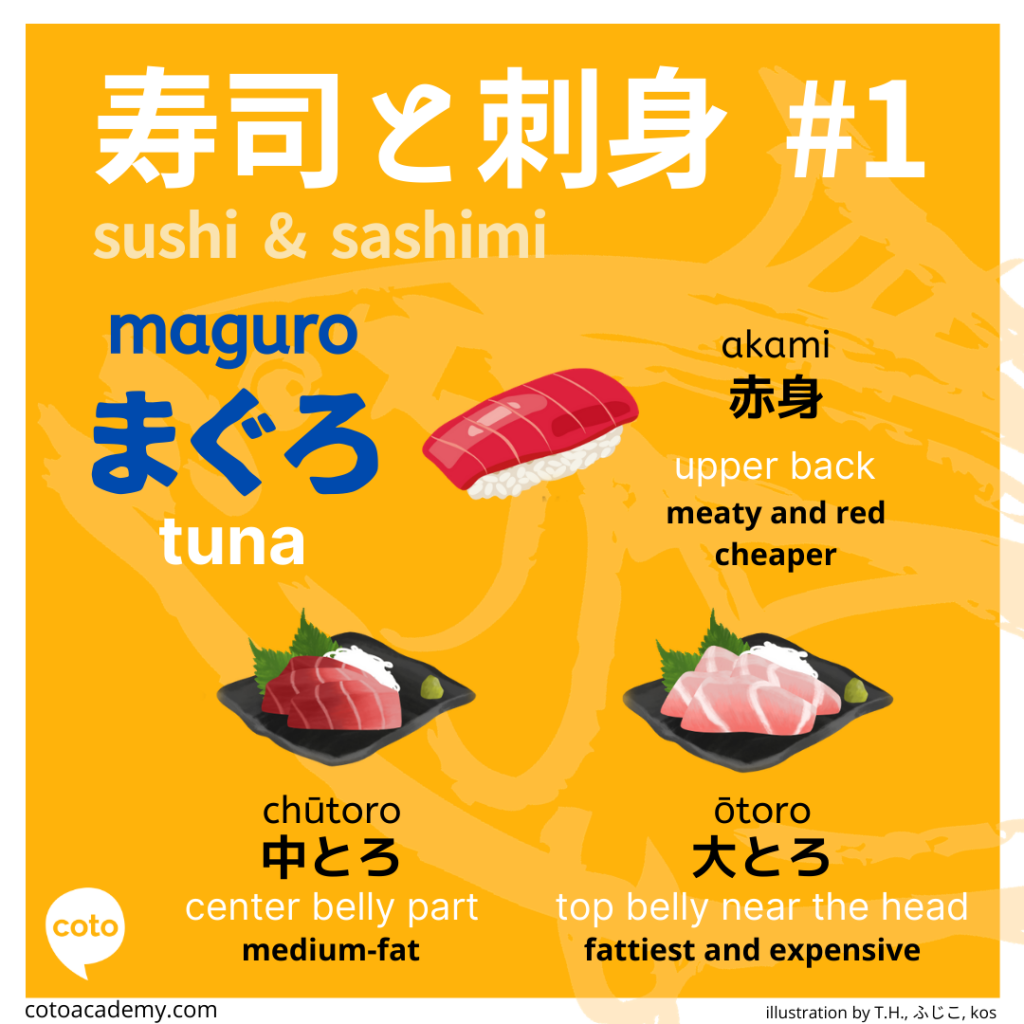
鮪 (Maguro – tuna) has different options for flavor and texture depending on the part of the fish that it comes from.

Toro is the fatty part from the belly of the fish. Akami (赤身) is the lean part from upper back. It is the most frequently-used part of the fish for sushi.

本まぐろ – honmaguro – is Pacific bluefin tuna.

Sāmon Sushi – Salmon

sushi and sashimi japanese salmon

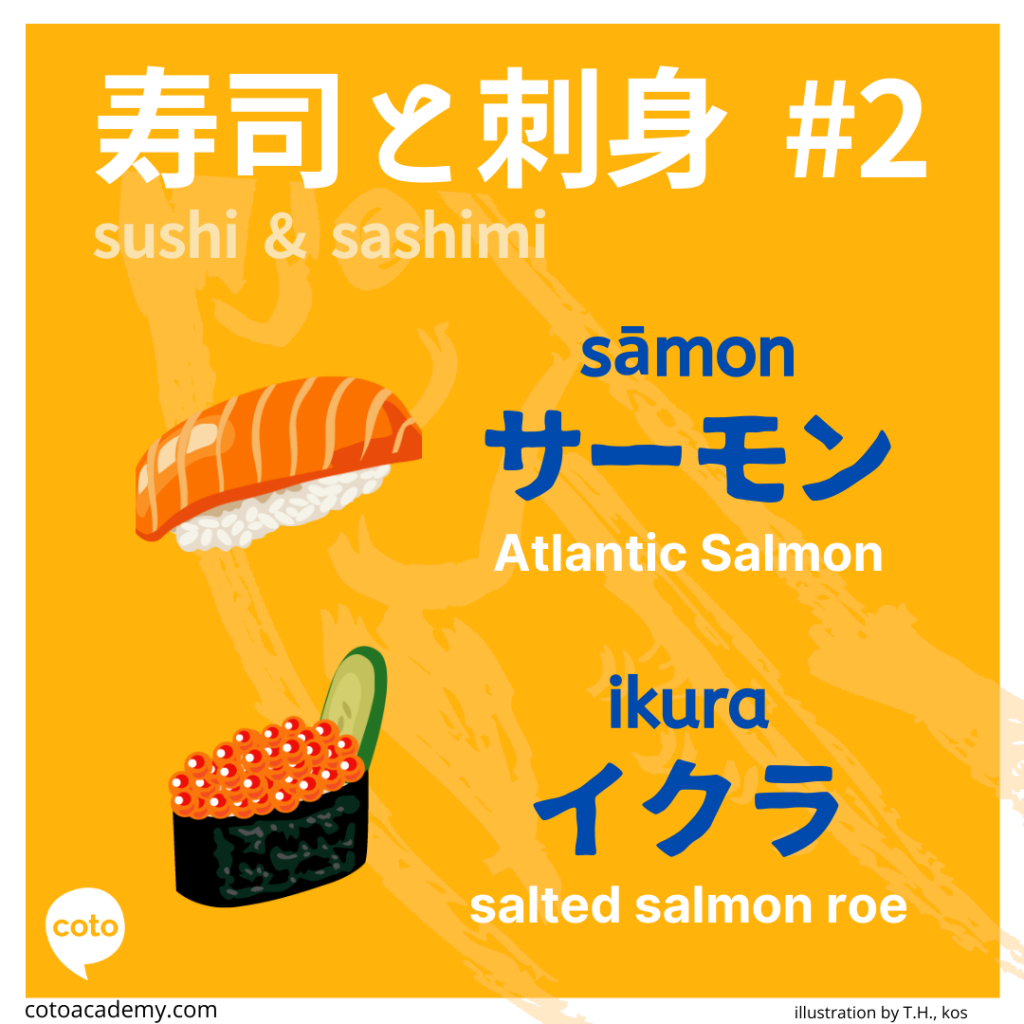
The サーモン (sāmon – salmon) used for making sashimi and sushi in Japan is Atlantic Salmon. Japanese sake/shake (鮭) means Chum salmon (シロザケ), and should not be eaten raw!

Ikura (いくら) is Salmon roe (eggs), and is quite expensive! It is often served on top of rice and inside seaweed with a cucumber – just like the picture above!

Ika and Tako Sushi – Squid and Octopus

sushi and sashimi japanese squid and octopus

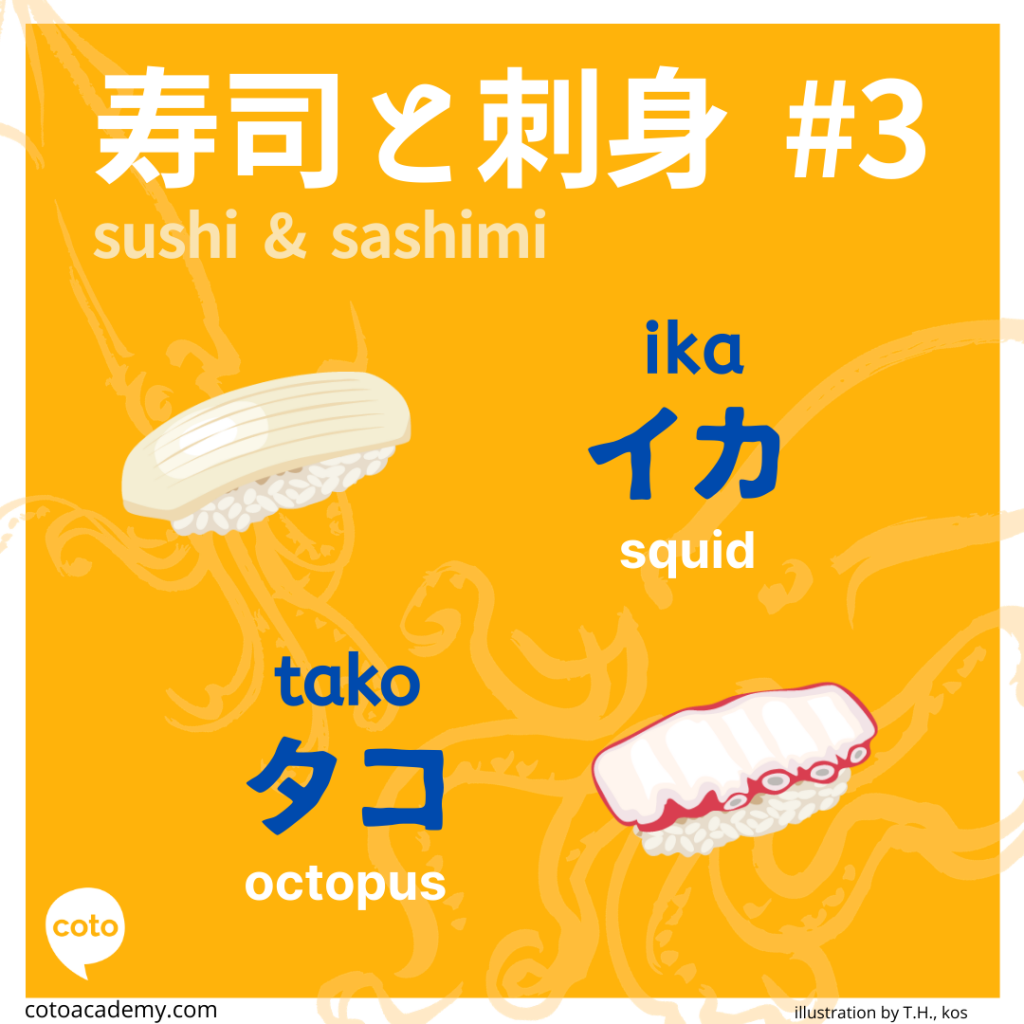
Ika (烏賊/イカ – squid) and Tako (蛸/タコ – octopus) are both considered “light” flavored fish. And yes, these are almost always served raw!

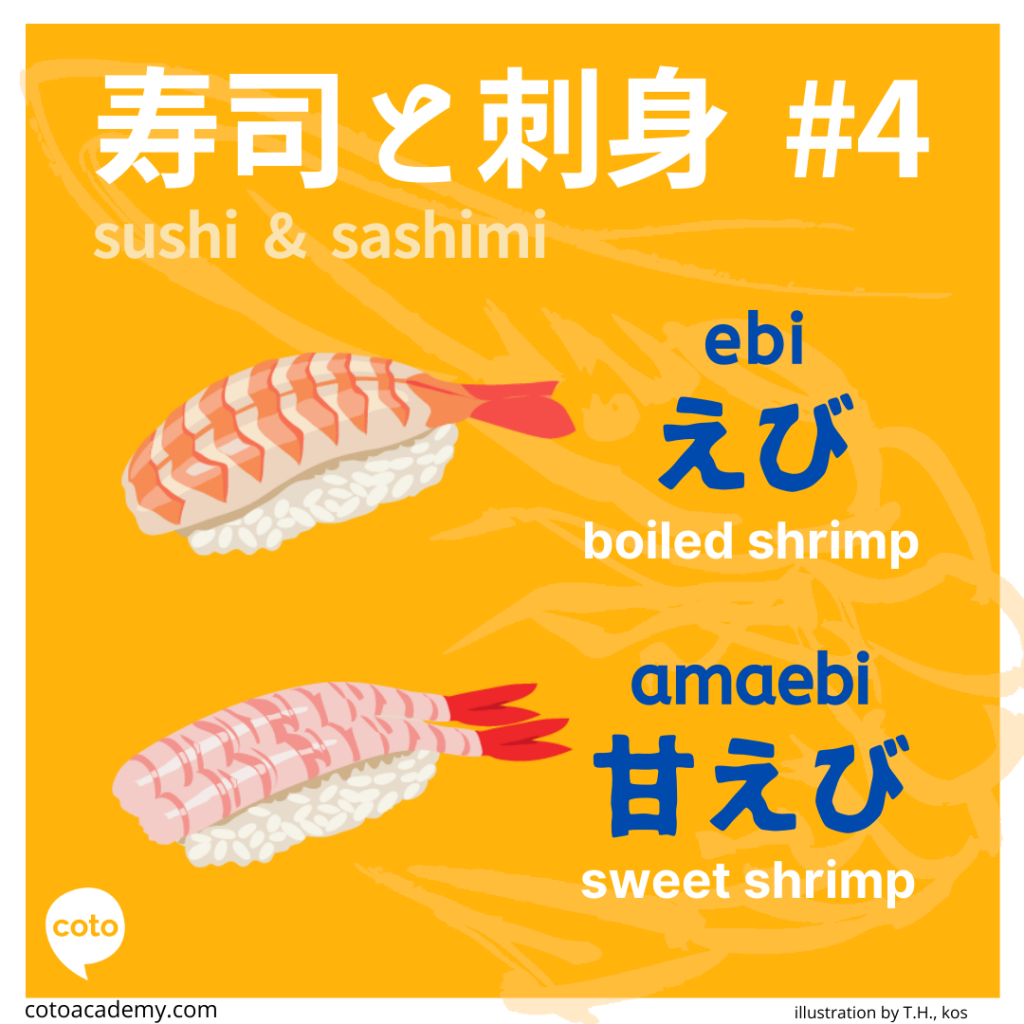
Ebi Sushi – Shrimp

sushi and sashimi japanese shrimp

Did you know that Japanese sushi serves multiple types of shrimp (海老/えび)???

Here are some of them!

  1. 海老 – ebi – shrimp
  2. 甘えび – amaebi – sweet shrimp (commonly served raw)
  3. ぼたん海老 – botan’ebi – Jumbo shrimp (plumper and larger than amaebi with similar taste.)
  4. 車海老 – kurumaebi – Japanese tiger prawn (commonly used for Edomae­-style sushi)

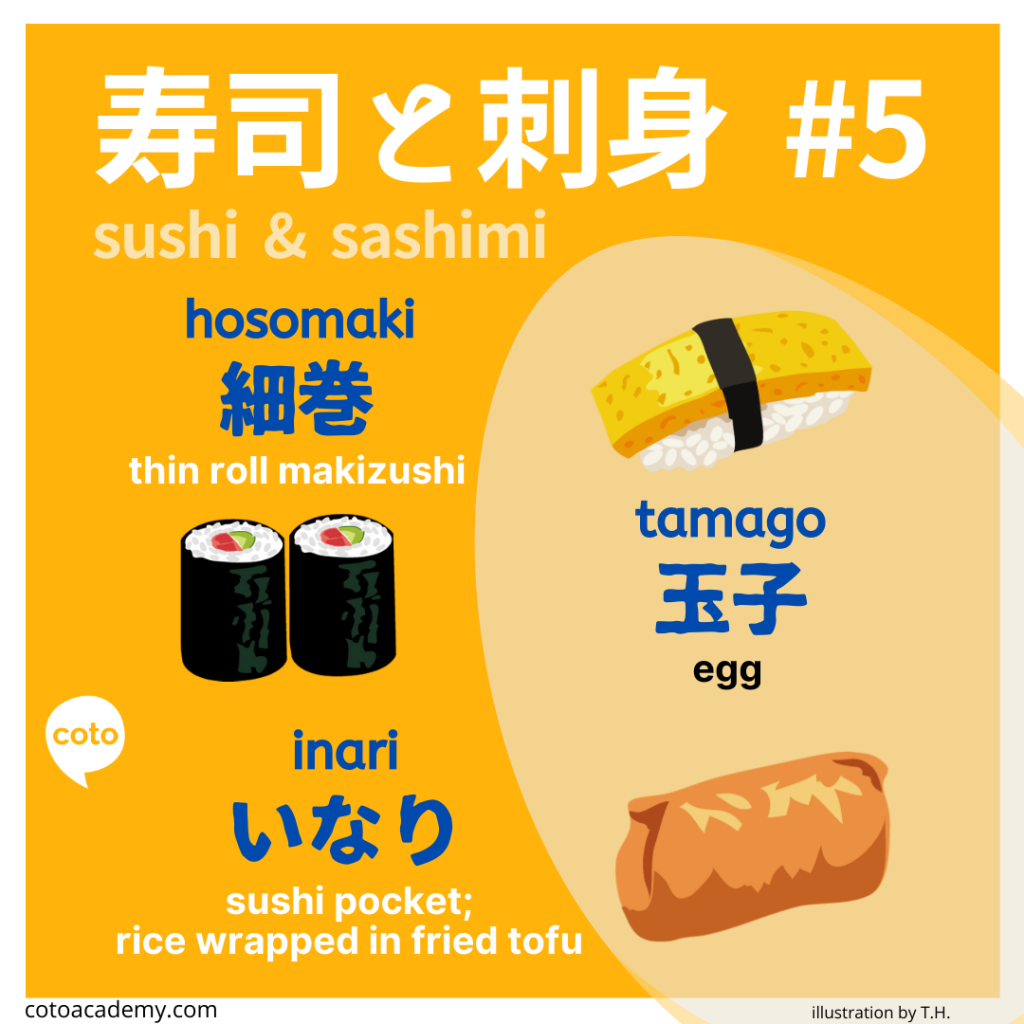
Maki – Rolls

sushi and sashimi thin rolls and egg

細巻/細巻き Hosomaki diameter is around 3cm, and there is usually only one ingredient inside. It’s thin and rolled with nori and looks like a gun, which is why it’s also sometimes called 鉄砲巻き (teppō-maki).

Some common hosomaki are:

  1. かんぴょう巻き – kanpyō maki – dried gourd roll.
  2. かっぱ巻き – kappa maki – cucumber roll.
  3. 納豆巻 – nattō-maki – fermented soybean roll.
  4. 鉄火巻 – tekka maki – sliced raw tuna roll.

There is also 太巻 – futomaki – which is a thick roll of makizushi. With a diameter above 5cm, it can hold more than one kind of ingredient.

The 玉子 (tamago – egg) sushi is often wrapped with some seaweed to hold it together. This is a sweeter piece of sushi – almost like a dessert!

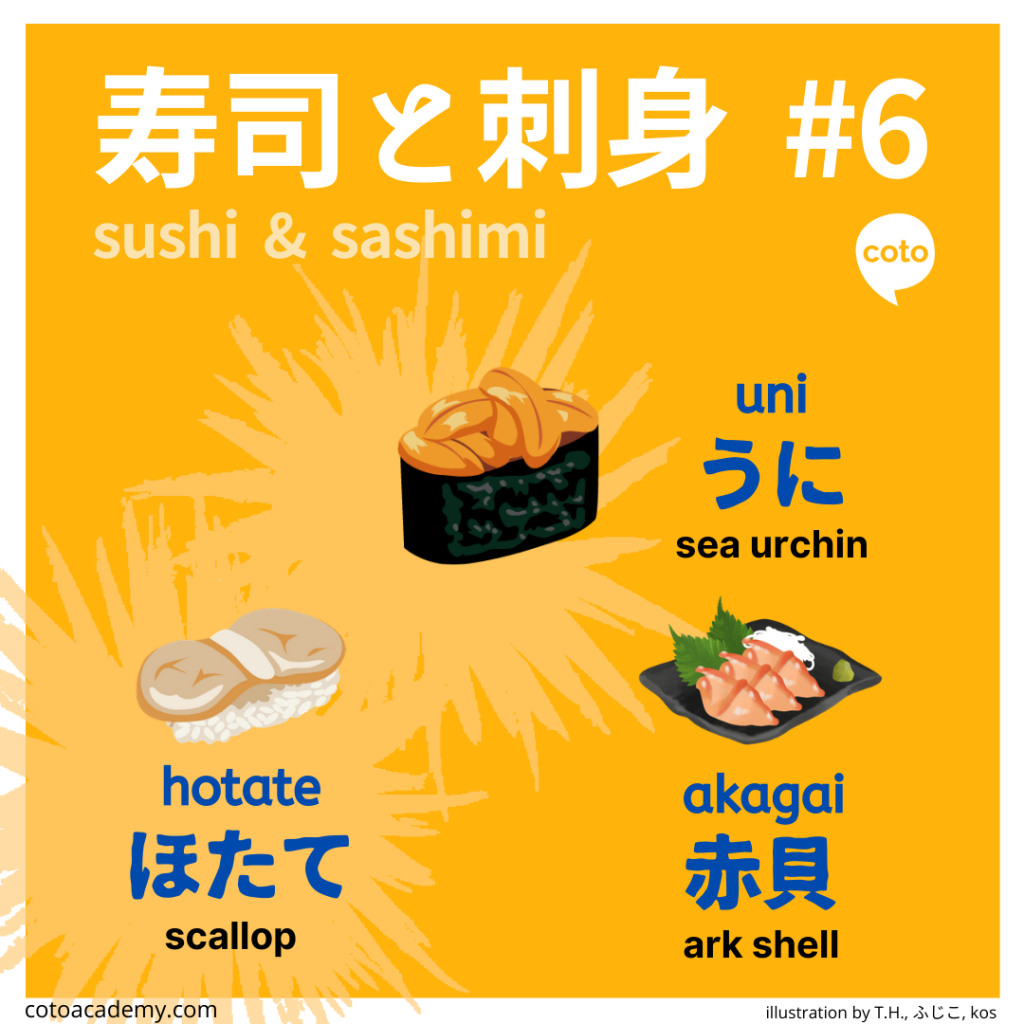
Kai/Gai – Shellfish

sushi and sashimi shellfish and sea urchin sushi

Shellfish (Kai/Gai – 貝) are also popular picks for sushi – especially the popular うに!

Here are some different kinds of shellfish in Japanese:

  1. 帆立 – ほたて- hotate – scallop.
  2. 赤貝 – あかがい – akagai – red clam, ark shell.
  3. ホッキ貝/北寄貝 – ほっきがい – hokkikai – Sakhalin surf clam.
  4. つぶ貝 -つぶがい – tsubugai – whelk.
  5. 海栗/海胆 – うに – uni – sea urchin​.

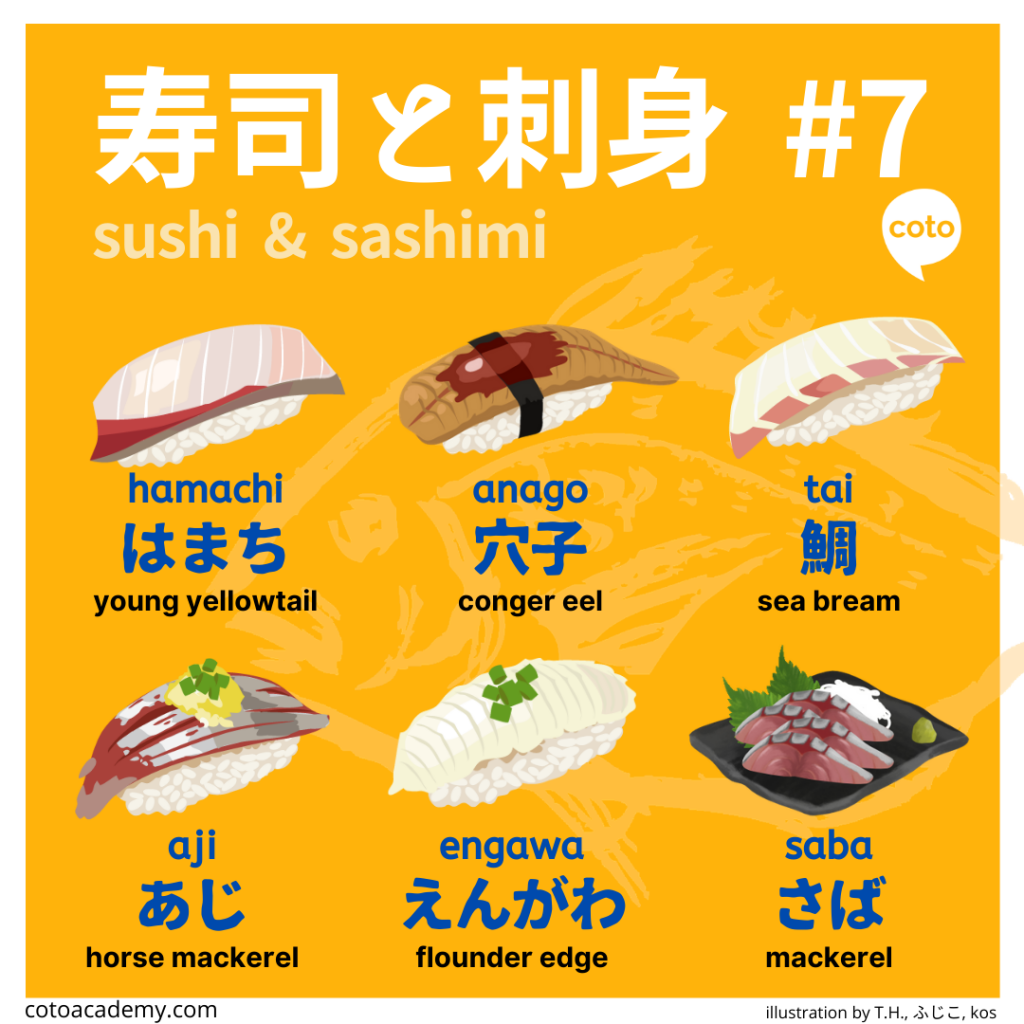
Sakana – Fish

sushi and sashimi various Japanese fish names

Here are some more types of sushi fish!

  1. 魬 – はまち – hamachi – young yellowtail​.
  2. 鰤 – ぶり – buri – yellowtail.
  3. 穴子 – あなご – anago – conger eel.
  4. 鯛 – たい – tai – sea bream.
  5. 鯵 – あじ – aji – horse mackerel.
  6. えんがわ – engawa – flounder edge, fluke fin.
  7. 鯖 – さば – saba – mackerel.

The えんがわ fish gets its name from the word for a veranda in a Japanese house that resembles a porch (縁側 – engawa). It is the meat at the base of a fin from ヒラメ(hirame – flounder ) and カレイ (karei – righteye flounder.) It is a very precious part, and only 4 pieces can be taken from a single flounder.

Ordering Sushi at a Restaurant in Japan

Sushi restaurants in Japan usually fall into one of 2 categories: Conveyor belt sushi (回転寿司) and over the counter sushi restaurants.

Conveyor belt sushi is fun and family friendly, but the quality is often lower than the over the counter sushi. It is more affordable and more convenient, however, making it an excellent option for a casual dinner out! These establishments often have touchscreen menus available, so you can order as you go until you are full!

The over the counter sushi is an experience of it’s own. You can watch them make the sushi right in front of you before they pass it over the counter!
These restaurants often offer sets – or “courses” – that are prepared by the sushi chef for your dining pleasure. You should eat the sushi as soon as you receive it for the best taste!

You can also order with “omakase!” (おまかせ) – which means “I’ll leave it to you!”

Sushi can be eaten with either chopsticks (おはしーohashi) or bare hands. Either one is acceptable!

Hopefully this article was able to provide you with useful information about sushi in Japan and Japanese sushi names! Maybe now you can try out ordering some new kinds of fish in Japanese next time you are at a sushi restaurant 🙂

Learn to order sushi fluently by taking Japanese lessons with us!

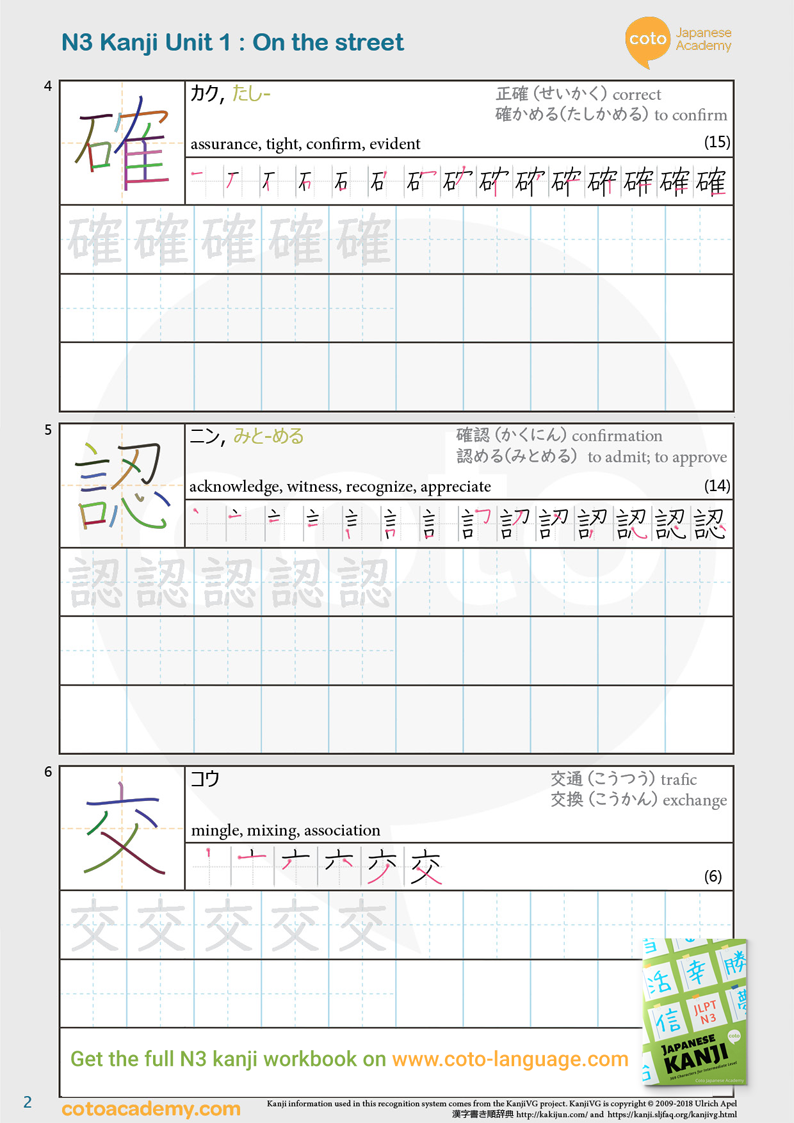
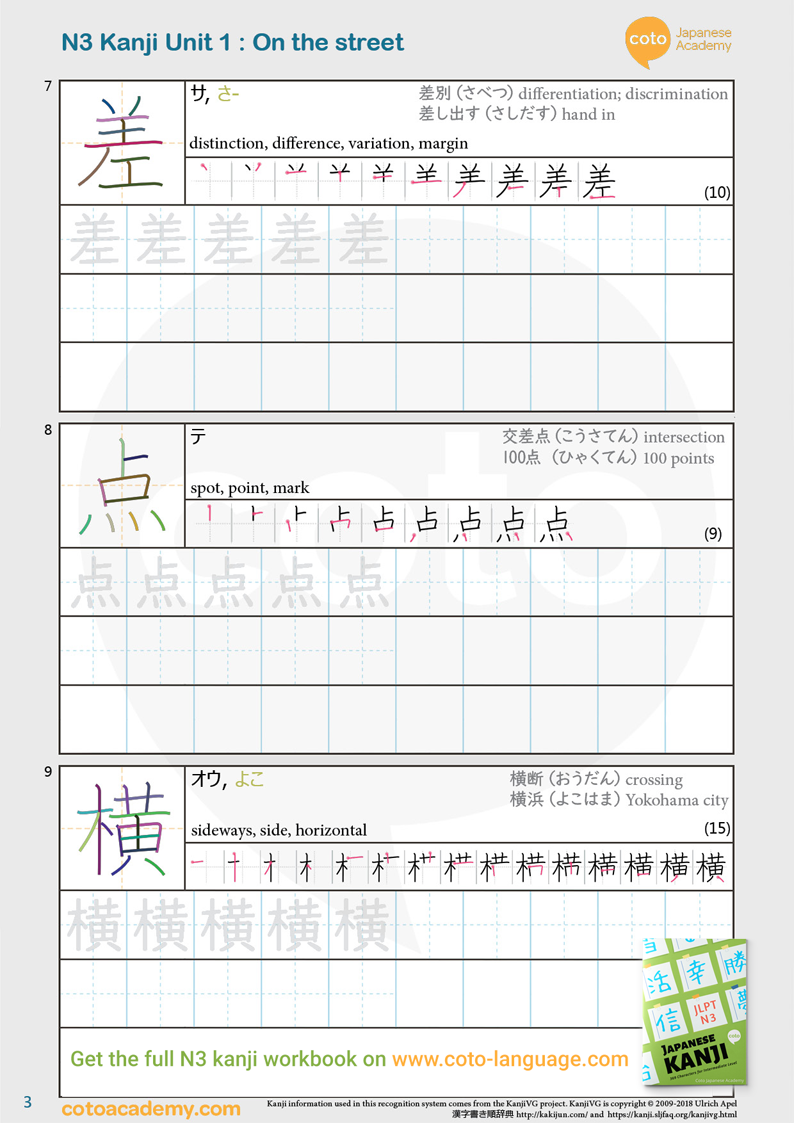
When living in Japan, Kanji can be seen in many places. These various locations include traffic signs, shop signs, restaurant advertisements, etc. Let’s practice using this Kanji Worksheet.

In our N3 kanji Workbook unit one, we’ll be presenting to you common kanji you will see on the street.

Are you looking to pass the JLPT N3? Enrollment for our Online JLPT N3 Prep Course is OPEN!

Feel free to check out our previously uploaded worksheets as well! And be on the lookout for more worksheets that we will be updating soon!

Click here to download: FREE Kanji Writing Practice Sheet – JLPT N3 Unit 1 On the Street – PDF

JLPT N3 kanji practice workbook street 信号
JLPT N3 kanji practice workbook street 確認
JLPT N3 kanji practice workbook street 交差点

Click here to get the full N3 Kanji writing workbook – Digital Download

Are you interested in starting a business in Japan?  Is your dream to move to Tokyo and open a restaurant, shop, or an internet start-up?
After several of our students have asked us about finding information about this – we thought it was time to write our own article.
We hope that this guide is helpful to you and that it motivates you to continue learning Japanese and further your life in Japan.

Starting a business in Tokyo

In Japan starting a business can be confusing. Thinking about the idea – many questions come up.
Can you apply for a visa as a business owner?  What are the requirements for incorporation? Do I need to hire a lawyer?
These are great questions.

The first and last step in starting a business in Tokyo

Many people do not know this – but actually – the Tokyo Metropolitan Government has a one-stop resource center for foreigners looking to open their businesses in Japan.
Located inside the ARK Hills building in Tameikesanno – and adjacent to the JETRO office. (There are also Shinjuku and Shibuya satellite offices!)
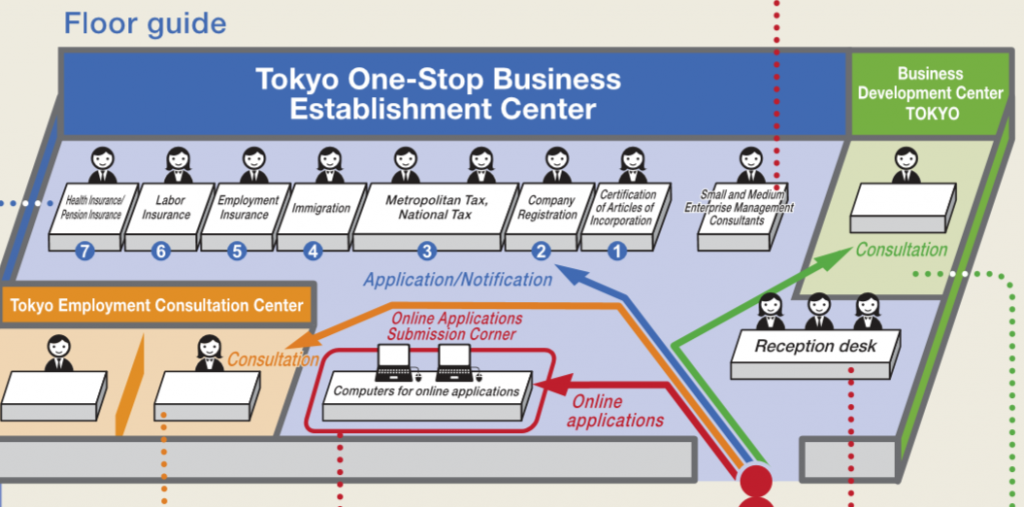
The TOSBEC or – “Tokyo One-Stop Business Establishment Center”  is a free-consultation desk that will help in-bound investors with the logistics of opening a business.
At this one location – they will guide you through all of the legal paperwork required to open your business – and they will even help you to apply for a business/investor visa.
Additionally, they also offer free seminars that you can attend and ask questions
The best part?
All of these services are provided FREE!
They cover the following:

  • Help with creating the certificate of Articles of Incorporation (Providing access to notary assistance)
  • Consultation related to company registrations (how to go about the process)
  • Notification of National and Metropolitan Taxes (How to register and become compliant – they will guide you through the process.)
  • Immigration Issues (They are capable of helping you to obtain a special “Start-up” visa!)
  • Employment, Pension, and Health Insurances (They will help you to enroll in the employment insurance scheme and make sure that you are compliant.)

The best part is – all of these services are not just consultative – they actually help you to submit your documents!
You can see which booths they provide and a diagram of the center below:

Tokyo Start up Business Center
The different services provided by the TOSBEC


You can call to schedule a consultation appointment with them. Phone is actually more responsive than email during business hours.  🙂
ARK Mori Building

  • Consultation appointment:03-3582-4934
  • Other inquiries: 03-3582-8352
  • FAX: 03-5561-4123

Shibuya Satellite Center

  • Consultation appointment: 03-5489-4630

Marunouchi Satellite Center

  • For consultation appointment: 03-6259-1882

Location
ARK Mori Building

Shibuya Satellite Center

Marunouchi Satellite Center

Operating Hours
Morning: 9:30 am ~12:00 am
Afternoon: 13:00 pm ~ 17:30 pm
Operates Monday to Friday
If you are interested in learning business Japanese.  Coto Japanese Academy offers a 4 week intensive business course designed to help you achieve cultural fluency.
This intensive course covers the basics of Japanese business communication.
You can learn more about it by clicking the link below:

Often times, it’s not just enough to have a high-level of Japanese communication skill to start and scale your business in Japan. You’ll need to get a deep understanding of Japanese culture and work etiquette.

This is where Coto Business Communication School — or CBCS — comes in. As our premier business Japanese communication class, we aim not to just teach you keigo (business Japanese), but help you navigate complex business scenarios in Japan.

If you are interested in growing your business with the right Japanese communication skill, learn more about CBCS and contact us today!

Click Here to join our 30 day challenge to learn Hiragana

How to Express Ability to do Something in Japanese

1. Using the Sentence Pattern: V+ことができます

This structure is one of the most straightforward ways to express ability. It consists of three parts:

V + こと
The first part, V+こと, involves nominalizing the verb. If the verb is intransitive, like 泳(およ)ぐ (oyogu, swim), you simply add “こと” to the plain form of the verb to turn it into a noun.
Example: 泳ぐこと (to swim)

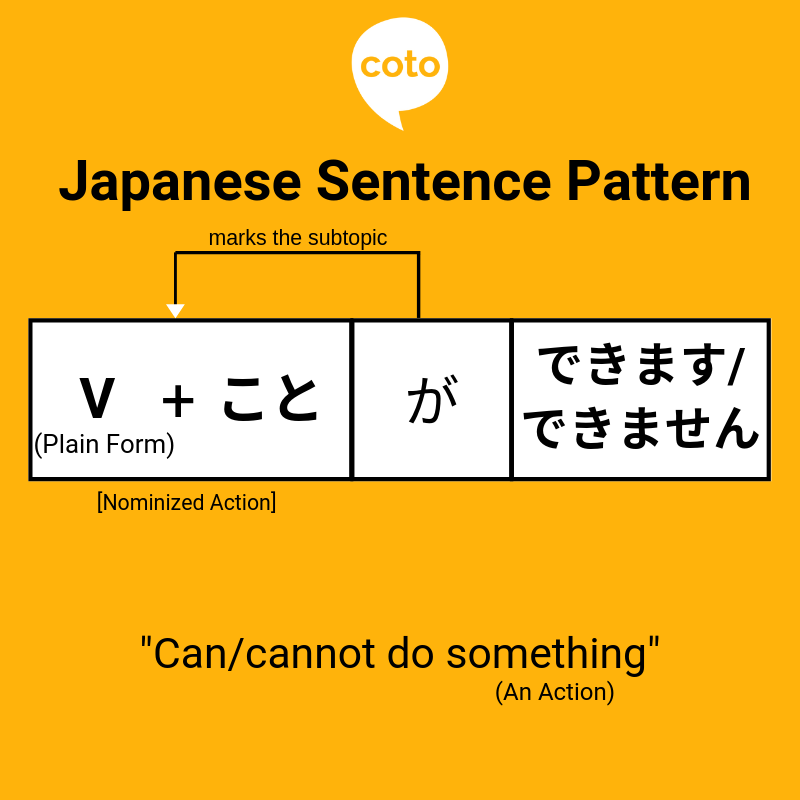
When expressing something that you can or cannot do in Japanese, you may use the following pattern:

V+ことができます
(Verb + koto ga dekimasu)
“can do (something)….

Japanese Sentence Pattern, image, photo, picture, illustration
Japanese Sentence Pattern

V+こと

For transitive verbs (verbs that take an object), you need to place the object with the particle before the verb and then add “こと” at the end.
Example: 絵(え)を描(か)く e o kaku, to draw a picture.
→ 絵を描くこと (the act of drawing a picture)

が (Particle)
The particle here acts as a subtopic marker for the nominalized verb (V+こと). It’s used to indicate the ability to perform the specific action mentioned.

The particle “が ” acts as a subtopic marker in the sentence. In this case, the subtopic is the nominalized action V+こと. Click here to learn more about this paticle

できます (Verb)
The verb できます means “can” in Japanese. Its plain form is できる. If you want to express inability, change できます to its negative form: できません (cannot).

Complete example sentence

私(わたし)はフランス語(ご)を話(はな)すことができます。
Watashi wa furansugoohanasukoto ga dekimasu
I can speak French.

鈴木(すずき)さんは走(hashiru)ることができません。
Suzukisan wa hashirukoto ga dekimasen
Suzuki cannot run.

Asking & Answering to a Question With できる

When asking others whether he/she can do something, simply add “か” at the back of the sentence
When you are asked a can/cannot question, simple ways to answer are: はい、できます (Yes, I can) or いいえ、できません(No, I cannot)

Example sentences:

キムさんは弁当(べんとう)を作(つく)ることができますか。
Kimusan wa bentou o tsukurukoto ga dekimasuka
Kim, can you make bentos?

はい、できます。
Hai, dekimasu
Yes, I can.

ペンギンは飛(と)ぶことができますか。
Pengin wa tobukuto ga dekimasuk
Can penguins fly?

いいえ、できません。
Iie, Dekimasen
No, they can’t.

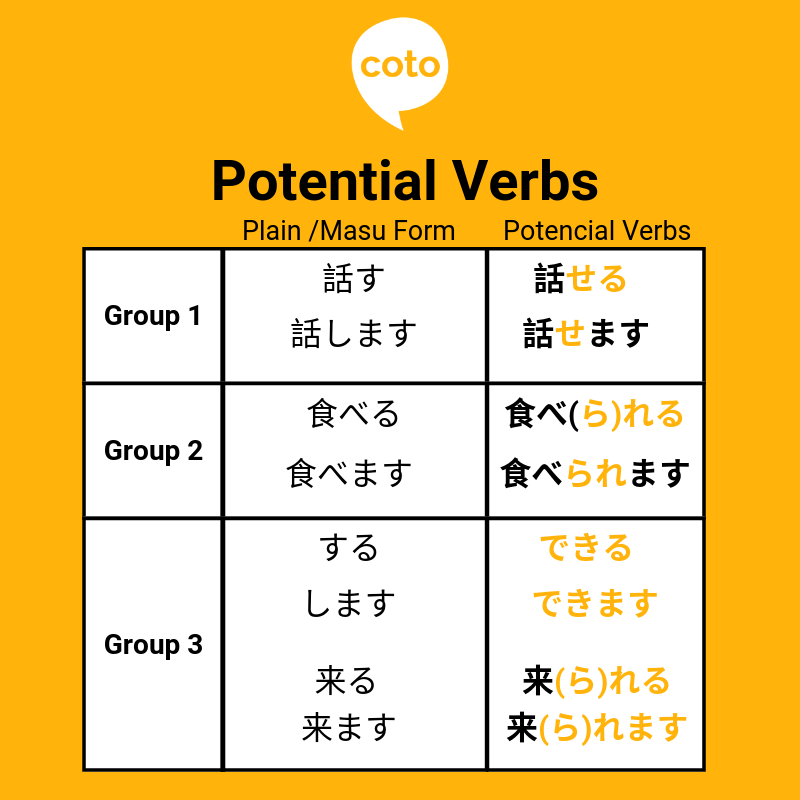
Using Potential Japanese Verbs

Another way to express can or cannot do something is by using potential verbs.

Potential Verb Transformation Rule

Group 1: Change the final vowel to the one on the “え column” of the same role then add “る” to the back.
Group 2: Remove “る” at the back and add “られる” (“ら” is sometimes omitted in oral Japanese)
Group 3: する ―できる 来るー来(こ)られる
Japanese Potential Verbs, image, photo, picture, illustration
Japanese Potential Verbs

Example Sentences

コンビニでATM が使(つか)えます.
Conbini dewa ATM ga tsukaemasu
ATM can be used at a convenience store.

レストランでおいしい料理(りょうり)が食(た)べられます.
Resutoran de oishiiryouri ga taberaremasu
You can have delicious food at a restaurant.

私(わたし)は家(いえ)で勉強(べんきょう)できません.
Watashi wa iede benkyoudekimasen
I can’t study at home.

Now that you have learned the 2 ways of expressing ability in  Japanese. What about asking the 5W1H questions in Japanese?


If you are interested in studying Japanese in Tokyo, find out more about our school by filling out the form below.

If you’re thinking about how to go about planning and managing living expenses in Tokyo, this article will help you to plan your trip budget.

We hope that this helps you achieve your goal of studying Japanese in Japan – so without further ado, here is some additional information about the cost of living and studying in Japan.


Average School Fees
Finding Accommodation
Transportation
Visa
Food
Summing up…
 

Average School Fees

As with most schools, they would typically charge a one-time Enrollment Fee on top of your school fee. Material Fees are separate and are incurred as and when a lesson calls for the use of a particular book.

Don’t worry too much about the Material Fees though, if the school does give handouts, it should have already been included in the school fees.

For Enrollment Fees, the range would typically be at about 10,000 yen to 35,000 yen. As for Material Fees, it can be anywhere from 3,000 yen up to around 5,500 yen for each Book. With that being said, the more books you need for your course of study, the more expensive it would be for you.

Next, let’s take a look at the typical school fees for the various different kinds of courses. For easier comparison, we will look at the prices from a per month basis.
 
Full-time Courses
For most full-time courses that can span anywhere from 3 months to even 2 years (24 months), their prices are relatively reasonable. This can go as low as from 50,000 yen per month up to 60,000 yen per month.

Do note, however, that most schools tend to offer packages, of which the longer you sign up with them, the less you have to pay per month. As such, it would be good if you can decide in advance how long you’d like to spend studying in Japan!
 
Short-term Courses
If you are only able to stay in Tokyo on the short-term, fret not as there are still short-term courses available for beginners out there!

These, however, may be a tad bit more expensive than your intensive courses you’d only be staying to study with the school for anywhere between 1 week up to 3 months.

This can range anywhere from around 55,000 yen per month up till 67,000 yen per month.
 
Flexible/Private Tutoring Courses
As a working adult, you would more often than not need a more flexible schedule if you’d like to learn Japanese. This is what most daytime and evening Flexible/Private Tutoring Courses are aimed at targeting, of which the latter of the two is the more expensive option.

For Flexible Courses, it is usually charged by the number of lessons of which each would span around anywhere from 50 to 90 minutes. Lessons can be priced anywhere from 3,000 yen up to 7,000 yen.

With that, let’s assume that you take 8 to 15 lessons a week (12 Hours in Total). This would add up to around 45,000 yen to 56,000 yen a month.


As for Private Tutoring,it would be the more expensive option among the two at around 2,000 to 6,000 yen per hour. Assuming you study 4 hours a day, 3 times a week, that would add up to around 96,000 yen to 288,000 per month. (12 Hours in Total)
 

Finding Accommodation

With school fees out of the way, now let’s take a look at finding your very own accommodation in Tokyo. As there are many wide variety of options, sharehouses and apartments are the more popular ones that people tend to choose.

For a sharehouse, it’s basically a shared living space with people from different walks of life. You get a room/bed to yourself whereas the living room, toilets and shower are all shared spaces.

There are mainly two types of rooms of which you can get from a Sharehouse namely a Dormitory Room or a Private Room. Of which, the latter of the two would be the more expensive option. Do note, however, that prices can also vary based on the location you choose.

A Dormitory Room entitles you to a bed within a room of which is also shared with other people. A rivate Room, on the other hand, entitles you to a room with your very own bed.

A Dormitory Room can typically go from anywhere as low as 35,000 yen up to 65,000 yen per month depending on the size of the room as well as location. As for a Private Room, it would go at around 49,000 yen per month up to 95,000 yen per month.

If privacy is an issue, you can also opt for getting an apartment. These tend to be on the upper end of the scale in terms of monthly rental which can range anywhere from 120,000 yen up to 250,000 yen per month.

We will recommend that you get this option should be travelling to Tokyo with your friend.
 
As mentioned earlier, prices can vary based on the location and room size. With that, you can either choose to live further from Central Tokyo where property is relatively cheaper with more space or live nearer towards Central Tokyo where property sizes are relatively smaller but may cost more.


With these in mind, there are often additional charges such as Contract Fee, Utility Charges and Deposit Fees. As the prices discussed above are inclusive of the Utility Charges, let’s just take a look at the Contract Fee and Deposit Fee.

For Contract Fee, this is usually a one-time non-refundable fee that has to be paid up front and can be at around 30,000 yen or so.

As for the Deposit, it would really depend on the property company but typically 70% to 80% of the value paid up front can be refunded at the time of your return. A good gauge would be at around 15,000 yen or so.
 

Transportation

Now, let’s take a look at Transport. As you land in Tokyo, most of the time you’d have to first take a Shinkansen (Bullet Train) to the city area.

A one-way Shinkansen ticket would typically cost around 2,000 yen per person. 

To travel around Tokyo, you’d typically spend around 5,000 yen per month if you live near your school and almost double of that at 10,000 yen per month if you live further away.


Let’s not forget the flight prices. A typical round-trip flight from the States to Tokyo would cost around 112,000 yen inclusive of airline taxes.
 

Visa

Moreover, if you’re planning to stay in Tokyo for more than 3 months, you’d definitely have to get a Student Visa. For a Single Entry Visa, it would cost around 3,000 yen where as a Double/Multiple-Entry Visa would cost around 6,000 yen.

To apply for the Certificate of Eligibility, a prerequisite of the Visa application, takes approximately 2 months to be processed, granted and thereafter delivered to you in your home country.

As for the Visa itself, it would take approximately 1 week before you can receive it upon presenting the required documents. You can take a look at some of the generally required documents for visa application over here.

If you’d like to save the hassle of applying for a Visa, why not try picking up some Japanese in less than 3 months with us! With our very own Intensive Course, all you need is 4 weeks to pick some Japanese up!

Food

With so many food establishments in Tokyo, it can be hard to decide as to whether or not you should dine-out for the day.

Should you be dining out everyday, I would give a rough estimate that you should be able to survive on 2,000 yen a day. This adds up to approximately 56,000 yen per month.

If you are looking to save some money, there are 2 other options for you. One of which is to have only one-coin meals from fast food chains like Matsuya, Sukiya or Yoshinoya. This would put you in at around 1,500 yen a day and 42,000 yen per month.

The other option would be to buy some groceries and cook your own meals. Through this, you would only spend approximately 1,000 yen a day and 28,000 yen per month.

But this does, however, come at the expense of your time due to the time needed in preparing your ingredients.

Summing up…

Okay so let’s assume that you are only staying here for one month and you already know when you are heading back so you’ve also booked the return flight in advance.

Up-front Fees: Property Contract + (Deposit – Refundable Deposit) + Enrollment & Material Fee + Shinkansen + Visa + Flight

For Upfront Fees, it would add up to approximately 174,500 yen excluding a Visa which can cost either 3,000 yen or 6,000 yen. This would be equivalent to approximately 1,539 USD.

Monthly Fees: School + Monthly Transport + Food + Rent

As for Monthly Fees, this would add up to approximately 194,000 yen a month which would be approximately 1,710 USD.

However, do note that this is based on the assumption that you rent a private room in a sharehouse near your school and also take on a short-term course.
 

Want to find out more about the courses we offer here at Coto? Help us by filling out the inquiry form below:

[contact-form-7 id=”12634″ title=”Inquiry Form_copy”]