In Japanese, there are several words that can be used to say “But” or “however” – such as kedo, shikashi, and demo.
Today we will look at the word でも (demo) and how it can be used in a Japanese conversation. It’s one of the most essential JLPT N5 grammar points.
In Japanese, the word for “But” is でも。
It usually appears at the beginning of a sentence after an initial concept.
For example:
日本人ともっと話したいです。でも、私の日本語はあまり上手ではありません。 nihonjin to motto hanashitai desu. demo, watashi no nihongo wa amari jouzu dewa arimasen. I want to speak to Japanese people more. But my Japanese is not so good.
or
スーパーに行きました。でも、閉まっていた。 Suu-paa – ni ikimashita. demo, shmatteita. I went to the supermarket, but it was closed
Demo is often used to start a new sentence or to connect two ideas together.
Grammar Point: でも
でも is a conjunctive particle that is used to connect two clauses. It is similar to the English word “but” in that it is used to contrast two ideas. However, there are a few key differences between the two words.
First, でも can be used at the beginning of a sentence, but “but” cannot. For example:
でも、私は日本語が下手です。 (Demo, watashi wa nihongo ga heta desu.) – But I am not good at Japanese.
Second, でも is more informal than “but.” It is commonly used in everyday conversation, but it is not as appropriate for formal writing.
How to Use でも
でも can be used in a variety of ways to express different shades of meaning. Here are a few examples:
To contrast two ideas:
私は日本語が話せます。でも、日本語が書けません。 (Watashi wa nihongo ga hanasemasu. Demo, nihongo ga kaけません.) – I can speak Japanese, but I cannot write Japanese.
To express a concession:
今日は忙しいです。でも、あなたのために時間を作ります。 (Kyou wa isogashii desu. Demo, anata no tame ni jikan wo tsukurimasu.) – I am busy today, but I will make time for you.
To express a reservation:
私は日本語が上手だと思います。でも、まだまだ勉強が必要です。 (Watashi wa nihongo ga umai to omoimasu. Demo, madamada benkyou ga hitsuyō desu.) – I think I am good at Japanese, but I still need to study.
Examples of でも in Japanese Sentences
Here are a few examples of how でも is used in Japanese sentences:
私は日本語が好きです。でも、漢字が難しいです。 (Watashi wa nihongo ga suki desu. Demo, kanji ga muzukashii desu.) – I like Japanese, but kanji is difficult.
今日は晴れです。でも、風がとても強いです。 (Kyou wa hare desu. Demo, kaze ga totemo tsuyoi desu.) – It is sunny today, but the wind is very strong.
私は日本に行きたいです。でも、お金がありません。 (Watashi wa nihon ni ikitai desu. Demo, okane ga arimasen.) – I want to go to Japan, but I don’t have money.
Conclusion
でも is a very common Japanese word that can be used to express a variety of different meanings. By following the tips in this article, you can learn how to use でも correctly and confidently in your Japanese conversations and writing.
Try it yourself! We’ve compiled 30 other N5 grammar points, so check them out here to prepare the upcoming test!
Sentence Structure
In this guide to Basic Japanese Grammar, we will explain in broad terms, the most used Japanese sentence patterns and how to alter them to change them from positive statements to negative statements, as well as how to ask questions while using them. We will continue this series with part II – Grammar Particles
Basic Japanese Sentence Patterns
In broad terms, Japanese sentences can be divided into the following three patterns.
Watashi wa Nihon-jin desu.I am a Japanese person. [Noun Phrase] 私は日本人です。 Meari-san wa isogashii desu. Mary-san is busy. [Adjective phrase] メアリーさんは忙しいです。 Tanaka-san wa ramen o tabemasu. Tanaka-san eats ramen. [Verb Phrase] 田中さんはラメンを食べます。
“Desu” has a similar function to “to be” in English, and comes at the end of Noun and Adjective Phrases. Verb Phrases end with [-masu]. “Wa” is a particle that denotes topics and subjects. (The particles “ga” and “mo” can also indicate a subject.
Negative Sentences
Negative Sentences are made by modifying the end of a predicate, which is typically the last part of a sentence. This grammatical structure is the reason that one must listen to the very end of a Japanese sentence to know whether it is negative or affirmative.
Watashi wa Nihon-jin jya-arimasen. I am not a Japanese person. [Neg. Noun Phrase] 私は日本人じゃありません. Meari-San wa isogashiku nai desu. Mary-San is not busy. [Negative Adjective Phrase] メアリーさんは忙しくないです. Tanaka-San wa ramen o tabemasen. Tanaka-San does not eat ramen. [Neg. Verb Phrase] 田中さんはラーメンを食べません.
Interrogative Sentences (Questions)
Attach “ka” to the end of a Declarative Sentence to create an Interrogative Sentence.
Meari-san wa isogashii desu ka.Is Mary san busy? メアリーさんは忙しいですか? Tanaka-san wa ramen o tabemasu ka. Does Tanaka-San eat ramen? 田中さんはラーメンを食べますか?
Coto Japanese Academy is a Japanese school in Tokyo that provides small size group classes in a relaxed and fun environment. If you are looking for a Japanese school in Tokyo that provides speaking focused small group classes – please visit us at www.cotoacademy.com
Start taking Japanese lessons and master basic Japanese grammar!
This will be a thorough guide on how to apply for the JLPT online. It’s almost that time of the year again when most of us are getting all ready to sign up for the Japanese Language Proficiency Test, otherwise known as the JLPT. With varying difficulty levels from N5 to N1 (with N1 being the most difficult), it is relatively important to start deciding on which level to take on the test date before applying for the JLPT online. With that being said, let’s get on with some of the details related to the test!
Test Dates
First things first, let’s go through the dates on which the tests are being held so you can mark them down on the calendar. Throughout the span of one year, there are typically JLPT tests being held biannually. These tests are usually held once in July and once in December.
First JLPT Test in 2023: July 2, 2023
Second JLPT Test in 2023: December 3, 2023
Registration Dates for 2023 July JLPT
Registration through the MyJLPT page is not yet open for the July 2023 JLPT.
Registration Dates for 2023 December JLPT
Registration through the MyJLPT page is not yet open for the December 2023 JLPT.
Test Location
Moving on, let’s see the various locations in which you can take the JLPT. You have two option: take the test locally in Japan or in an educational institute overseas. For the full and comprehensive list of overseas institutes which conduct JLPT, head on down to the link over here to check if it is an approved institute.
As the location in which you take the JLPT varies, there may be different procedures, windows or deadlines of which you have to take note. However, the test date still remains to be the same. For more information on how you would go about applying for the JLPT online or otherwise, please click on any one of the links below:
Looking at the test components, JLPT Test Levels N1 to N3 is composed of 3 Components: Reading (60 marks), Vocabulary (60 marks) as well as Listening (60 marks). As for JLPT Test Levels N4 to N5, there are 2 Components: Japanese Language Knowledge (120 marks) and Listening (60 marks).
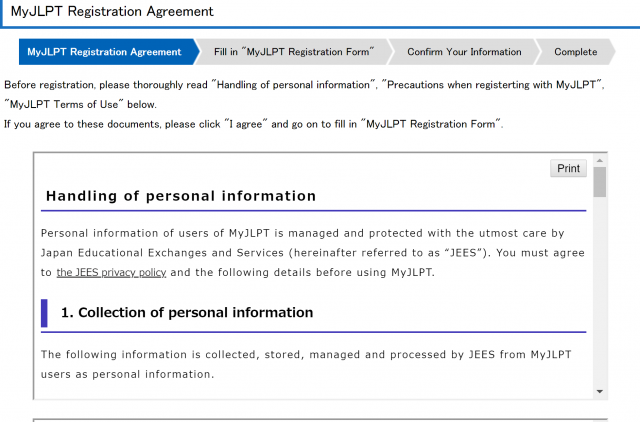
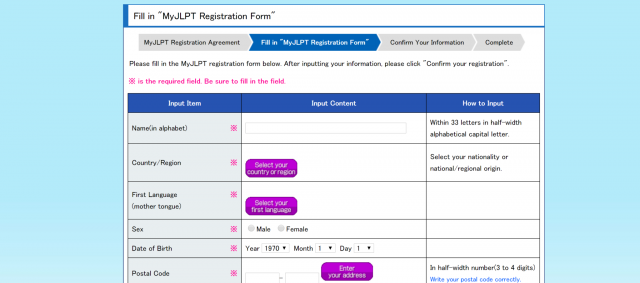
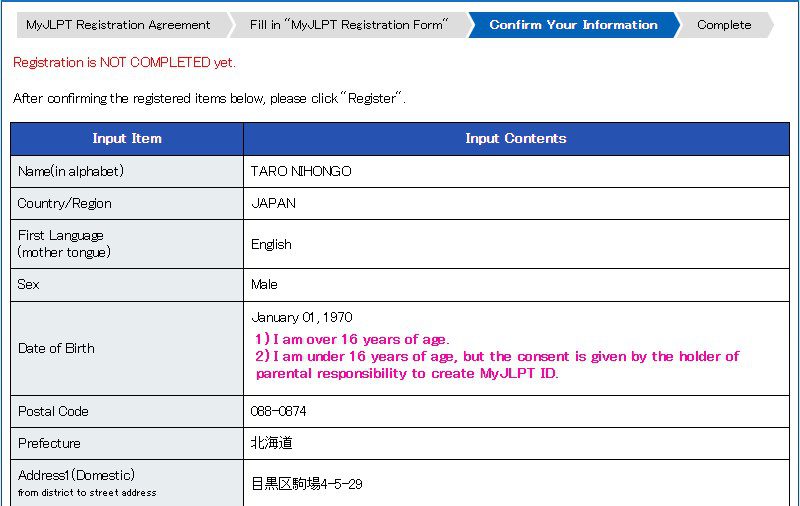
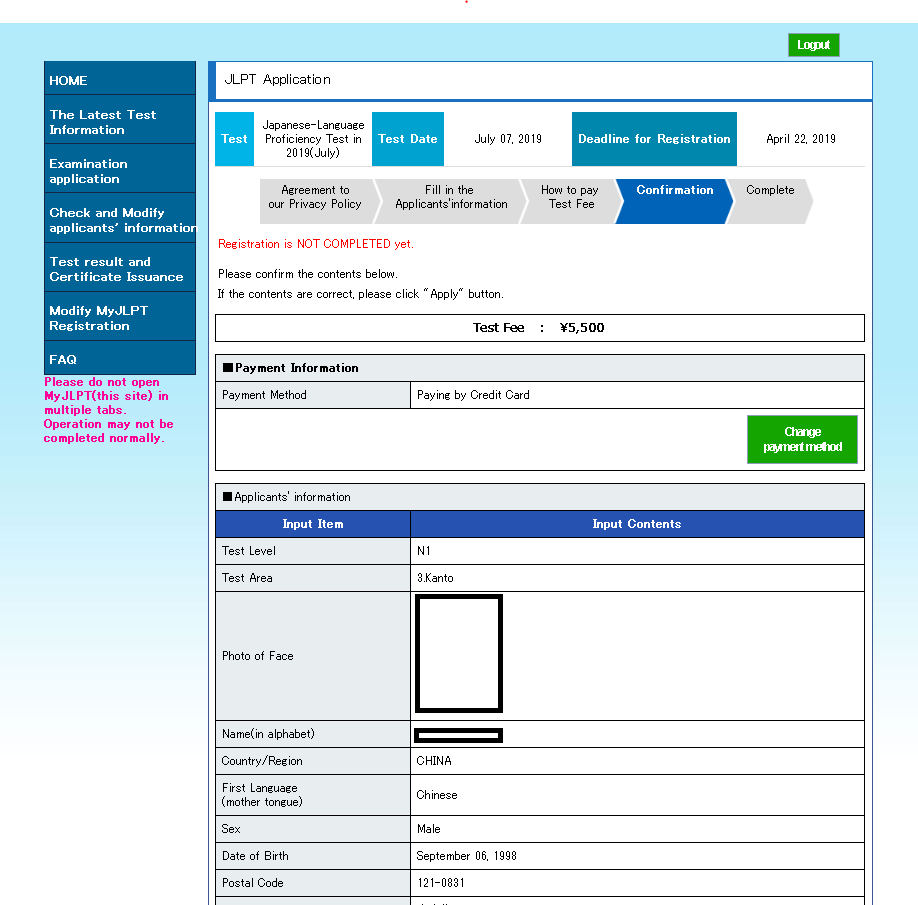
Step 5: Confirm your Personal Information and check your Email Inbox for a Confirmation Email
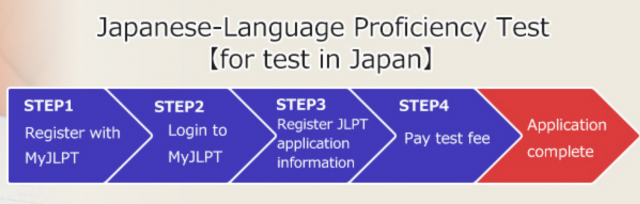
Part 2: Registering for a Test Online with your MyJLPT Account
Once you have obtained the myjlpt id you will be asked to complete the online application from your myjlpt page. The website itself is more friendly to certain web browsers – and the site recommends that you use Microsoft edge.
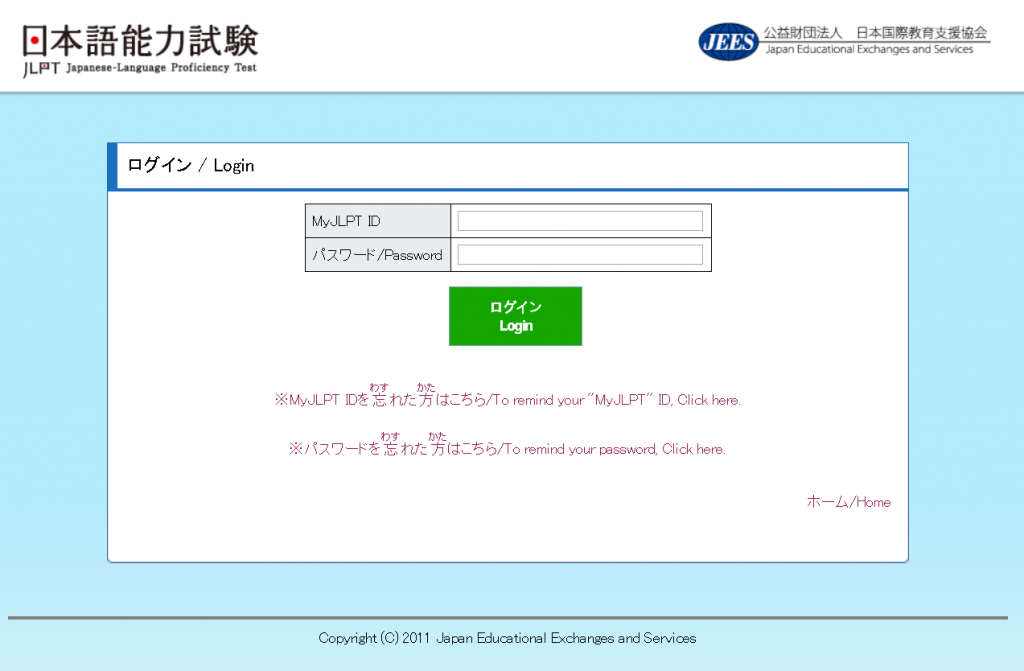
Step 1: Log in to your My JLPT account
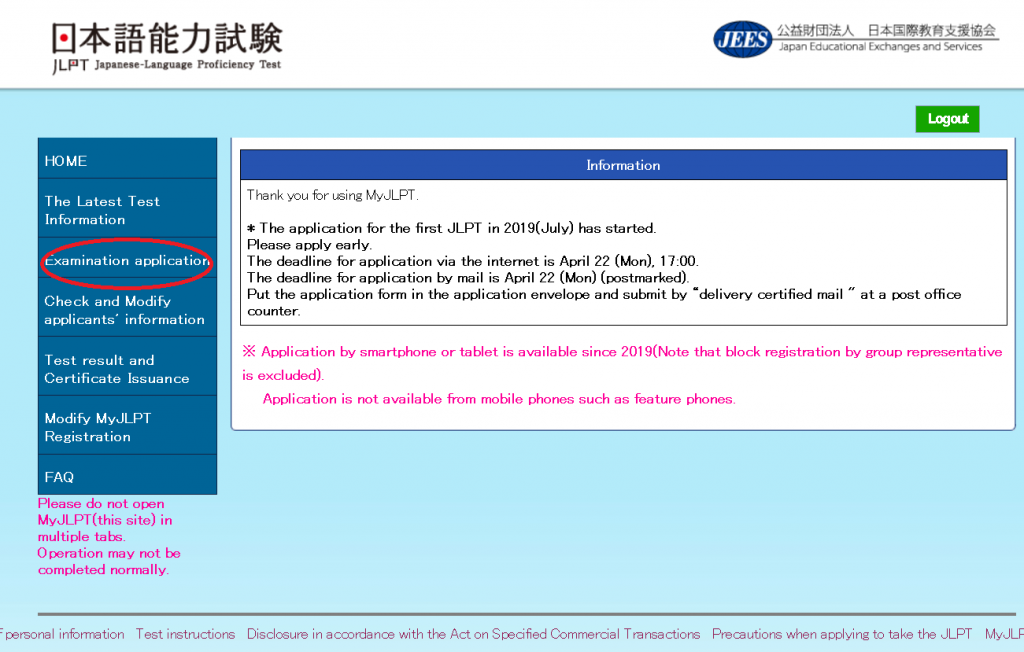
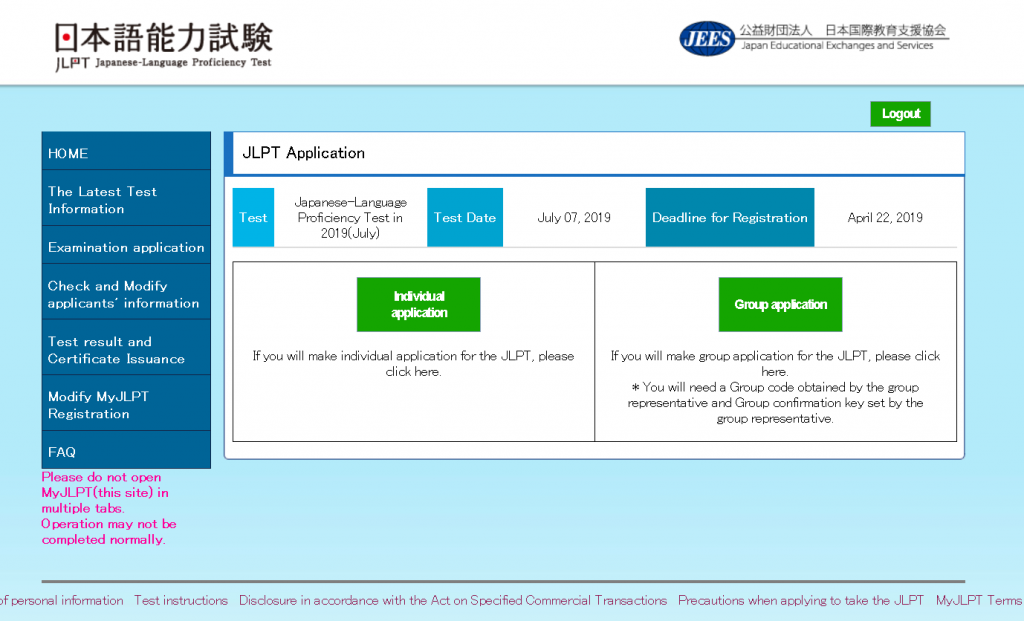
Step 2: Click on “Examination application
Step 3: Choose your application type
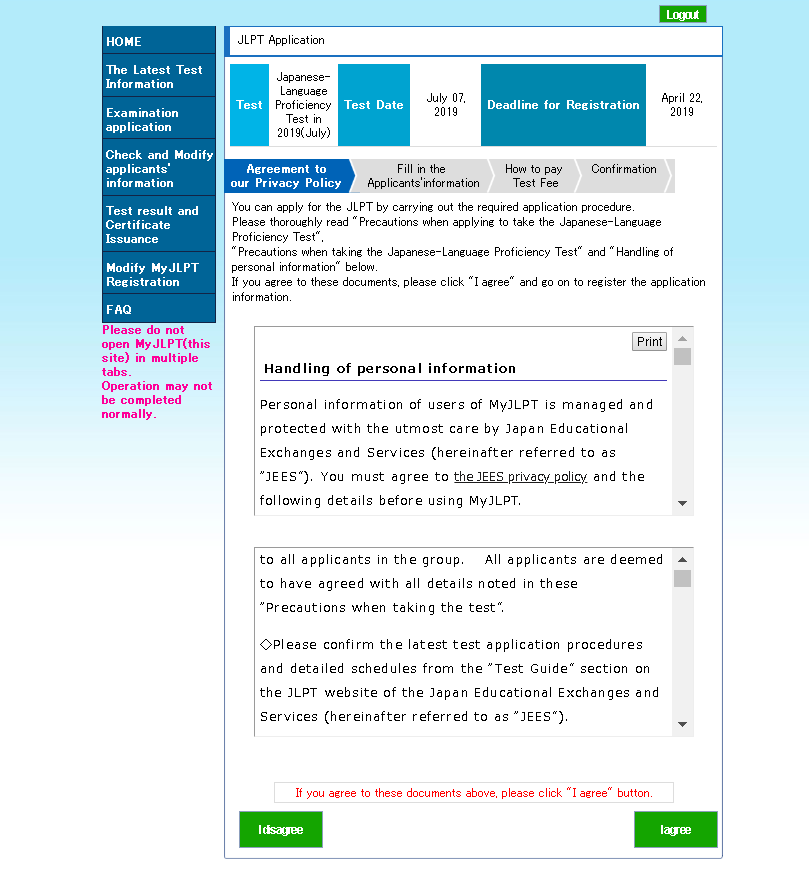
Step 4: Sign the agreement to the privacy policy
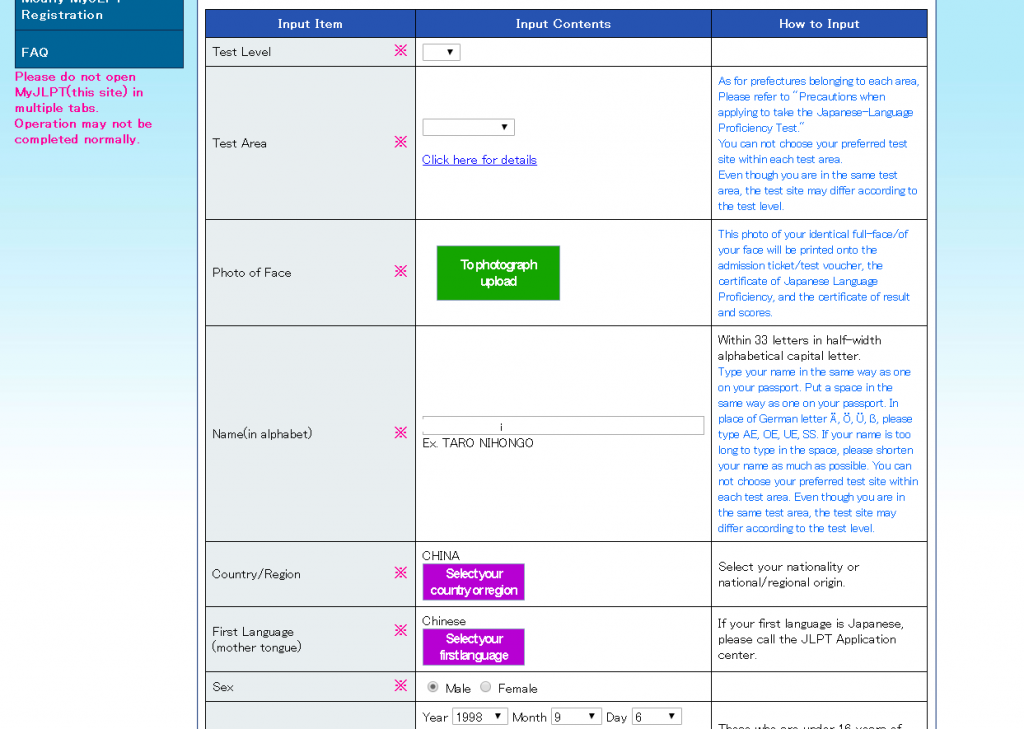
Step 5: Choose your level and fill in other details required
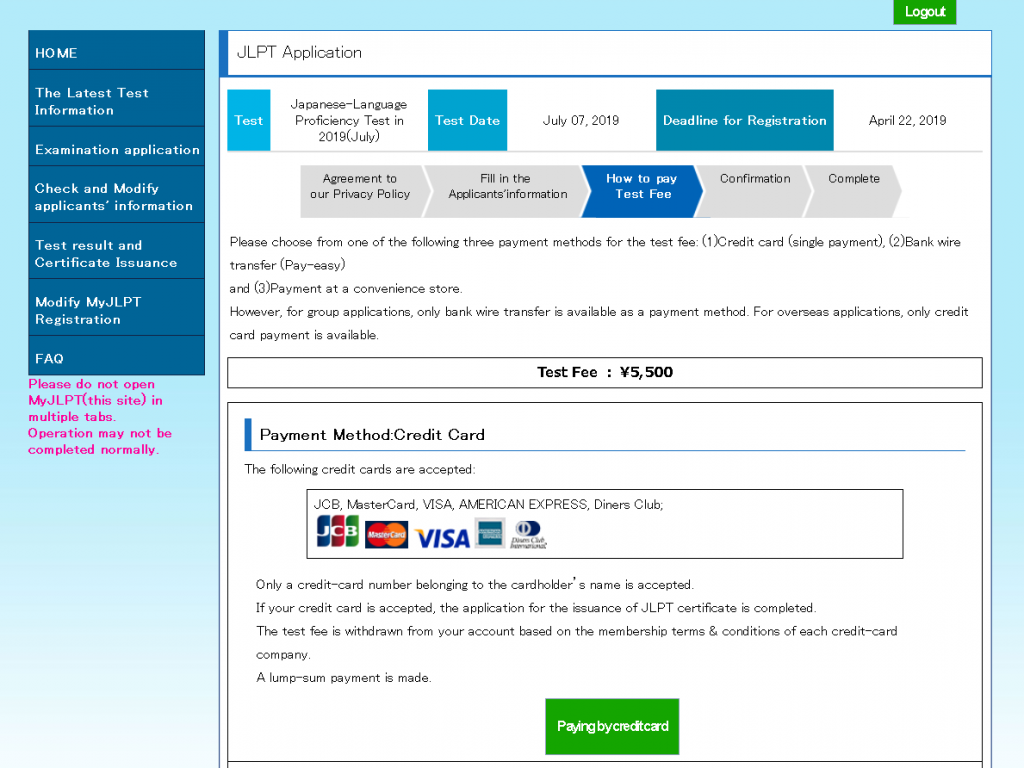
Step 6: Choose Payment type
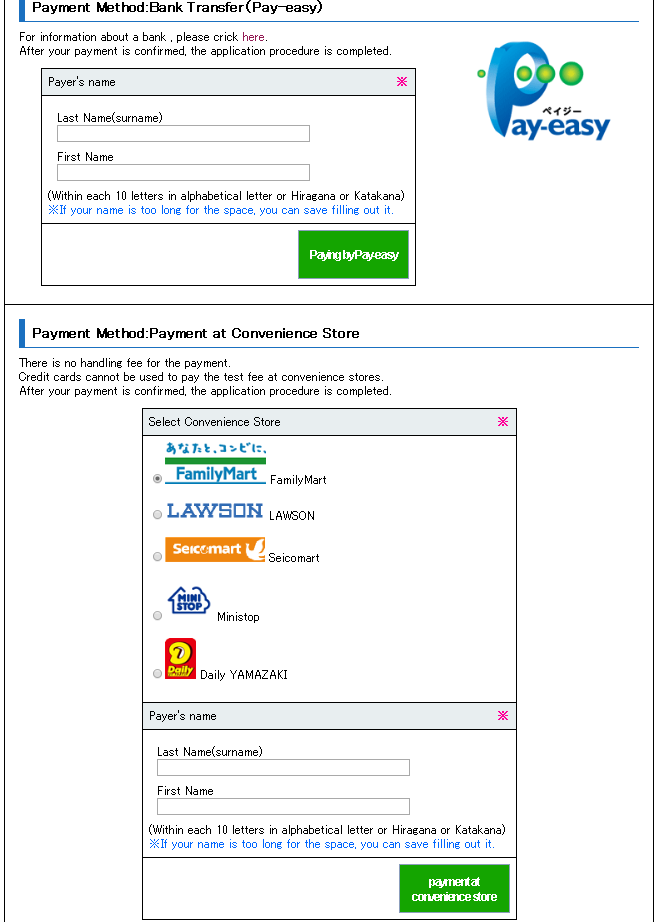
If you are in Japan, you can pay the test fee through several payment methods: credit card, bank transfer or payment via the convenience store. Please confirm the available payment method for countries outside Japan. Generally, credit card is acceptable.
Step 7: Confirm your information
Final step: The application will be completed after confirmation of your information
Application Window
For local students, the application window can start anywhere from Mid-March (July Test) to Mid-August (December Test). As for overseas students, the application window can be anywhere from March to April (July Test) or August to September (December Test). Check your MyJLPT Account for more details and stay up to date on when you can apply.
Payment of Fees & Window for Payment to be Made
After completing your application, you must complete payment before your registration will be confirmed. Test Fees are approximately 5,500 Yen but may vary based on the location in which you decide to take the test.
If you are in Japan – the payment options for the JLPT range from online with a credit card to cash at a convenience store or post office. If you are outside of Japan – the payment method will depend on the test location.
From January 17, 2022, a separate fee of 110 yen will be required for a cash payment from Japan Post Bank ATM. For group applications, a fee of 110 yen will be required for each “payment number”.
The test payment window for December is early to late September.
After making payment, you will be set to receive a Test Voucher which you would need to bring into your test venue to confirm and verify your status as a participant of the JLPT you have signed up for. Ensure that this slip of paper is well-kept and not lost as it is very important.
If you sign up for the JLPT 2022 in December, you will likely receive your test voucher sometime in November.
With these, remember to bring in some form of identification together with your Test Voucher. With that, take the test and you’re all good to go.
Release of Results
After all that hard work, just sit back, relax and give yourself a well-deserved break. Until the time comes, enjoy yourself! But until when? Well, the release of results can vary based on whether you’ve taken the test locally or from an overseas educational institute but here are some dates you can stay on the lookout for!
Local July Test: Early September
Local December Test: Early February
Overseas July Test: Early October
Overseas December Test: Early March
Note: For Overseas Students, collect your Score Reports, and hopefully a Certificate of Proficiency, at your Local Host Institute. As for Local Students, the Score Reports and Certificates will be mailed to you directly based on the address associated with your MyJLPT Account.
If you have questions about our school or taking JLPT Prep lessons with us, don’t worry. Here’s a link to the FAQ site where you can check to see if it answers any queries you have. With that, we would like to wish you all the best and happy studying! 😀
When is the next JLPT and when can I sign up?
The next JLPT Examination is in: December 4, 2022
Registration is from: August 25 to September 15
Where do I apply?
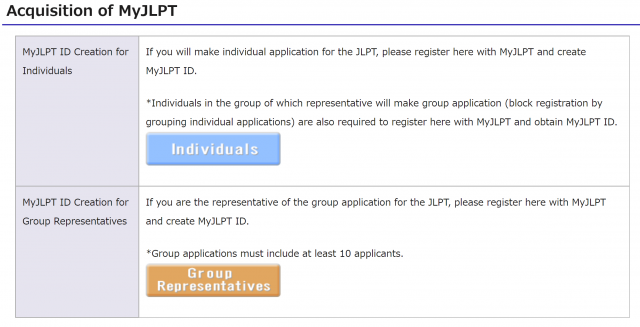
To apply, you will need a MyJLPT account, which you can sign up for here. Once you have an account, you can sign in with your account and start to register.
When do the JLPT results come out?
Depending on when you take the test, the release of the results can differ. In general, you will get your results 2-3 months after the test. Here is when you should look out for your results depending on when you take the test!
Local July Test: Early September
Local December Test: Early February
Overseas July Test: Early October
Overseas December Test: Early March
I have a question about the JLPT that isn't addressed here. What do I do?
If you have any JLPT related inquiries, you can visit the JLPT FAQ site. Your answer should be there.
Start taking Japanese lessons and pass the JLPT exam!
Confused about Japanese Particles? Want to know the difference between wa and ga? Check out this easy to use reference guide.
Japanese particles are an indispensable key in understanding Japanese sentences. Learn changing how a particle is used can change the entire meaning of a sentence. In this blog, we sort out 13 common Japanese particles for the JLPT N5-N4 level. This cheat sheet covers 17 common particles, the usages, meaning and example sentences.
You can get the free download of our learning cheat sheet below.
は
Noun+は
①topic
②emphasis; contrast
③at least
①わたしはケンです。
I’m Ken.
に
Noun+に
①time
②place
③target
①わたしはあさ6じにおきます。
I get up at six in the morning.
を
Noun+を
①object
②place
①わたしはまいあさ、しんぶんをよみます。
I read the newspaper every morning.
が
①Noun+が
②③Polite form +が
①object (like, be good at…)
②but
③~but~(preface)
③おなかがいたいんですが、かえってもいいですか。
My stomach hurts. May I go home?
で
Noun+で
①by~(means)
②at~(place)
③in~(time)
④make of
⑤because of
④にほんのいえはきでつくられます。
Japanese houses are made from wood.
と
Noun+と
①with
②and
③(say or write or think) that~
①わたしはともだちとあそびます。
I will play with my friends.
も
Noun+も
①also
②all
③as much as
④totality
②このスーパーのしょうひんはどれもやすいです。
Anything at this supermarket is cheap.
から
①Noun+から
②Polite form, Plain form +から
①from
②because
②きょうははこどものたんじょうびですからはやくかえります。
It’s my kid’s birthday today so I will be going home early.
まで
Noun+まで
Up to; until
わたしは5じまではたらきます。
I work until 5 PM.
しか
Noun+しか
only (used with negatives)
わたしはひらがなしかかけません。
I can only write Hiragana.
だけ
Noun+だけ
only
かいしゃにがいこくじんがひとりだけいます。
There is only one foreign employee at the company.
Start taking Japanese lessons and master Japanese particles!
Are you trying to pass the JLPT N2 level test? Maybe you want a promotion at work, are trying to pass a job interview – or you might just want to challenge yourself!
The JLPT N2 is quite a beast, but if you follow these study tips you can easily pass. In this guide, we will show you the way to victory so you can pass the N2!
The JLPT N2 is divided into three sections: language knowledge, reading comprehension, and listening comprehension. Each section is scored out of 60 marks, and to pass, you need at least 30 marks in each section.
At the lowest, you need 30/60 per section (90/180 total) to pass. Unfortunately, failing one section will result in a fail on the whole test.
But if you follow just this guide, you will be able to pass with flying colors.
How many Japanese Kanji should I know for the JLPT N2?
In total, you need to know roughly 1000 kanji for the N2.
If you have already passed the JLPT N3, you only need to learn an additional 350 Kanji. This is roughly the same gap from the N4 to N3, so it’s totally doable.
The secret with kanji is to just practice, practice, practice. The good news is there is no writing section, so you only need to be able to read the kanji. That being said, practicing to write the kanji is a great way to carve them into your brain.
What about N2 Vocab?
The vocabulary list for the N2 consists of roughly 6,000 words – around 2,500 more than the N3.
The best way to master the vocab is to memorize the words along with their kanji. Likewise this will also help you retain all of the kanji – so the vocabulary and kanji study reinforce each other.
Plenty of free resources online with kanji and vocabulary lists catered towards N2 study. (Like this list from Memrise)
Mastering the Japanese N2 Grammar will make the JLPT much easier for you. There are around 200 Grammar “points” you need to learn between N3 and N2.
The N2 grammar is tricky because there are many rules – and maybe just as many exceptions. But if you study carefully, the answers to the problems become easier than you might think.
Books are probably a better resource than websites or online flashcards. It is harder to capture the nuances of Japanese Grammar, especially when you get to the N2 level and above. We recommend ‘An Integrated Approach to Intermediate Japanese’ for a book that covers N2 Grammar.
N2 Reading
Since the JLPT N2 has a whole section for reading comprehension, it is important to focus heavily on the reading. They often pull sections from articles or books for the test, and you can expect to be tested on their specific contents.
For reading practice, it is a good idea to focus on reading actual Japanese articles – especially those geared toward Japanese middle school students. You can also check out NHK News Web Easy.
There is usually a bit of furigana for the reading, but don’t count on it being very helpful. It’s best to be ahead of the game as much as possible.
Our Online JLPT N2 Prep Course has a section devoted to Grammar and Reading – check it out to see how you can pass the N2!
JLPT N2 Listening
How hard is listening to the JLPT?
It’s not too bad if you are used to hearing Japanese a lot. It’s often said to be the easiest section.
However, you do not want to underestimate or overlook studying for the listening portion. The questions come at you fast, and you can easily get behind. You are given a blank sheet of paper that you can use to take notes. However, you don’t want to rely on this too much because it can trip you up. Just relax and take each question as it comes.
The best way to prepare for this section is to maximize your Japanese input. Use podcasts, Japanese Tv News, Television programs, and anything that uses proper spoken Japanese for study.
On another note, JLPT prep books come with CDs to accompany the listening. These will be the best way to prepare since the questions will come at you at the same pace as in the actual test. This way, you can get a feel for the rhythm and be comfortable when the listening test comes.
How to Prep for the JLPT N2
The best way to prepare for the JLPT N2 is with JLPT N2 practice tests. You can find PDFs of old JLPT N2 tests online, download them, and take them on a timer.
Taking multiple N2 practice tests has several benefits. The most obvious is getting used to the test format and the types of questions that you will be asked across all 3 sections.
Another big perk of taking the practice tests properly is that you will train your brain to complete the sections within the time limits. When the timer runs out at the JLPT test site, it’s pencils down (.02 pencils, actually). But if you can get used to taking the test on a timer, you will be able to finish the sections with time to go back and review.
If you are curious about study hours, check out our article detailing How Many Hours of Study it takes to pass each level.
If you are serious about passing the JLPT N2, we strongly encourage you to enroll in our Online JLPT Prep Course.
App Recommendations to Study for N2
Language and flashcard apps are a great way to prepare for the JLPT. Here are some of our favorite Apps for iOS and Android!
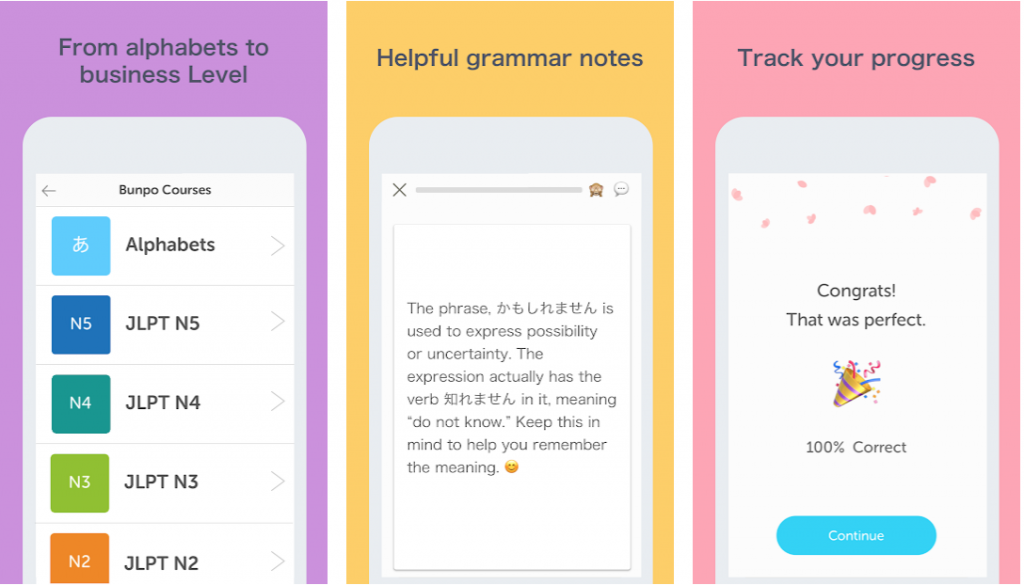
Bunpo: Learn Japanese – Android & IOS
Bunpo: Learn Japanese is available on both Android and IOS!
Bunpo is a free resource for studying Japanese Grammar on your mobile device. It covers JLPT levels N5 to N1!
When you first start the app, you can select a JLPT level to study for (in this case, N2). The Bunpo runs you through lessons and quizzes to help you prepare for the JLPT!
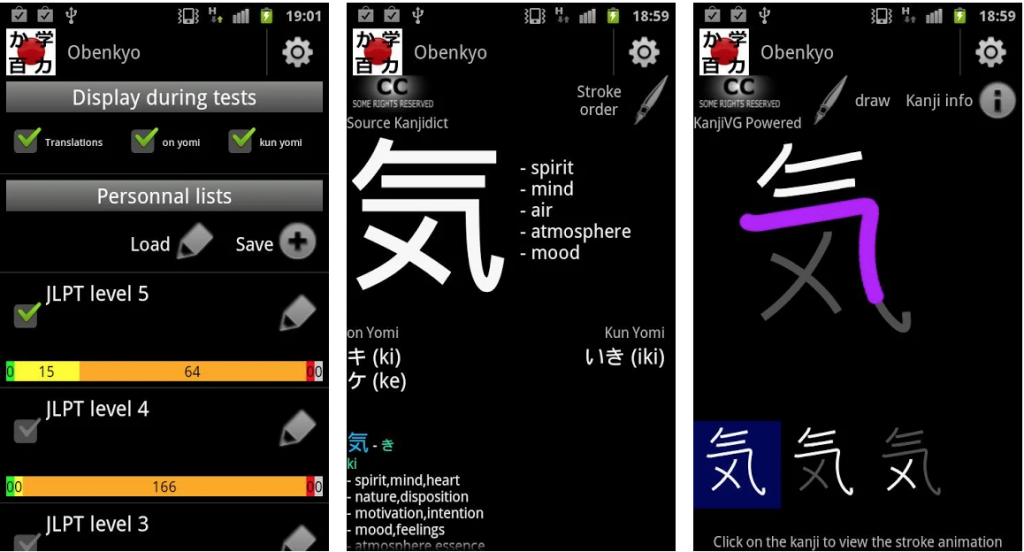
Obenkyo – Android
Obenkyo is available on Google Play as an Android app. Like Bunpo, however, it covers JLPT levels N5 through N1.
Obenkyo focuses on Japanese vocabulary and kanji, but they also have grammar.
Japanese – Android & IOS
Available on both Android and IOS, Japanese is a massive “study companion” for anyone learning the Japanese language – at virtually any stage.
Japanese has dedicated study lists for the JLPT, which feature Kanji, Vocabulary, example sentences, talk-to-text, and flashcard mechanisms.
What’s more is Japanese and the other apps above are all free to download!
Recommended Textbook to Study for the JLPT N2 – Shin Kanzen Master N2
Our ultimate Japanese textbook recommendation for passing the JLPT N2 is the New Kanzen Master series JLPT N2. This bundle (5 books) has all the information you need to pass the JLPT N2.
Each book in the bundle covers (respectively): Kanji, Grammar, Listening (w/ CD), Reading Comprehension, and Vocabulary.
It’s also our textbook for our Online JLPT N2 Prep Course, so we mean it when we say it’s our recommendation.
Online JLPT N2 Prep Course
If you are serious about passing the JLPT N2, consider enrolling in our Online JLPT N2 Prep Course. This course is perfect for anyone who is self-studying but wants to improve their understanding of the language – or anyone who wants an easy way to pass the JLPT N2.
Our N2 prep course focuses on grammar, reading, vocabulary, and Kanji, and you must pass the JLPT N2. You will have access to weekly sessions taught by Nagai-sensei in our virtual classroom.
By ensuring your JLPT N2 certificate, you will be in a good position in a Japanese working professional environment. The JLPT N2 is important for anyone pursuing a career in Japan.
The test is typically held once a year, usually in July and again in December. The application window may seem narrow, but it can be easy to miss it, so be careful!
You can apply and register for the JLPT online via the MyJlpt page. Choose the test level and then pay online. Then, you will be alerted to the zoning/location of the test when they send out your test voucher.
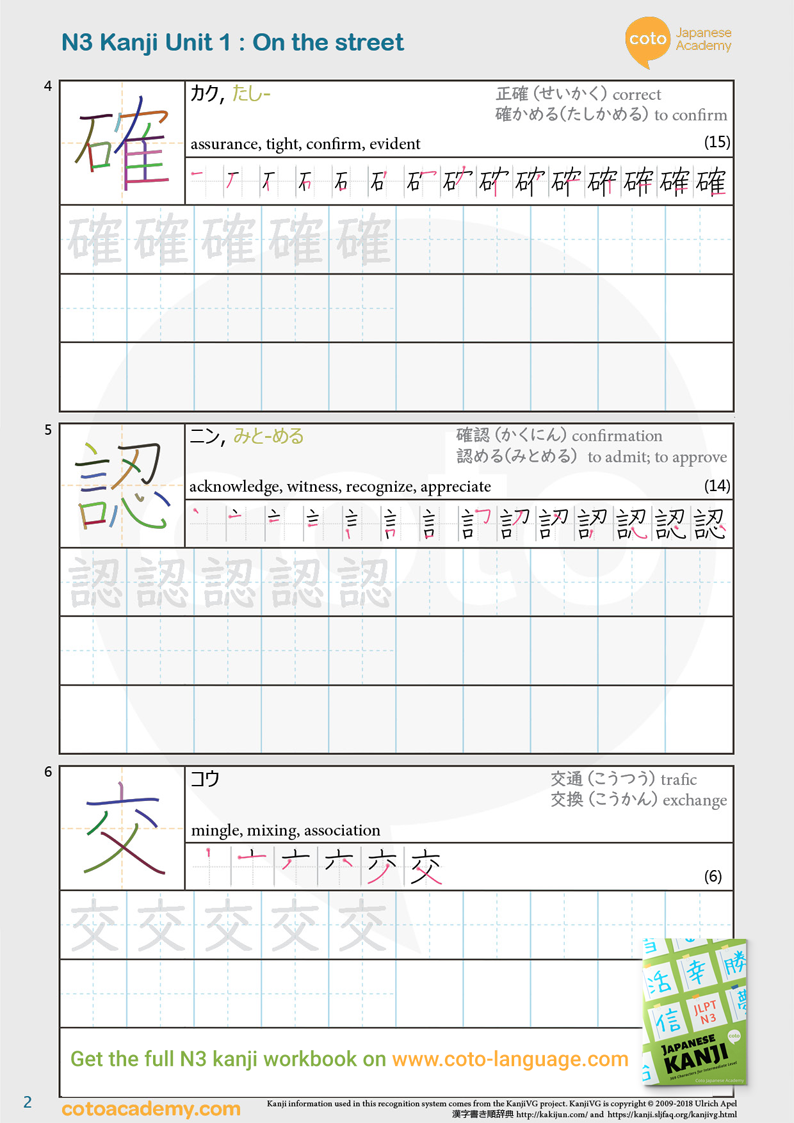
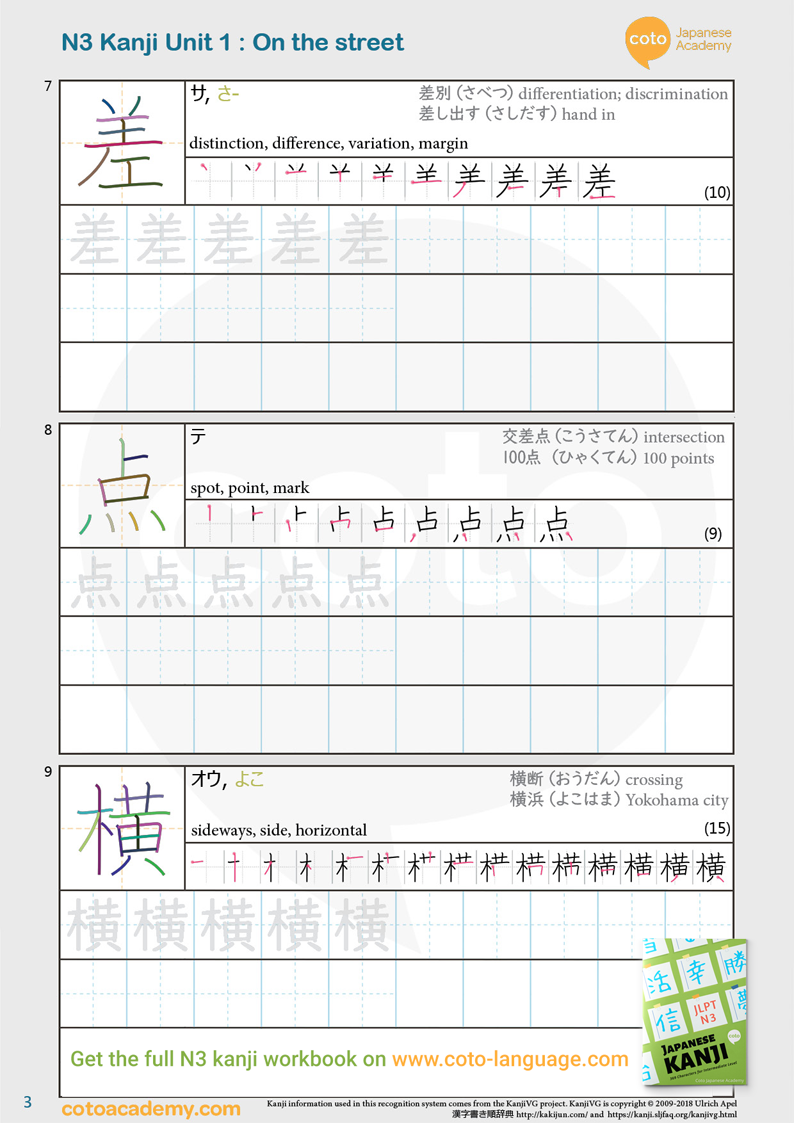
When living in Japan, Kanji can be seen in many places. These various locations include traffic signs, shop signs, restaurant advertisements, etc. Let’s practice using this Kanji Worksheet.
In our N3 kanji Workbook unit one, we’ll be presenting to you common kanji you will see on the street.
After working through ‘Minna no Nihongo’, gloriously passing JLPT levels N5 or N4 and mastering the basic grammar needed to order your favourite sushi, your next step should be to level up to JLPT N3.
This level is described as ‘the ability to understand Japanese used in everyday situations. Looking to pass the easy way? Learn how to pass the JLPT N3 with our JLPT N3 Online Course!
Let’s take a look at what skills are needed to do well on each part, and get some useful tips on how to ace the test! Kanji Vocabulary Grammar Reading Listening
Note: Finding the right JLPT N3 textbook is just as important as studying the subject. That’s why we recommend you check our JLPT N3 textbook recommendations before you continue.
1. Kanji
Bad news: You must know approximately 650 kanji in order to pass. Good news: You should already know around 300 of them, from N5 and N4. You are already halfway there! The kanji is getting progressively more difficult. However, what works best is studying the most common radicals first, as it is easier to find meaning in each kanji. Most importantly, practice, practice practice! A website extremely useful is NHK’s New Web EASY. It is not always easy studying for N3, and I usually need a dictionary, but it is great reading practice. The thing that makes it easier, is that most topics will be familiar to you as they would be news articles. As texts on familiar topics are a lot easier to understand, I’m less likely to give up quickly. Another useful N3 Kanji resource is our JLPT N3 Kanji Writing Workbook! This do-it-yourself PDF workbook is downloadable and will help you master the 369 kanji gap between N4 and N3.
2. Vocabulary
For me, the most difficult part of studying Japanese is expanding my vocabulary. Especially at the beginning, all words sounded very similar to me. It’s getting better, but it is still hard. There was one website that greatly helped me expand my vocabulary, and that is renshuu.org. It is free, and one of the best resources for vocabulary cramming out there. I use it on the train, when waiting in line, and even before going to bed. The words are grouped by JLPT level, and I recommend studying N1 or N2, to be well prepared for N3.
3. Grammar
When it comes to grammar, I prefer books over websites. One book I particularly like is ‘An Integrated Approach to Intermediate Japanese’. This book is not just dry grammar, as it contains interesting information about Japanese culture too. If you understand the grammar in the book, you should already be well prepared to take the JLPT N3 test. Another piece of advice I would like to give is to do mock tests online. Whatever you don’t understand you can look up and include in your studies. However, after studying the book mentioned above there shouldn’t be many unknown words or structures in the test anymore. For reference, the official website has a few practice questions.
4. Reading
For the reading portion of the JLPT test, it should not be too difficult after you followed the advice above. Texts in the tests follow a very similar format every time it is conducted, and the subjects of the texts are never too surprising. Even the kanji mostly have furigana to help you. Common themes are emails from a boss/co-worker, a trip (travel), someone talking about a memory they have, a bulletin with date/time information.
5. Listening
The JLPT N3 listening test is something you can’t learn from books only. The age-old adagio of conversation practice wherever you go comes into play here, and the TV can also be a useful study mate in this case. Listening to comedians making fun of each other can help you get used to the flow and sound of the language, but keep in mind that it will be very different from what you will actually hear during the test. What you will hear during the test is usually spoken quite slowly and clearly, so if you are used to people speaking at a natural speed you may be pleasantly surprised. One of the best ways to practice conversation and work on your specific language issues is to go to a language school. At Coto Japanese Academy, the small class size and professional teachers will help you reach your Japanese language goals, not only to pass the JLPT but also to use in your daily life and work! Click to tweet this Japanese tip to share it with more Japanese learners!
Coto Japanese Academy is a unique Japanese Language School in Iidabashi Tokyo, we offer relaxed and fun conversational lessons for all levels of Japanese learner. Coto Japanese Academy prides itself on its community atmosphere and fun lessons that focus on creation of opportunities to speak and learn Japanese. If you are interested in studying Japanese in Tokyo – please visit our contact page here.
Start taking Japanese lessons and pass JPLT N3 exam!
Are you currently studying Japanese? If so, then you might be interested in knowing more about the Japanese Language Proficiency Test, in short, the JLPT!
Launched in 1984 as a biannual testing service by the Japan Foundation and Japan Educational Exchanges & Services, the JLPT is a tool to evaluate and certify the Japanese proficiency of non-native speakers.
It’s reputation grew fast and wide, and currently more than 600,000 examinees around the globe pass the JLPT every year! In 2010, a revised version was introduced to better assess the Japanase language skills, taking advantage of 25 years of data from the previous JLPT along with research on Japanese language pedagogy.
How is the JLPT Japanese Test Structured?
The JLPT is divided into five levels, from N1 through N5, with the N5 being the easiest, testing the reading and listening skills of non native Japanese speakers. Let’s check a broad summary of the linguistic competence that are evaluated, resumed on the official website.
Since 2008, the Japan Foundation and Japan Educational Exchanges & Services does not provide official study hour recommendations anymore no more than precise list of contents such as kanji or vocabulary needed for each level.
The Easiest JLPT Levels: N4 & N5
The Level 5 of the JLPT measures the ability to understand some basic Japanese. Typically, the test check if the examinee is able to read and understand typical expressions and sentences written in hiragana and katakana. Some basic kanji are also expected to be known. The examinee should be able to listen and comprehend conversations about topics of daily life and classroom situations. Since the conversations are spoken slowly and short, the test measure the ability to pick up information.
The Level 4 introduces more vocabulary and kanji. Examinee has to read and understand passages on familiar daily topics and be able to follow the contents of daily life conversations. Spoken slowly, the conversations of the listening part are longer, and covers daily life’s topics.
N4 and N5 measure the level of understanding of basic Japanese mainly learned in class.
The JLPT N3: A Mid-level Japanese Proficiency Test
The level 3 (JLPT N3) is a bridging level between N1/N2 and N4/N5 that has been launched in the revised version of 2010.
The Level 3 measures the ability to understand Japanese used in everyday situations to a certain degree. The examinee should not only be able to read and understand written materials about everyday topics, but also be able to understand summary information such as a newspaper headlines and slightly difficult writings.
The listening part gets more difficult as conversations are spoken at a near-natural speed and the examinee should be able to follow their contents and understand the relationship among the people involved.
Business Level Japanese: JLPT N2 & N1
Those who desire to work or study in Japan are usually required to hold at least the JLPT N2, if not the N1, the most difficult level. They both measure the level of understanding of Japanese used in a broad range of scenes in actual everyday life.
Very often, the level 2 is considered to be the “business level” of Japanese whereas the level 1 is considered a proof of “fluency” in Japanese.
The level 2 measure the ability to understand Japanese language in daily life and a “variety of circumstances to a certain degree”. The corpus for the reading part is more dense, with long documents such as newspapers’ articles, commentaries, flyers…
Not only should the examinee comprehend the content but he is asked to understand the intents of the writers.
The listening part will have longer conversations a near natural speed and news reports about various topics. One should understand contents, ideas and main points of the conversation.
The level 1 goes even deeper in the comprehension of Japanese writings, asking examinee to be able to follow abstract writings and to understand structures, contents and intents of the documents. The listening part presents lectures, news reports and conversations at a natural speed.
The JLPT Does Have Limits in What it Can Measure
The summary of the linguistic competences expected from the test takers as helpful as it may be, seems to be quite abstract for who is not versed in linguistic.
Like for all language proficiency test, we can debate on their accuracy and efficiency. Languages covers several types of skills – reading and writing, speaking and listening, and although one test examinee can be very good in reading, he might not be able to speak.
Nonetheless the JLPT measures skills for employment screening and as a form of qualification and is greatly valued by educational institutions and companies hiring foreigners. Recruitment companies in Japan will all tell you that holding the N1 or N2 level of the exam is extremely important for foreign nationals hoping to land a job in this country.
Which JLPT Level Should I Take?
If you wish to know if you are ready for the level you are taking this year, check the official “self-evaluation” list provided by the official website. You can also find sample questions to grasp a better understanding of the JLPT.
Our advice? Do not fear the JLPT! Learn practical Japanese and do not solely study grammar or kanji, but Japanese language as a whole. Practicing conversation – although your speaking ability is not measured, is a very good way to pass successfully the JLPT as you will know how to communicate and be better at understanding content!
Coto Japanese Academy is a unique Japanese Language School in Iidabashi Tokyo, we offer relaxed and fun conversational lessons for all levels of Japanese learner. Coto Japanese Academy prides itself on its community atmosphere and fun lessons that focus on creation of opportunities to speak and learn Japanese. If you are interested in studying Japanese in Tokyo – please visit our contact page here.